Showing posts with label public education. Show all posts

Tuesday, September 23, 2025

Religion in Schools and Harris Thinks Trump is a Communist Dictator. Life in the US


Richard Mellor


There is so much evidence that politics in the US is infantile that it's hard to gauge what are the worst examples of it. Kamala Harris said Monday night that the United States is “…dealing with a communist dictator in the White House.” A “communist” dictator?


Does Ms Harris have any understanding of the difference between communism and fascism? It’s beyond me. Perhaps it’s because the US public is more at home with fascism than communism. One thing I do know is that an atheist (and Communism is associated with atheism while fascism is not) has a far less chance of becoming president than a sex offender or felon for example. We know that’s the case because we have one sitting in the White House at the moment who is both. 


As we’re on the subject of the degeneration of US society, democratic rights and free speech, it’s important to recognize that right wing Christian nationalism is becoming more entrenched in government than ever. Religion has always been an integral part of the state. Catholicism, once the religion of the European aristocracy until the reformation when the rising capitalist class needed to make some adjustments to the belief system, is now one of the world’s two main religions representing the interests of the capitalist class.


It is a dangerous moment when organized religion, no matter which kind, begins to gain more and more political power. In the aftermath of the murder of one of the bright young stars of the right wing Christian Nationalist movement the efforts to embed organized religion in to the state apparatus is intensifying. 


Ryan Walters, Oklahoma State Superintendent of Public Schools is proposing having Turning Point USA chapters in all the state’s high schools. 


“I am very excited to announce a partnership with @TPUSA to establish chapters in ALL Oklahoma high schools. Radical leftist teachers’ unions have dominated classrooms for far too long, and we are taking them back,” Walters said Tuesday in a post on the social platform X. (From The Hill)


This is a dangerous precedent and also a recipe for disaster. It will lower the already dismal level of education we have here in the US and also cause conflict between the many different religious organizations and views in US society. Religious instruction has no place in public education and no place in politics or is state legislatures. People’s belief in god or a creator is a purely personal matter and should remain that way.


Enough said.

Monday, June 10, 2024

Payday Report: 27,000 Virginia Teachers Win Historic Union Election

Reprinted from Payday Report

27,000 Virginia Teachers Win Historic Union Election with Presidential Election Implications

Fairfax Education Unions rally for a union in Fairfax County (Fairfax Education Unions)

This morning, it was announced that Virginia Education Unions, a joint coalition of Virginia-based AFT and NEA locals, had won a historic union election to represent over 27,000 teachers and school staff in Fairfax County, Virginia.

97% of all teachers voted to unionize and 81% of all support staff voted to unionize.

“Today marks the culmination of a 47-year-long fight to win collective bargaining at Fairfax County Public Schools. The reason our campaign was successful was because we all took agency over our own lives,” says David Walrod in a statement.

The union victory in the 9th largest school district is one of the largest teachers union elections in decades. It also has the potential to dramatically reshape the politics of Northern Virginia. 

“I think people are realizing that they are not respected and want to be able to have the American dream,” said Fairfax Education Association President Leslie Houston. 

Fairfax County, the Virginia suburbs of DC, is the 5th richest county in America. However, most public employees say that they can no longer afford to live in the communities where they teach. This has helped motivate many public employees, particularly after the pandemic, to get involved

“Every educator should have the right to live where they work, and every educator should be able to live on their pay and not have to go and get a second job in 2024,”’ says Houston. 

(Listen to our full interview with Leslie Houston here)

The union election is the result of decades of organizing. For decades, collective bargaining has been outlawed for public employees on Virginia. 

However, as the state of Virginia began shifting more Democratic, unions began to heavily push the Democratic Party in Virginia to allow collective bargaining rights. 

In 2020, former Democratic Virginia Governor Ralph Norrham signed a bill allowing municipalities to grant collective bargaining rights to public employees in Virginia. Since then, tens of thousands of public employees across Virginia have joined the labor movement, making it the fastest growing state for unions in the country. 

“We’ve been working toward this for years. (Since) back in 2017, when Governor Ralph Northam was elected, we’ve been working to try to get a Democratic legislature here in Virginia,” says Fairfax County Educator Coalition President David Walrod. “In 2019, we spent a lot of time working on lobbying to try to get on the path to a collective bargaining bill, And once it went into effect in May of 2021, we then had to work with our school board to try to get a resolution through and try to get them to approve collective bargaining.”

He says that the union had to work overtime to educate people in Virginia about collective bargaining rights. 

“For 50 years, we weren’t allowed to engage in collective bargaining. So you’ve had folks that have come in, grown up, went to public schools, graduated, got their degrees, spent their entire life teaching, and are retiring. And during that entire time, collective bargaining was never legal. And so what we’re trying to do right now is to get folks to see that Virginia is a collective bargaining state,” says Walrod. 

Walrod credits cooperation between unions as being key to the historic union election there. 

In a show of solidarity, both the Fairfax County Federation of Teachers, an affiliate of AFT, and the Virginia Education Association, an affiliate of NEA, decided to work together to form a combined union for all teachers and school staff, rather than compete against each other. 

“We’re stronger together, we’re stronger when we’re all pointed in the same direction. We’re stronger when we are working with a collective voice. And so the idea that we could be getting 27,000 folks a voice that they haven’t had before is definitely a pretty powerful feeling,” says Walrod. 

Now, the union says that it will target other schools throughout the state of Virginia, particularly in the Democratic-heavy DC suburbs of Northern Virginia, which had once been a stronghold of ant-unionism. (Walrod says that his union is literally located a little over a mile down the road from the headquarters of the National Right to Work Legal Defense Foundation). 

The union feels that the historic victory will inspire other workers in Virginia’s rapidly unionizing public sector to organize. 

“I certainly hope that’s gonna have a ripple effect elsewhere,” says Walrod. 

After the pandemic, Fairfax Education Association President Leslie Houston says that many teachers would be receptive. Controversy over school closings during COVID and book ban attempts have led to many parents attacking teachers in the affluent Virginia suburbs of Fairfax County. 

“I remember, as the teachers feeling so loved, right, for the first month [of the pandemic] until people found out that they weren’t going back to school for the year. And then when Fairfax County Schools decided that we weren’t going back until there was a vaccine, then we became the villain,” says Houston. 

Now, teachers say that they will have more support with a union in place. 

Now, with growing public sector unions in the state, the Democratic Party is likely to be strengthened in Virginia, with unions run by Democratic allies. 

“It is my hope that the reason that the politics of the state is changing is because people are realizing they’re righting a wrong.” says Leslie Houston. 

Payday will have more on this historic union election later in the day.

Listen to our full 24 minute interview with Fairfax Education Association President Leslie Houston. 

Donate to Help Us Cover How Virginia Historic Teacher Union Election Will Inspire Southern Workers

About the Author

Mike Elk
Mike Elk is an Emmy-nominated labor reporter and alumni of the Guardian. In addition to filing nearly 2,000 stories from 46 states, Elk traveled with Lula from Sáo Bernando do Campos all the way to the Oval Office in the White House. Credited by the Washington Post for being the first reporter to track the strike wave systematically, Elk started Payday Report using his NLRB settlement from being illegally fired for union organizing in 2015. He lives in his hometown of Pittsburgh and works frequently in Rio de Janeiro, where he attended college at PUC-Rio. He speaks both Portuguese and Pittsburghese fluently. His email is melk@paydayreport.com

Thursday, July 6, 2023

Poverty is linked to poorer brain development – but reading can help counteract it

Poverty is linked to poorer brain development – but reading can help counteract it

Jeanette Virginia Goh/Shutterstock
Barbara Jacquelyn Sahakian, University of Cambridge; Christelle Langley, University of Cambridge; Jianfeng Feng, Fudan University, and Yun-Jun Sun, Fudan University

Early childhood is a critical period for brain development, which is important for boosting cognition and mental wellbeing. Good brain health at this age is directly linked to better mental heath, cognition and educational attainment in adolescence and adulthood. It can also provide resilience in times of stress.

But, sadly, brain development can be hampered by poverty. Studies have shown that early childhood poverty is a risk factor for lower educational attainment. It is also associated with differences in brain structure, poorer cognition, behavioural problems and mental health symptoms.

This shows just how important it is to give all children an equal chance in life. But until sufficient measures are taken to reduce inequality and improve outcomes, our new study, published in Psychological Medicine, shows one low-cost activity that may at least counteract some of the negative effects of poverty on the brain: reading for pleasure.

Wealth and brain health

Higher family income in childhood tends to be associated with higher scores on assessments of language, working memory and the processing of social and emotional cues. Research has shown that the brain’s outer layer, called the cortex, has a larger surface are and is thicker in people with higher socioeconomic status than in poorer people.

Being wealthy has also been linked with having more grey matter (tissue in the outer layers of the brain) in the frontal and temporal regions (situated just behind the ears) of the brain. And we know that these areas support the development of cognitive skills.

The association between wealth and cognition is greatest in the most economically disadvantaged families. Among children from lower income families, small differences in income are associated with relatively large differences in surface area. Among children from higher income families, similar income increments are associated with smaller differences in surface area.

Importantly, the results from one study found that when mothers with low socioeconomic status were given monthly cash gifts, their children’s brain health improved. On average, they developed more changeable brains (plasticity) and better adaptation to their environment. They also found it easier to subsequently develop cognitive skills.

Our socioeconomic status will even influence our decision-making. A report from the London School of Economics found that poverty seems to shift people’s focus towards meeting immediate needs and threats. They become more focused on the present with little space for future plans - and also tended to be more averse to taking risks.

It also showed that children from low socioeconomic background families seem to have poorer stress coping mechanisms and feel less self-confident.

But what are the reasons for these effects of poverty on the brain and academic achievement? Ultimately, more research is needed to fully understand why poverty affects the brain in this way. There are many contributing factors which will interact. These include poor nutrition and stress on the family caused by financial problems. A lack of safe spaces and good facilities to play and exercise in, as well as limited access to computers and other educational support systems, could also play a role.

Reading for pleasure

There has been much interest of late in levelling up. So what measures can we put in place to counteract the negative effects of poverty which could be applicable globally?

Boy reads near his house in a village of the Canhabaque island.
All countries could help facilitate reading for children. Anton_Ivanov/Shutterstock

Our observational study shows a dramatic and positive link between a fun and simple activity – reading for pleasure in early childhood – and better cognition, mental health and educational attainment in adolescence.

We analysed the data from the Adolescent Brain and Cognitive Development (ABCD) project, a US national cohort study with more than 10,000 participants across different ethnicities and and varying socioeconomic status. The dataset contained measures of young adolescents ages nine to 13 and how many years they had spent reading for pleasure during their early childhood. It also included data on their cognitive, mental health and brain health.

About half of the group of adolescents starting reading early in childhood, whereas the other, approximately half, had never read in early childhood, or had begun reading late on.

We discovered that reading for pleasure in early childhood was linked with better scores on comprehensive cognition assessments and better educational attainment in young adolescence. It was also associated with fewer mental health problems and less time spent on electronic devices.

Our results showed that reading for pleasure in early childhood can be beneficial regardless of socioeconomic status. It may also be helpful regardless of the children’s initial intelligence level. That’s because the effect didn’t depend on how many years of education the children’s parents had had – which is our best measure for very young children’s intelligence (IQ is partially heritable).

We also discovered that children who read for pleasure had larger cortical surface areas in several brain regions that are significantly related to cognition and mental health (including the frontal areas). Importantly, this was the case regardless of socioeconomic status. The result therefore suggests that reading for pleasure in early childhood may be an effective intervention to counteract the negative effects of poverty on the brain.

While our current data was obtained from families across the United States, future analyses will include investigations with data from other countries – including developing countries, when comparable data become available.

So how could reading boost cognition exactly? It is already known that language learning, including through reading and discussing books, is a key factor in healthy brain development. It is also a critical building block for other forms of cognition, including executive functions (such as memory, planning and self-control) and social intelligence.

Because there are many different reasons why poverty may negatively affect brain development, we need a comprehensive and holistic approach to improving outcomes. While reading for pleasure is unlikely, on its own, to fully address the challenging effects of poverty on the brain, it provides a simple method for improving children’s development and attainment.

Our findings also have important implications for parents, educators and policy makers in facilitating reading for pleasure in young children. It could, for example, help counteract some of the negative effects on young children’s cognitive development of the COVID-19 pandemic lockdowns.The Conversation

Barbara Jacquelyn Sahakian, Professor of Clinical Neuropsychology, University of Cambridge; Christelle Langley, Postdoctoral Research Associate, Cognitive Neuroscience, University of Cambridge; Jianfeng Feng, Professor of Science and Technology for Brain-Inspired Intelligence, Fudan University, and Yun-Jun Sun, Postdoctoral Fellow, Institute of Science and Technology for Brain-Inspired Intelligence (ISTBI), Fudan University

This article is republished from The Conversation under a Creative Commons license. Read the original article.

Wednesday, August 17, 2022

Public Education Can't Be Left to the Private Sector

Source: Low waged and students of color are the majority at for-profit colleges

Richard Mellor

Afscme Local 444, retired

GED/HEO

8-17-22


When, through whistleblowers or those rare occasions that the corrupt, rotten dealings in the private sector are so widespread that the capitalist state has to take action, we hear about it in their mass media. But we only hear what amounts to damage control and must be left with the impression that the “rule of law” and decency prevails. The conclusion we must draw is the system works.

I see that yesterday, the US Department of Education cancelled the debt of all the remaining federal student loans, of the now defunct for profit university outfit, the ITT Technical Institute.  This $4 billion taxpayer relief will cancel the debt for 208,000 students who attended the college from 2005 to 2016 when the company closed down after being banned from enrolling new students (receiving federal aid). The company filed bankruptcy in 20


This bailout is the second for ITT as in August 2021 the US Dept. of Education forgave $1.1 billion in loans after discovering that the company had defrauded students using legal chicanery. According to the Wall Street Journal, in all, the Biden Administration (the US taxpayer) has paid out $13 billion in loan relief that is connected to institutions that it claims “swindled borrowers.”.


“For years, ITT’s leaders intentionally misled students about the quality of their programs in order to profit off federal student loan programs, with no regard for the hardship this would cause,”
Miguel Cardona, US Secretary of Education said in a press release.


And the Biden Administration responds as any Democratic or Republican Administration would, it turns to workers and the middle class to make us pay for the failure of the so-called free market. The same happened in the Savings and Loan crisis of the 1980’s and 90’s. Politicians in Washington deregulated the S&L industry which eventually led to many of them going bust with horrible consequences for the working class people whose mortgages were held by them. The taxpayer bailed out this industry to the tune of some $300 billion and then a government agency, the Resolution Trust Corp was set up to sell the salvageable ones back to the private sector at bargain basement prices.


What About Profits


In cases like these, it is always public sector money, or the taxpayer, that comes to the rescue whether it’s legitimate capitalist enterprises or corrupt and outright thuggish ones. If we take abandoned factories that are no longer profitable, or mines, or any industrial site or facility whose owners find not so profitable anymore and abandons it, the environmental cleanup, which with many industries in considerable, is borne by the taxpayer.


But when the public or the state (the taxpayer) is called upon to salvage the failures and destruction of private sector, the so-called free market, why is it that we bear the brunt of the costs?


In the case I raise here, education, who are the actual owners of this industry? Who are the investors, the owners of capital that they applied to this industry, in return for, well, a return. Money without working, that’s freedom for them.


Look at what the US is doing at the moment. It is leading a global effort to take from any Russian capitalists, their land, property, homes, yachts and so on. As the world’s dominant economic power it is not allowing these capitalists access to their money in US banks.


So who are the individuals that profited from conning a huge amount of US youth claiming they were providing a serious education for them that would guarantee them a secure future? Who are the individuals robbing the US taxpayer by making billions of dollars in the process as the money the young people paid these profiteers for an education is ours in the first place in the form of federal loans? What are their names?


When we are forced to pay for their failures, and look for recompense we must include not just who they are, but what they spent the profits on. Their yachts, their houses, their land, their speculative investments, and in some cases their private islands. We need to liberate these products of stolen wealth from their owners. We can guarantee them a place to live, a job, health care, security and other necessities; something they presently deny the rest of us.


In response to the competition from China, the US is being forced to introduce more government in to the market. Jason Furman, former chair of the White House Council of Economic Advisors under Barack Obama had this to say, “The Biden and Trump era is one of a government that wants to play a much bigger role in what is produced, where it is produced, how it is produced and with what labor it is produced.”


It’s extremely rare they public recognize there is such a thing as production in the sense that there are roles in that process. But there are roles in this process, class roles. Engels wrote that, The materialist conception of history starts from the proposition that the production of the means to support human life and, next to production, the exchange of things produced, is the basis of all social structure; that in every society that has appeared in history, the manner in which wealth is distributed and society divided into classes or orders is dependent upon what is produced, how it is produced, and how the products are exchanged.


Education should be a right in any civilized society. But we do not live in a civilized society; we live in capitalist society where profit trumps social need. In many other countries of the world, education is free. But in the US, and its closest economic and military ally, the UK we are moving in the opposite direction. The forces of production that Jason Furman mentions above must be taken under public ownership under democratic control and management.


Not only with failed market solutions to social needs, but all the important productive forces in society should be publicly owned and managed and that includes the financial sector, the banks and so forth.


The private sector, capitalism cannot provide jobs for millions of workers and it cannot provide the basic necessities of life even in the richest and most powerful capitalist nation in human history.


Society needs new managers.


Sunday, March 27, 2022

Sacramento Teachers On Strike

Teachers and school workers rally in Sacramento, California. (Ian Lee / Jolie Media)


Richard Mellor

Afscme Local 444, retired.

GED/HEO


Sacramento (CA) teachers, members of the Sacramento City Teachers Association, are on strike demanding pay that “….reflects the cost of living under inflation, more support for students, and the preservation of their health care plan.”


 Along with full-time teachers,  The SCTA represents, “… all part-time teachers and substitutes, adult education, special education, pre-school and children’s centers, school counselors, psychologists, nurses, social workers, librarians and many others in the Sacramento City Unified School District”, according to its website.


The demands are not new in the labor movement. The reality though, is that some of the wage gains made in the labor upsurge that has occurred during the pandemic have already been eaten up by inflation. And as far as health care is concerned, we are beyond the period where we can make any significant gains in health care, most union battles on this up to now have been defensive ones, maintaining what we already have. The demand has to be a national health care system not one controlled by insurance companies for profit, what amounts to a sickness industrial complex


I am a retired public utility worker with a defined benefit retirement plan and, by most US standards had an exemplary health care plan.  The defined benefit retirement has been almost eradicated in most US workplaces replaced with a stock market-oriented plan. Also, I retired at 54 and now you have to be 67; we are going backwards. And like nurses, teachers are in the forefront of the assault on workers in the US. The time when nurses and teachers considered themselves to be “professionals” rather than workers is long gone. Both these professions have been proletarianized.


In the video that accompanied this article on the strike, from Jacobin, one teacher says that we need smaller class sizes. This is nothing new. Not only is it virtually impossible for teachers to achieve the best results in a public-school classroom with 30 or more students and having to deal with all the social issues that come in to this workplace, the politicians of both parties are waging a campaign of school closures. These school closures naturally affect the poor and, in particular families of color.


Charter schools, the pathway to privatization, are on the increase. At the Democratic Party state Convention earlier this month, charter school proponents were involved in drawing up the party platform according to one education blogger who writes:

At the eleventh hour, following an eleven-hour meeting finalizing draft proposalsfor updating the 2022 CADEM platform, it came to light that one of its 23 platform “planks”, that of Education, had been tampered with by charter school (CS) industry insiders.


The Democratic Party will not defend public education yet the entire leadership of organized labor, including the NEA and CTA are wedded to it.


I know readers might be tired of me raising this important point. But the CTA leadership stresses that the CTA is, “The unified voice of educators in California’s public schools and colleges, CTA is a powerful and passionate advocate for students and public education.”


It’s good to be passionate and it’s good to advocate for anything we believe in, but to be powerful means something different. Workers’ power lies in our ability to withdraw our labor power. It is not appealing to this or that big business politician or writing to the Dear Abby column. It means stopping the economy or a section of it from functioning. This power in the last analysis is all we have. The bosses have capital, the media, the police, the justice system and the state but we have the numbers.

Labor history in the US is a rich and militant history of heroism and sacrifice. Yes, it also has its negative side, racism, sexism, xenophobia and all the other strategists that the bosses’ have used to undermine our unity and power, but we need to learn the lessons of the positive aspects of US labor history.


The reality is that if we stay united on a class basis as workers, if we see that our material interests are all the same, whether our wages are paid by Tesla or the state, we can win. And this mean organized and unorganized. It is not the fault of the unorganized or the 86% of US workers that are outside the ranks of organized labor. It is the fault of the leadership of organized labor.


The teachers are members of the Sacramento City Teachers Association (SCTA) affiliated to the state CTA (California Teachers Association) with some 310,000 members. The CTA is also an affiliate of the largest union in the US the National Education Association (NEA) with 3 million members.


California is also a unionized state with 2 million workers affiliated to the California Labor Federation which is the state arm of the AFL-CIO. The Los Angeles County Federation of Labor AFL-CIO has more than 800,000 workers affiliated to it and the docks of the entire West Coast of the US are organized. The same with the East Coast. How can anyone claim we are week with that amount of members in crucial industries?


Just as an example, the ILWU contract is up in July 2022, this workforce is also under attack. There are contracts up all over the place and organizing drives taking place throughout the US. All of these struggles have to be brought together. We have power, we just have to use it. The ILWU slogan is “An injury to one is an Injury to All” The employers have the same slogan and take it to heart. Does three reader really believe that Michelle Obama hugs George W Bush and claims he is her friend and partner in crime because she likes him? I very much doubt it, they understand the importance of class solidarity and so should we.


The problem is not that workers are weak here, it is that the heads of organized labor refuse to mobilize the potential power of the organized workers and hit the bosses where it hurts most, profits. This failure is what drives workers to the right and away from our traditional organizations.


In the Sacramento strike, close to eighteen hundred classified school staff — including “bus drivers, cafeteria workers, yard monitors, and custodians — represented by the Service Employees International Union (SEIU) Local 1021 are also striking.” This is a positive development and such solidarity has to be expanded throughout the labor movement and in to working class communities.


The labor officialdom will whine about the law and that we have to abide by the law. The only force in US society that cares about obeying laws when they want something is the present trade union hierarchy, except when it comes to suppressing the rights of their own members of course. Of course we have to consider the law and the consequences. But we have to mobilize the forces, enough of them, to negate this power. The problem is that the trade union heirarchy stars from a defeatist position. It’s like a boxer deciding it’s best not to hit the opponent otherwise they might hit back. The object is to counter our opponent’s offensive.


The US labor movement was built not by obeying laws but by mobilizing to challenge them. The laws of capitalist society are not written for workers they are written to defend capital; they will always use the law against us; they have shot and deported us in the past. Lawyers never built the labor movement, ordinary workers did and the rest of us benefited from it. In fact, it is the future generations that benefit from labor or any other social struggles more than those that engage in them. I have a good life here in the United States because people I never knew fought for it.


I am not a dreamer. Of course, the present leadership of CTA, NEA and the entire labor movement will not engage in this battle for our futures, and it’s not because they are criminals or corrupt in the way that we normally use those terms. They are bankrupt ideologically. They view the world the same way the boss does. The boss has the right to make profit no matter what. The boss has the right to own the factory. The bosses have the right to do with labor what they wish. When capitalism goes in to crisis they move to bail it out and we suffer the consequences.


We have what we have today, and we are getting less of it, because workers from all backgrounds, not just labor but those oppressed and marginalized peoples who suffered additional assaults in a racist and exploitive society rejected the status quo.


The SCTA leadership says that the teachers are on an open-ended strike. This is very similar to what we hear from the leadership and their army of full-time staff in all these disputes, “we will be here for as long as it takes” (full time staff and officials don’t lose money in these strikes normally.). I do not mean any disrespect here but this sort of rhetoric doesn’t phase the bosses. Workers can’t be on picket lines forever and they know it. One of the first communications we got from our employer when we struck was that our health insurance ended at the end of the month. That’s why they oppose a public health system.


We are in a favorable period and we have seen strikes like the one at Volvo and the bakery and Nabisco strike where workers held firm. We should also remind ourselves that in 2018-19, teachers struck in right to work states and made major gains, and they did so in opposition to their own leaders. This was possible because in these strikes, the labor hierarchy was weak or non-existent. No union can win alone, isolated facing the courts the cops, and what are at times global corporations.


I share the numbers (the members) and the important role organized labor (unorganized too) plays in the national economy. Without us, nothing works. But we have to reject the policies and strategy of the present leadership that have failed us for decades. It means a battle with them, we cannot avoid this. It means replacing them or leading where we can with demands that meet our needs not what is acceptable to the bosses or their politicians.


Wednesday, January 12, 2022

The Reactionary Nature of Identity Politics in the War Against Racism

Richard Mellor

Afscme Local 444, retired
GED/HEO

1-12-2022


The leadership of the Democratic Socialists of America’s New York City chapter (DSA) succumbed to the identity politics crowd last May by cancelling Adolph Reed’s invite to speak to the NYC chapter. Reed has been accused of not wanting to talk about race. Keeanga-Yamahtta Taylor, a professor of African-American studies at Princeton University says that,“Adolph Reed and his ilk believe that if we talk about race too much we will alienate too many, and that will keep us from building a movement,”


I have not read Adolph Reed’s work extensively but I can’t imagine that his position is that race or racism shouldn’t be talked about, the question is how we talk about it and what we can do about it. Anyway, it’s not about alienating white workers, it’s about dealing with social issues that unites us on a class basis that will advance our material well-being. The US ruling class will never advocate or even support such a strategy; racism has been too useful to them.


On the other hand, Adolph Reed argues that “An obsession with disparities of race has colonized the thinking of left and liberal types….” “There’s this insistence that race and racism are fundamental determinants of all Black people’s existence.”  NYT 8-14-20


Adolph Reed and Taure Reed from what I can gather, are correct in pointing out that class is subordinated to race in the US. I also believe that identity politics undermines the struggle of workers to combat the offensive of capitalism and the inequality, racial disparities and misery that the free market inflicts on people.


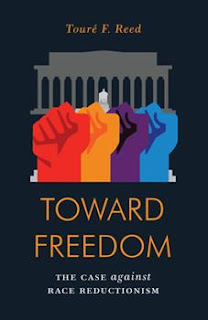
Adolph Reeds’ son Taure Reed makes the same points in his book, “Toward Freedom: The Case Against Race Reductionism”. He writes in his introduction to the book, “Liberals’ tendency to divorce race from class has had dire consequences for African American and other low- skilled workers. Specifically, race reductionism has obscured the political-economic roots of racial disparities, resulting in policy prescriptions that could only have limited value to poor and working-class blacks.”


In the forefront of this identity politics offensive is the white liberal or progressive academics among others.


The argument people like Robin Di Angelo and others of her ilk make that white workers are not open to discussing racism and want to avoid it completely need not be the problem it is made out to be unless the object is to shame and guilt trip people. The problem is that, as in all pressing issues in society, working class voices are not taken seriously and that we do not get to discuss such issues among ourselves from our class point of view and with the goal not of offering atonement to the white liberal middle classes and a get out of jail card to the white racist ruling class, but of strengthening our economic and social position within society as a whole.


Certainly the first place to start would be the genocidal war against the original inhabitants of this continent.


Why did chattel slavery arise in colonial America when it was against the laws and religious codes of the colonial power? Why did color become the issue it did and the concept of a white race arise-----a race that is superior to others?  It is not enough to say that racism is integral to or embedded in US society, the important question is why is it so and how can we eliminate it.

In a recent discussion on Facebook where I raised that Malcolm X argued that it was not possible to have capitalism without racism, a brother responded that there was racism, certainly nationalism and Anti-Semitism in the Soviet Union. This is true, but that confirms my view that it is a social construct with a purpose, it is not innate. The revolution in 1917 was made possible to a great degree through policies that aimed to unite ethnic and religious minorities and the rise of an autocratic bureaucracy was made possible in similar fashion through the relative weakness of the Russian working class and stirring up racist, nationalist and ant-Semitic hatred


There is no conquering or colonial power that can rule without dividing the conquered in some way, this includes the working class in general. In Ireland where the population was the same color, religion played this role.


We are taught history by the victors as the saying goes and what we are taught is white capitalist history. History from the viewpoint of the white capitalist class. However, the present narrative of how racism and the violent history of the US colonial settler state should be approached, in schools or in general, is determined by the middle and upper middle classes with a blessing from the billionaires and other big bourgeois; the unelected minority in society that direct social policy.


In the absence at this time of a powerful workers’ movement, the destructive influence of this petit bourgeois ideology is overwhelming. The US edition of the Guardian had an article earlier this week by an Englishman that asked why white people in England can’t accept that “we” owe a huge debt for enjoying the benefits of slavery and he sees hope in that white kids pulled down the statue of the 17th century slave trader Edward Colston. Knowing the Guardian’s political orientation particularly here in the US, I dared to read it. The author, Thomas Harding writes:


“In my view, white people in Britain have a special responsibility when it comes to this legacy. After all, the vast majority of those who transported the captured Africans to the Caribbean were white. Similarly, the vast majority of those who “bought” these enslaved people and made them work on the appalling sugar, cotton and coffee plantations were white.


Harding adds with regard to the guilt and responsibilities:


“This includes my own family, who made money importing tobacco from American and Cuban plantations that were worked on by enslaved people. As to the general population who gained from the enormous wealth that poured into Britain on the back of slavery, again the vast majority were white.”


By this measure, everyone living here in the US, all of us, have benefited from the global plunder that US Imperialism foists on the rest of the world. The wars, invasions, (4 million dead Vietnamese and the destruction of Iraq)  bombings, violent regime change throughout Latin America, are all about stealing wealth and we have all benefited in some way from it.

This “white man” is a member of one of Britain’s long-established bourgeois families that go back to the early period of British capitalism it seems. His family founded the famous J Lyons and co. once the largest catering company in the world, I remember Lyons very well.  He is a relative of Lord Lawson of Blaby who is a former Conservative Party politician who served in Margaret Thatcher’s government.


I was not born in the UK but I am proud of my English working-class background, and yes, I’m white and so is Thomas Harding apparently, but he has nothing in common with me and millions of English people except similarities in skin tone. No more than an African American worker does with Barack Obama who lives in a $15 million home in the Hamptons with white bourgeois and whose policies caused untold suffering to people of color throughout the world when he was president----the position demands it and he wanted to be there. Obama too has had to deal with racism and in a racist society it’s worse the higher up you go. He hasn’t had to deal with it anywhere near the level the black worker has.


Harding went to Westminster School, a school that is reserved for the British ruling class and from there to Corpus Christi College in Cambridge. You could spend 20 years walking the streets of English towns and come across no one who has attended Westminster school; that is not because it has a poor reputation, it costs somewhere in the region of $60,000 a year to go there and it is a school reserved for those from mainly upper-class backgrounds and others who are expected to make British capitalism a world leader in their field. He was born in to extreme wealth and influence in a country that once colonized close to a quarter of the world’s peoples; that’s where his wealth came from, there and the factories and coalmines of Britain.


Now I don’t hold the sons responsible for the sins of the fathers, and he is Jewish apparently and members of his extended family came from Germany and I am sure some of them probably perished. He probably experienced Anti-Semitism in the UK and at Westminster school no doubt. Any worker must condemn this and unconditionally fight against discrimination and oppression of all types. Bourgeois women must be defended against sexual oppression as a black CEO must be against racism. We condemn them on a class basis, not their color or sex, this is the issue.


Harding is a big liberal but he’s tricky like all of them. Sure, he mentions the history of his family making money from tobacco plantations in the Caribbean that’s no big deal for him, he’s not giving the money back. There were whites that also worked in the Caribbean plantations, often Irish as that was England’s first colony. Whites and blacks would run away together so plantation owners introduced legislation to curb that practice, the white runaway was responsible for the black. It’s obvious what the purpose of that law was.


Harding continues: The same is true of the shipowners and sailors, bankers and insurance officers, traders, dockworkers, shopkeepers and countless others involved in selling the commodities back in Britain.”


He makes whiteness the center of it all. In his list above , he includes dockworkers alongside capitalists (bankers’ commodities traders etc.) or agents of the capitalist class. The conditions of dockworkers and sailors in the rise of British capitalism were horrific and crews were often people from many parts of the world. The dockworker and the banker both being white are equally guilty. Just like the US workers of all colors and ethnic backgrounds are as responsible for the mass murder of 4 million Vietnamese as Henry Kissinger. That’s where this nonsense leads.


One can’t say because they played the same role because anyone other than a liar would say otherwise. But they become equally guilty when whiteness or color is the driving factor and the motive force behind oppression and colonization. British capitalism entered Africa in order to satiate its hatred of black skin. In Ireland it was a hatred of Catholicism.


Identity politics and this way of writing is conscious; it allows the middle classes who, riddled with guilt as they can be having attained their privileged social status through colonial plunder and exploitation of the working classes from the black slaves in the cotton fields of the US South to the factories of Manchester where it was processed by English workers and their children, to atone for their sins and blame the lowly “ignorant” white worker for their racism. They can continue to advance their class position in the capitalist pecking order unhindered.*

Most of all, it offers the orchestrators of the violence, the racism, the misogyny and many crimes against humanity a get out of jail free card. Their class and the free market system, they support and govern get off Scott free. This is the goal of identity politics.

While Malcolm X was clear that racism is an integral aspect of capitalism he did not specifically put socialism forward as the alternative. But his statement makes it clear that to end racism we have to end capitalism and only working-class unity can accomplish that. His comments definitely put socialism on the table. His thinking changed rapidly in his short life and he was clearly moving in that direction as was Martin Luther King. Both of them were taken from us before they had more time to develop these views further.

Angela Davis made it clear also, saying that,  “….. it’s a mistake to assume that we can combat racism by leaving capitalism in place.” That’s exactly what identity politics does, leaves capitalism in place replacing it with “whiteness” making skin tone front and center. It’s a method that makes fighting racism harder and the likelihood of eliminating it impossible.

As for Harding, he does not speak for English or any other workers. His existence has been and is as different from millions of English people and millions of workers throughout the world. Workers do not need class enemies like him and his rotten family, nor millionaires and Hollywood actors like Anne Hathaway to lecture us about racism.

What white workers in particular must play a significant role in, is helping to build the independent working-class movement in our communities and the workplaces that are more integrated than ever.  We can contribute to a situation where we can have these discussions honestly with all the horrors and violence that history contains but also those times when we have come together to increase our material conditions in the face of capitalist aggression and the divide and rule poison of racism. Under these conditions, the horrors of three hundred years of isolation, marginalization, slavery and Jim Crow can be discussed in a constructive way that shows a way forward. It was not the bond laborer that created the White Race.

I think that Lerone Bennett Jr’s comments in chapter three of his book, The Shaping of Black America are more accurate in describing, not only human nature, but the history and rise of  racism and slavery in Colonial America than all the middle class liberal writers like Robin DiAngelo and another one I’m only recently learning of, Anastasia Higginbothom, who are probably making lots of money writing nonsense.

Bennett wrote:

“Curiously unconcerned about their color, these people worked together and relaxed together.  They had essentially the same interests, the same aspirations and the same grievances. They conspired together, and waged a common struggle against their common enemy-------the big planter apparatus and a social system that legalized terror against black and white bondsmen………….the available evidence, slight though it is, suggests that there were widening bonds of solidarity between the first generation of blacks and whites.  And the same evidence indicates that it proved very difficult indeed to teach white people to worship their skin.”  (My added emphasis)


We can fault the white working class of the time for accepting the “poison bait” of white race identity and white supremacy but that’s another time.

Understanding the real material conditions that have made our history is what will lead to our emancipation, not the condescending racism of the liberal identity politics crowd.


*Eric Foner’s book British Labor and the American Civil War and the Confederacy’s efforts to get the British Parliament to drop the cotton blockade is an interesting read on this subject.


Other useful reading relating to this subject.

The Invention of the White Race Vols 1 and 2.

The Many Headed Hydra

The Shaping of Black America

Sunday, December 12, 2021

The Death of Snow Days | Opinion

From The Minnesota Reformer


Late last year, an email arrived in my in-box from the Minneapolis Public Schools, with an odd heading: “We’ve changed how we handle winter weather.”

I read on:

Earlier this year, the Minneapolis Board of Education approved an e-learning plan for our schools. That means that MPS no longer has to cancel school due to bad weather.

Were they talking about snow days? They didn’t say snow days.

While this likely won’t be much of a change for the foreseeable future due to COVID-19, it will be once we can return to in-person learning, no matter when that is.

The email did not say, “We are canceling snow days.” It didn’t even use the word, “snow day.” But as I parsed the anodyne, bureaucratic language (designed to obscure, not clarify), it sure seemed like that’s what they were saying: Whenever it snowed, it would be like a little slice of pandemic all over again.

The email continued:

If you don’t agree with our decision, as always your family can make the choice that’s right for your student by following your school’s standard absence procedures.

Translation: If you don’t agree with our decision, screw you.

The message felt like one more dump on the pile of crap that was 2020. But who had the energy to fight it? No one knew when we would be back in school anyway, so it didn’t seem to matter. Besides, could they really just kill the snow day? Without consultation? Without clarity? Without ceremony?

Time dragged on. Most of us forgot about this email. Then in November of 2021, almost exactly a year later, another email arrived, vaguely titled: “Inclement Weather and E-Learning.”

Instruction for MPS students will continue this winter even on days when winter weather makes travel difficult. While some of us will be sad to see “snow days” go, the State of Minnesota has approved up to five “e-learning days” for schools annually.

Translation: The snow day is dead.

Among the many diktats handed down by Superintendent Ed Graff (yes, that’s how it feels), to me this was the most egregious and heartbreaking. Snow days are part of our history. They are part of our culture. They teach us to love winter. They teach us to respect nature. Deep in our hearts, every one of us still hopes for a snow day.

Unlike the pointless shuffling of the Minneapolis School District’s “Comprehensive District Design,” the death of the snow day changes the fabric of childhood across the city. Growing up in Minnesota, I remember looking outside to see the world covered in white. Everything stopped. The world was silent and clean, like a new space had opened up in time, one we could fill with whatever we wanted. Snow days were one of the purest joys of youth.

Less so for parents…I know this as the father of teenagers who had their share of snow days. But if snow days were a kind of parental purgatory, e-learning days are a house-bound hell, as parents try to force their child to endure the most soul-crushing kind of screen time.

Having grown up in the 1980s, I may be too old to appreciate the rigors of modern education. But it’s hard for me to see the death of the snow day as a step forward. For those of us trying to encourage our children to spend less time online, to be less connected, and to be more in touch with their own minds and selves, this is a step in precisely the wrong direction.

The message it sends to our children is this: You are never off. You can never escape. Your time is not your own. Nothing is more important than your work. You must always be connected. You must always have your device. And your device must always have you.

There is a good chance my kids will be sick on e-learning days. That’s the least I can do for them. But even so, it won’t be the same as a real snow day. It won’t feel like a gift from the Gods of winter. They won’t feel free. Instead, they will feel like they are skipping school. They will feel the strain of their electronic chains. They will feel the ever-present fear that they are falling behind, losing ground, failing.

From now on, in Minneapolis, the joy of the snow day will be replaced with the dread of e-learning. Our children will never experience the pure feeling that Bill Watterson, poet laureate of childhood, captured over and over in his comic, Calvin and Hobbes. It was the feeling he chose to convey in his final cartoon. In it, the boy and his tiger wade through waist-deep snow with their sled:

“Wow,” Calvin says, “it really snowed last night! Isn’t it wonderful?”

Hobbes responds: “It’s like having a big white sheet of paper to draw on!”

“A day full of possibilities!” Calvin says. “It’s a magical world, Hobbes, ol’ buddy…Let’s go exploring!”

Minnesota Reformer is part of States Newsroom, a network of news bureaus supported by grants and a coalition of donors as a 501c(3) public charity. Minnesota Reformer maintains editorial independence. Contact Editor Patrick Coolican for questions: info@minnesotareformer.com. Follow Minnesota Reformer on Facebook and Twitter.