Showing posts with label France. Show all posts

Thursday, September 25, 2025

Huge day of action shakes France

 Republished from the UK Socialist Website Left Horizons

Huge day of action shakes France

By Greg Oxley

Since the fall of the Bayrou government on the September 8, France has been in turmoil. After the massively supported day of protest on the 10th, the historic attendance of 610 000 at the Fête de l’Humanité (a yearly political and social event organised by the French Communist Party, PCF) from the 12th to the 14th, the day of strikes and demonstrations on the 18th was another outstanding success.

Trade union demonstrations were organised in more than 250 urban centres around the country, with a total attendance of somewhere between 800 000 and a million people.

Besides the official marches, countless rallies and gatherings took place outside workplaces, schools and universities. Workers listed their grievances and declared their hostility to Macron’s vicious cuts in public spending and attacks on workers’ rights.

This movement demonstrated beyond doubt that the most powerful force for organising and mobilising the people is still the trade unions.  Historically, trade union membership in France has been lower in percentage terms than in many other European countries.

Nonetheless, they can call upon enormous social reserves, beyond the card-carrying membership. Besides those who actually took to the streets, millions more supported the movement, showing once again that austerity policies – this time involving close to €44bn of cuts in public expenditure – are profoundly unpopular.

Instability and paralysis

Constitutionally, President Macron can hang onto power until 2027, but the next two years will be fraught with instability and governmental paralysis. Macron does not have a majority in the National Assembly (parliament). He has the power to dissolve the National Assembly, but he is not likely to do that, because it would undoubtedly result in a further weakening of his position.

This is not the first time major demonstrations against government policy have taken place in France. In the past, the strategy of the government was simply to bide its time, allowing the workers to march through the streets, chanting their chants, blowing their horns and waving their banners for a few weeks, and then pass the contested laws once the movement had died down.

In the present circumstances, however, this is not possible, because of the parliamentary impasse. The pro-Macron members of parliament are caught between those of the left parties on one side and the nationalist right on the other, and therefore cannot pass any measures without the support of one of these oppositional blocks.

Abolition of two bank-holidays – dropped

So it was with the Barnier and Bayrou governments, and so it will be with the newly appointed Lecornu government. Lecornu has dropped the abolition of two paid bank holidays, which figured in Bayrou’s budget proposals. But otherwise, his policy is essentially the same, and will most probably suffer a similar fate, with a vote of “no confidence” bringing the government down.

Overall, the situation in France could be characterised by growing social instability at the bottom of society and institutional instability at the top. However, this instability does not, in and of itself, solve anything for either of the contending classes. Even if Macron is prevented from applying this latest raft of austerity measures, this will not ease steadily declining living standards and working conditions.

Modern capitalism is incompatible with the social conquests of the past. Government measures are one thing, but the economic realities of the profit system, constantly eroding  the real value of wages and wearing down the remaining safeguards against poverty and despair for millions of people, are another.

On the demonstrations, it was clear that many workers and young people understand this reality. They can see that they need to fight not only Macron, but also the systemhe represents. This is an idea which is also present in the speeches and publications of the PCF and La France Insoumise.  However, neither of these parties – at leadership level – have been capable of addressing this crucial question in their programme and policy.

Economic problems weighing down working people

If the most pressing social and economic problems weighing down on the working people cannot be resolved under capitalism, then we need a policy that strikes at the root of the power of the capitalist class, and that root is private ownership of industry, of banking and finance, of commerce and technology.

Call it what you will: nationalisation, socialisation, collectivisation, but what needs to be done is to take the control of all the main levers of the economy out of the hands of the capitalists and place them under the democratic control of working people. Only then can the production and distribution of wealth be organised for the public good, rather than for the profit and greed of an all-powerful minority.

Unless the labour movement recognises this necessity, unless it stands clearly and unequivocally for the expropriation of the capitalist class, whether it be in France or any other country, the left parties and the trade unions will be powerless to resolve the problems caused by capitalism. They will effectively confine themselves to fighting a losing struggle against the consequences of the system rather than against the system itself.

That is why, in France, we have a situation that amounts to a stalemate, wherein, despite all of Macron’s difficulties, neither side can inflict a decisive blow to the other. This stalemate is fraught with danger. People want and need change. They need solutions.

If the left cannot provide it, many of them will turn to the nationalist and xenophobic forces on the extreme right. This process is already underway in France, as it is in many other countries in Europe.

Greg Oxley is editor of the French Marxist website La Riposte.

Monday, July 21, 2025

France: Prime Minister declares war on workers’ living standards

 Republished from the UK Socialist website Left Horizons

From La Riposte

On July 15, during his speech soberly called “the moment of truth“, François Bayrou, French Prime Minister, presented his plan to restore public finances. It is nothing less than a set of measures, each more reactionary than the last: a blank year in 2026, i.e. a freeze on social benefits, pensions, unemployment benefits, a freeze on civil servants’ salaries, the elimination of two public holidays, one in three retirements not replaced in the civil service with the aim of eliminating 3000 jobs, reduction in funding for local authorities and reduction in the coverage of drugs for long-term illnesses. Bayrou hopes to save nearly 44bn through these budget cuts.

The first effect of these measures will be to considerably degrade public services. Working conditions for hospital staff will be even worse, with fewer and fewer staff and, consequently, a decrease in the quality of care. The same will be true in schools.

The vast majority of these measures are a frontal attack on the workers and youth who benefit from these public services. To give the illusion that “the effort is shared”, Bayrou will ask for a “solidarity contribution” from the “wealthiest” households. He also mentioned savings to be made on high incomes, tax evaders, tax loopholes for billionaires and tax optimisation for the wealthy, but all this without announcing anything concrete, whereas for the rest of the plan, the measures are well detailed and quantified. These last words are only a consolation prize that masks emptiness.

Bayrou responds to the imperative of capitalism

And for good reason: Bayrou responds to an imperative, that of capitalist interests. In his speech, he placed a strong priority on the competitiveness of French companies. French capitalism has been in decline for many years, outpaced and overtaken by its economic competitors in Europe and the world.

The objective of making French companies more competitive is a vital necessity in order to, on the one hand, avoid being crushed by the competition and, on the other hand, so that billionaires such as Bernard Arnaud and his ilk continue to amass ever more profits.

If Bayrou wanted to make savings, he could very well have done so in terms of government aid to companies, which amounts to €210bn a year, whereas shortly before Bayrou’s speech, INSEE (the French National Institute of Statistics and Economic Studies) published a report that shows in detail an increase in the number of people living below the poverty line. This is a demonstration that Bayrou is only a lackey of capital, a servant of the capitalist class.

In his speech, Bayrou devoted long minutes to raising the spectre of debt: “For 50 years, all governments combined, the budget has been in deficit“, “there is more expenditure than revenue”, etc. In lecturing, he presented himself as the one who manages his budget as a good father.

It is true that the debt has never stopped growing and now stands at €345.8bn, or 114% of GDP. The argument often put forward is that if the state does not control its finances and lets its debt slide, interest rates could soar and consequently considerably increase the cost of borrowing.

This is what happened at the end of 2024 with political instability and the downgrading of France’s rating by the rating agency Moody’s (see our article on the subject here). However, it should be noted that France’s borrowing is done on the financial markets and is subject to speculation (up and down). In other words, the borrowing rate of the debt is suspended by the law of the market and the actions of speculators who brandish the threat of soaring rates, or even the refusal to lend.

Tsipras in Greece was forced by international capital to retreat

On this point, we can only agree with Bayrou, when he re-explains how, in Greece, Alexis Tsipras “had to” capitulate only a few days after his election in the face of the threat of the troika (ECB, European Commission and IMF) and the heads of government of the time, François Hollande of France and Angela Merkel of Germany in the first place, as well as the speculative capitalists brandishing the same threat.

Tsipras’s social reform programme turned into a draconian austerity plan: a 15% cut in civil servants’ salaries, a 30% cut in retirement pensions, to name but a few examples (see our article here). Such are the mechanics of the capitalist system, which obeys its own laws.

This is an important lesson that we must keep in mind. The capitalist class will put up a fierce resistance against any attempt at reforms of social progress. As long as it retains economic and political power, it will have the means to defeat reformist governments. It is no coincidence that Bayrou cited this example. It should be taken as a warning.

Of these cuts and restrictions of Bayrou, only the military budget is increased. From the outset, he announced an increase of €3.5bn in 2026 and 2027, which is in addition to the military programming law. To justify this increase, Bayrou brandished the threat of war that weighs on France. With these words, “we will not sell out our security imperative“, he is trying to instil fear and prepare us for war against an unknown enemy.

If France wages a war, it will be above all with the aim of defending French capitalist interests. By this means, political leaders worked to strengthen power and economic dominance for the benefit of French capitalists against their rivals. The appeal to patriotism and national unity by evoking a foreign enemy is a classic of the representatives of the capitalist class. They will try by all means to put the workers behind the banner of capitalist interests while at the same time they will suffer austerity and deprivation and thereby to make austerity accepted as a necessary evil.

The arms industry is rubbing its hands together because the increase in military budgets will result in additional orders. Shareholders will see dividends and stock yields increase when they are already at record levels. We will have to endure austerity, the degradation of our public services with fewer resources for hospitals and schools so that a handful of capitalists will enrich themselves and take us to the horrors of war.

Two obstacles are likely to stand in the way of the austerity “program” of the capitalist class. Barely unveiled by Bayrou, it is already unpopular. It is possible that, in the face of hostile public opinion, the 2026 budget will not be adopted. Bayrou would then be forced to resort to the constitutionarl clause 49.3, which would offer the possibility for deputies to bring down this government by a motion of censure in the National Assembly.

Most opposition parties would support a censure motion

The whole of the left and the Rassemblement Nationale (RN), the party of far right Marine Le Pen, would support such a motion, as was the case in 2024. Although it is easy to predict the position of the French Communist Party (PCF), and the left party, La France Insourmise (LFI) which will probably take the initiative, it is less clear predicting the stand of the Socialist Party, (PS).

The latter let themselves be fooled, consciously or unconsciously, by Bayrou during the last motion of censure in the Assembly, in exchange for restarting the pension reform, which ended in total failure. Bayrou will try the same maneuvre by opening discussions and reaching out to the PS, among others.

The second possible obstacle, and perhaps the most decisive, is the reaction of workers and youth. Thse social counter-reforms, considered as such in the eyes of all, despite all the sleight of hand to make people swallow the pill (threat of war, debt crisis), could be the starting point of a massive mobilization.

But this will depend on the attitude of the union leaderships, first and foremost the General Confederation of Labour (CGT), which will have the task of preparing the unions and the workers by giving concrete objectives and directives for the struggle.

The fight against this government must take the form of an extra-parliamentary movement to inflict a stinging defeat on this government and thus restore workers’ confidence in their ability to fight and in the possibility of victories. This would be a first step towards the revolutionary overthrow of reactionary governments and the capitalist edifice of which they are the political representatives.

Monday, December 16, 2024

No end in sight to political crisis in France


Reprinted from the UK Socialist website Left Horizons.

No end in sight to political crisis in France

By Greg Oxley of La Riposte

The nomination of François Bayrou as Prime Minister, replacing Michel Barnier, who was overthrown by a vote of no confidence earlier this month, solves nothing. The mountain has laboured and brought forth yet another mouse. Just as Barnier’s government was doomed from the outset, for lack of support in the National Assembly, Bayrou will no doubt suffer the same fate.

A former Justice Minister under Macron in 2017, Bayrou was forced to resign after being charged with “misappropriation of public funds”. His case is still going through the courts. The first task of the new government will be to get the Barnier’s budget through parliament. But how can that be done, given that Bayrou has no more support than Barnier? The institutional crisis is clearly far from over. It could well lead to the end of the presidency of Emmanuel Macron.

To understand how this situation came about, we have to go back to the events of June 2024. In the European elections of that month, Macron’s party suffered a crushing defeat, gaining only 14.6% of the vote, making him the most unpopular sitting president since the founding of the Fifth Republic in 1958.

That election also showed a further increase in the social basis of the right-wing nationalist party, the Rassemblement National (RN), led by Marine Le Pen and Jordan Bardella, which got 7.76 million votes (31.7%). The left parties, individually weak and bitterly divided, made a poor showing.

Snap election made matters worse for Macron

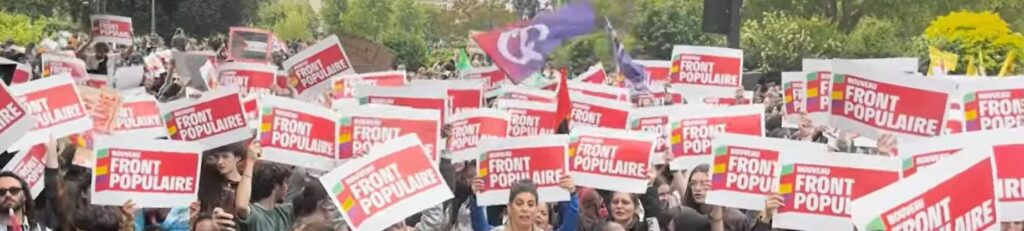
Macron’s response to his defeat was to dissolve the National Assembly (the French parliament), which provoked a snap election, a little more than two weeks later. He appealed to the electorate to give him a strong parliamentary base, as the only alternative to what he called “the extremes”, meaning the RN on the right and the left parties. The latter, alarmed by the upsurge in support for the RN, decided (literally overnight), to end years of squabbling and division by creating a broad alliance called the New Popular Front (NFP).

New Prime Minister, Bayrou was forced to resign after being charged with “misappropriation of public funds”. His case is still going through the courts. 

Macron’s ploy failed miserably, and instead of strengthening his position, it was weakened even further. On the far right, the RN won 33% of the vote, against 27% for the NFP. After the second round, the NFP emerged as the largest parliamentary group, followed by the RN. Macron only got 20%. Macron’s candidates won 168 seats, the other right-wing party, the Republicans (formerly that of Chirac and Sarkozy), got 66. The NFP won 180 and the RN won 143.

It took Macron no less than 60 days to name a Prime Minister, which he eventually chose from among the Republicans! Former PM, Dominique de Villepin, met the announcement by ironically recalling the words attributed to Jesus Christ in the book of Saint Matthew: “And the last shall be the first.”

Thus, the “zombie government” led by Michel Barnier was doomed to impotence from the outset. The budget he presented to parliament amounted to yet another round of the vicious cuts and austerity measures that Macron has pushed through since he first came to power in 2017.

Barnier lasted only three months

The NFP tabled a vote of no confidence, and the RN declared they would also vote against the government. Seeing that there was no chance they would get majority approval of the budget, Macron and Barnier used the infamous clause 49.3 of the Constitution, which allows a government to adopt laws without parliamentary support. However, the vote of no confidence still took place. The Barnier government fell three months after coming into existence, and the budget fell with it.

Finding himself back to square one, Macron had to find another Prime Minister, and Bayrou will now have to cobble together a new minority government, which will probably collapse in turn. How long can this go on?

Macron says he will not resign, that he will stay on until 2027. But it would seem that the only way he could do that would be through permanent institutional upheaval, or through ruling directly by presidential decree. Neither option is politically viable, and so it seems that sooner or later Macron is likely to resign, which will mean new presidential and parliamentary elections.

The social and economic backdrop to these developments is such that France is heading for a period of profound instability. When Macron came to power, he claimed to represent the political “centre”. Promoted as some kind of economic whizz kid, “breaking the mould of traditional politics”. He claimed he was neither left nor right, and would simply apply policies that ‘worked’, to guarantee job creation and prosperity, reduce inequality and unite the nation.

In practice, however, he carried out an implacable defence of capitalist interests at the expense of the rest of society. His first act was to reduce taxes on the super-rich amounting to €5bn of lost revenue for the state.

Then he attacked health and education. In the midst of the Covid pandemic, he closed nearly 18,000 hospital beds. A series of measures effectively cut pensions. He slashed benefits for the unemployed and the poorest sections in society. The numbers of the ‘officially poor’ rose to 14.4% of the population. Among families with three or more children, the percentage is 26%.

Macron adopted many of the policies of the far right

The economy has been stagnant since 2019 and GDP grew by just 0.8% in 2023 and is projected to grow by 1.1% in 2024. Inflation has been undermining living standards, driving many people to despair, as shown by the insurrectionary demonstrations and blockades of the ‘Gilets Jaunes’ in the winter of 2018-2019.

In an attempt to divert public anger away from the government and the capitalists, Macron adopted many aspects of the racist and nationalist policies advocated by Le Pen. His ‘”anti-separatism” laws framed sections of society deemed to be “not really French” as a potential internal threat, separate from and hostile to the interests of the ‘Nation’ and democratic values.

The police have been given sweeping powers, and increasingly deadly arms and equipment, to use in defence of ‘law and order’. Tens of thousands of job losses have been announced in the last few weeks alone. Companies like Michelin, after having received millions of euros in public subsidies and making record profits in 2023, has announced the closure of two factories and major cuts in the workforce.

Manufacturing industry accounts for only 10% of GDP. The working people are restless. Civil servants, teachers, workers in the agricultural sector, railways workers, moved into action. These movements are relatively low-key for the moment, but attitudes are hardening. Governmental chaos is unfolding amid social chaos.

The workers’ organisations will have to take bolder action in the future, and yet, unfortunately, growing anger in society has also seen widening of the social basis of right-wing nationalism. It can by no means be excluded that the next presidential and legislative elections could bring the RN to power. In the first round of the last legislative elections, more than 10.6 million people voted for the RN.

Tensions and failures among NFP leaders

The only force that can prevent an RN victory is the NFP left alliance. However, this alliance includes the Socialist Party whose right-wing elements are attempting to sabotage the NFP from within, and the Communist Party (PCF) whose leadership, around Fabien Roussel, has had a conciliatory attitude towards participation in a government – which would necessarily be a minority government – under Emmanuel Macron.

Tensions within the NFP, therefore, mean that the alliance may not survive long enough to face up to threat from the RN. Not only that, but the program of the NFP, despite the inclusion of a number of important social and economic reforms, is fundamentally flawed.

Previous left governments which tried to carry out social reforms, such as the socialist-communist government of 1981-1986, have been forced to abandon them and adopt policies in the interests of big business. They were not prepared to take decisive measures to break the power of the capitalists, which is rooted in private ownership of the banks, productive industry and distribution, and therefore had no means of fighting against capitalist sabotage. The program of the NFP, which contains no measures whatsoever to deal with this fundamental problem, shows that its leaders have learned nothing from the failures of the past.

Nationalist rise is an international phenomenon

 The rise of nationalism is an international phenomenon and is essentially a reaction to the social and economic consequences of capitalist “internationalism”, or globalisation. People are desperate. In France and elsewhere, workers have been let down by previous left governments. The trade unions have proved incapable of defending them in the face of declining living standards. Even the better off sections of society feel that they are losing ground.

The difficulties are not just financial. Many areas, especially rural areas, have seen a collapse of vital services such as public transport, post offices, schools and hospitals, not to speak of affordable housing and stable employment. It appears to many workers that globalisation has meant a loss of control, rendering governments impotent in the face of foreign competition and open borders.

Powerful forces are driving a trend towards protectionism and the notion of national “preference” or “priority”. In the minds of tens of millions of people, a major change is necessary, to put an end to social and economic decline. If the left cannot convince workers that it can and will bring about this change, then right-wing nationalism and racism will inevitably gain ground.

The struggle against this reactionary danger can only be waged and won by the emergence of a mass movement of the working people around bold socialist policies that strike at the roots of capitalist power and privilege, linking social reform to the need to expropriate the capitalist class and open the way for democratic planning in the interests of the mass of the population.

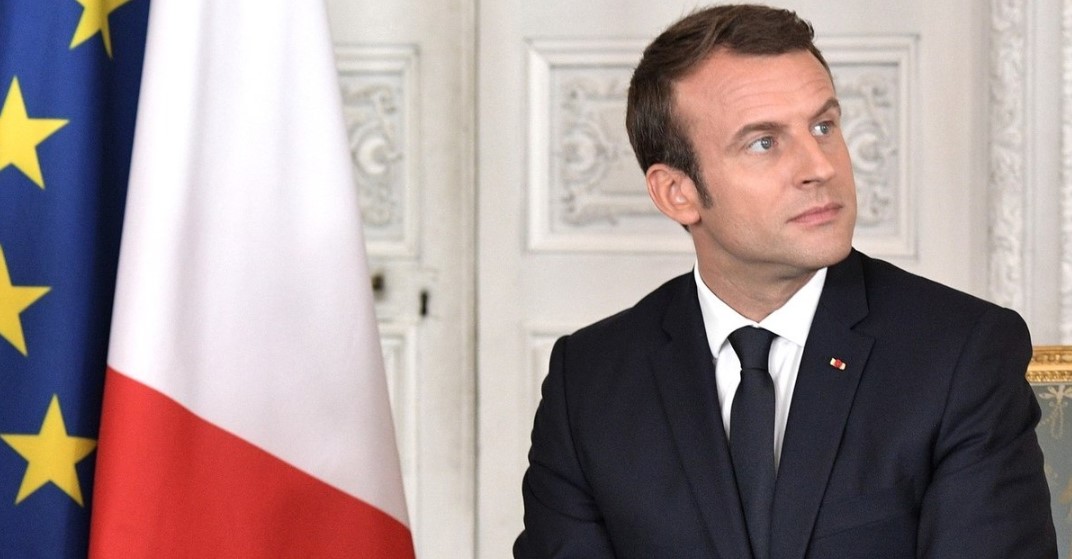
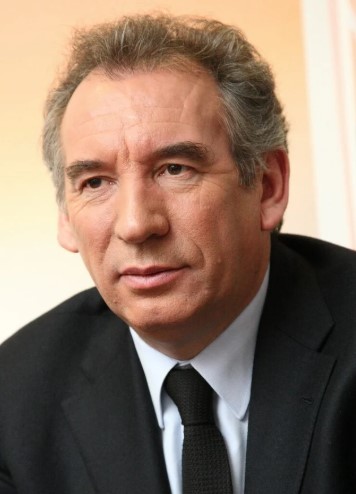
Greg Oxley is editor of the French marxist website, La Riposte, which can be found here. Pictures: from Wikimedia Commons, Macron (top) here and Francois Bayrou here, and NFP flags from NFP website here. 

Saturday, June 29, 2024

Michael Roberts. France: Macron’s gamble

France votes over two rounds on June 30 and July 7 in a snap parliamentary electioncalled by President Macron after his party suffered a heavy defeat in the June EU Assembly elections. France has two rounds of voting: if a candidate gets 50% of more in the first round, he or she is elected.  If not, then in the second round, the top two candidates fight it out. A survey released by pollster IFOP found the National Rally (NR) leading all other parties with the support of 35% of voters. The New Popular Front (NFP), a leftist alliance of socialists, communists and greens, came in second with 30% and President Macron’s centrist Ensemble was third with 20%. 

If those results hold, no party will amass enough votes to meet the 289-seat threshold for an absolute majority in the 577-seat lower chamber, the National Assembly.  Macron’s party is already governing without a majority after its poorer-than-expected showing in the last 2022 legislative elections, forcing it either to seek out coalitions to pass legislation or use a presidential edict to bypass the Assembly without a vote.

Under France’s constitution set up by President de Gaulle in the late 1950s, Article 8 says the president appoints the prime minister.  Macron would be expected to offer the job to the leading parliamentary group.  But as that is likely to be the National Rally, Macron may seek to form a coalition of other parties.  Actually, the NR party leader Jordan Bardella has said that he would not accept being prime minister if his party does not get an outright majority. 

So the scene is set for either paralysis or possibly a financial crisis as foreign investors and French big business run for cover if the NR should gain an outright majority.  The Financial Times is worried.  “At best, a parliament dominated by the political extremes would plunge France into a period of prolonged instability. At worst, it would lead to the adoption of spendthrift and nationalistic policies that would swiftly provoke an economic and social crisis in France.”

Basically, France is split three ways politically.  One-third backs a pro-EU, pro-capitalist France as represented by the ‘centrist’ Macron; one-third backs a nationalist, anti-EU, anti-immigration France as represented by Le Pen’s NR; and one-third backs a socialist pro-labour France as represented by Melenchon and the newly formed NFP.

France is a key G7 economy, now the seventh largest in the world with 68m people, representing around one-fifth of the Euro area GDP.  But its former imperialist global past has been reduced to exerting control over French-speaking West Africa (that dominance is now seriously under threat) and trying to control the EU in alliance with Germany.

In manufacturing, France is one of the global leaders in the automotive, aerospace and railway sectors as well as in cosmetics and luxury goods.  It has a highly educated labour force and the highest number of science graduates per thousand workers in Europe.  Its services sector is large, led by tourism (France has the largest number of tourist visits in the world) and financial services. Additionally, France is one of the world’s largest exporters of farm and agricultural products and is renowned for its wine, spirits and cheeses. The French government provides significant subsidies to this sector and France is the largest exporter of farm products in Europe.  France is linked closely to its largest trading partner, Germany, which accounts for more than 17% of France’s exports and 19% of total imports.

Similar to many western European nations, France has experienced poor real GDP growth.  Annual real GDP growth has been steadily falling over the last 40 years.  And now in the 2020s, it has virtually ground to a halt.

The French economy has followed the same pattern as the other G7 economies in the 21st century: slowing economic growth in the 2000s, then the Great Recession, followed by even weaker growth in the 2010s, along with slowing investment growth and stagnating productivity.  The investment to GDP ratio has been volatile, falling sharply in successive recessions, but currently suffering a record fall.

Slowing productive investment growth generally leads to stagnating labour productivity and France is increasingly affected.  Indeed, total factor productivity (a measure of the impact of ‘innovation’) is now falling absolutely.

As always, behind this relative stagnation lies the falling profitability of capital.  French capital’s profitability started to decline sharply at the beginning of the 21st century (the advent of the euro) and gathered pace after the Great Recession.  My calculations suggest that average profitability is now at an all-time low after a fall during the COVID pandemic slump.

Source: Basu-Wasner, EU AMECO, author’s calcualtions

No wonder corporate bankruptcies are rising fast since the pandemic. 

Manufacturing continues to contract.  The HCOB France Manufacturing PMI fell to 45.3 in June 2024 from 46.4 in the previous month (a score of 50 means stagnation). This marked the 17th consecutive month of contraction in France's factory activity,

Even the Banque de France in its latest report had to admit that “economic activity in France is set to remain subdued in 2024 (0.7% annual growth) after a significant slowdown in the second half of 2023.”  Poor productivity growth and high inflation has meant that real wage earnings have fallen – again as in many other G7 economies.  Average real wages are still nearly 3% below 2019 levels.

Source: OECD

And employment growth has stopped.

Banque de France admits that in 2024 “business investment is likely to be penalised by relatively sluggish activity, as well as by financing costs and lending conditions.” The BdF mentions the geopolitical disaster that the Ukraine war has meant for France (and even more for Germany), which has kept inflation rates up and GDP growth down.  It even expects a larger slowdown in nominal wages than it expected at the start of 2024 and “we cannot rule out the possibility of another downward surprise on business productivity, which could reinforce the dynamics of unit wage costs and give rise to additional inflationary pressure.”

The decline in average real incomes in the last four years only adds to the inequality of incomes and wealth in France. Although inequalities of income and wealth in France are not nearly so extreme as in the US, they are still grotesque. Indeed, inequality has worsened in the last 40 years.  In 1983, the top 1% of income earners took 7.5% of all personal income, 10% took 30% and the bottom 50% received just 21.4%.  By 2022, the top 1% took 12.7% (an over 60% increase), while the top 10% share rose to 34.8% and the bottom 50% share fell to 20.3%. 

Inequality of wealth (net personal wealth) is, as usual in all major economies, much worse.  In 1983 the top 1% of wealth holders owned 15.9% of all personal wealth in France, the top 10% had 50% and the bottom 50% held just 8.9%.  By 2022, those inequalities got even worse.  The top 1% of wealth holders now had 24% (over a 60% increase), the top 10% now owned 57.7% and the bottom 50% saw their share of personal wealth fall to just 5.1% (a 48% decline).

Source: World Inequality Lab

In its latest report, the Observatoire des Inégalités paints a picture of a country where gaps in income levels and living standards between the most affluent and the least affluent are widening. The minimum living standard gap of the richest 10% has remained around 3.28 times higher than the maximum living standard of the poorest 10%.

This weekend election is not for the presidency, which remains the most powerful force in the constitution.  Emmanuel Macron is in that office until May 2027.  The National Assembly has limited powers, although the government and Assembly does set the budget and direct economic policy. But given what has happened to living standards and public services in France under successive governments, no wonder enthusiasm for the Assembly elections has waned.

In 2018, the voter turnout was less than 50% for the first time, compared to a near 65% in early 2000s.  National Rally may become the biggest party in the Assembly after the weekend, but the real winner will be the No vote party.

If National Rally gains an outright majority, this will probably spook financial markets for a while.  That’s because what worries big business and the financial sector is ‘uncontrolled’ government spending and rising public debt.  National Rally plans to help (small) business with lower taxes. NR would cut the pension age back to 60 years, reversing Macron’s recent forced rise to 64 years.  NR claims it will increase benefits to the old and to children, while keeping the working week at 35 hours and overtime tax-free!

NR’s economic policy is thus anathema to French capital and attractive to French labour, but it is combined with racist and nationalist measures.  Muslims and other immigrants would lose rights to work in various public posts and their relatives could deported.  NR leader Bardella says that immigrants have nothing to fear from his government “as long as they behave themselves”.

Big business is hoping that NR will be tamed in government and by the threat of ‘market discipline’ as debt costs rise.  They look to a repeat of the very acceptable role adopted by Italy's' ‘hard right’ PM Meloni, who has fitted nicely into all the policies of EU Commission and NATO.  In practice, under the NR, there will be no real attack on the hegemony of French big business. NR policies in a capitalist France with its low growth and profitability are utopian. Neither the needs of labour nor capital will be met.

When we turn to the NFP, we find a similar utopianism, even if it is trying to promote the interests of labour over capital.  Its economic program is a 100-billion-euro economic stimulus plan funded by government borrowing and some nationalisation in sectors such as the motorway network.  The NFP would increase public spending, raise minimum and public sector wages, freeze prices of key essentials, increase taxes on the wealthy, create jobs to reduce the unemployment rate to 6% and also, like the NR, cut the retirement age to 60. But big business and finance do not want government spending to rise.  For them, austerity is necessary.  You see, the French government budget deficit is widening.

And this is driving up government debt to exceed the agreed limits under Eurozone fiscal rules.

This must be stopped.  But what the economic apologists for French capital ignore is why the government deficits and debt have risen.  It is not because of ‘excessive’ government spending on welfare and benefits etc; it is because France, like other G7 economies has suffered a series of financial crashes and slumps so that the public sector has had to bail out the private sector.  And slow growth in output, investment and incomes has reduced tax revenues and increased public spending relative to GDP.  The solution is not austerity but planned public investment through control of the strategic sectors of the French economy to increase output, investment and incomes.

But such policies would be very frightening for French capital.  So it will opt for the racist NR government over the leftist NFP – no surprise there.  Take the view of Olivier Blanchard, a French mainstream economist and former chief at the IMF.  Both the NR and Left programs are bad news, but for him it is the program of the NFP that is worse, despite the racist, anti-immigrant policies of the National Rally.  Why?

Well, you see there are two sorts of left programs. There is "a social democratic one that tries to equalize chances and redistribute without destroying the incentives to create and produce". (By this Blanchard means capitalism is maintained). And then there is "a revolutionary one, which goes much further, is nearly confiscatory in nature”  Shock, horror!  Blanchard: "as a social democrat, I believe in equalizing chances, in improving education, in redistributing income from the rich to the poor", but the NFP program "can only lead, like many of its predecessors, to economic catastrophe."

In his usual quixotic hubris, Macron is gambling that, in calling the election, along with the help of the media and mainstream opinion, he can frighten enough voters not to vote for the ‘extremes’ of right or left, and so restore the political stability of French capitalism.  If the polls are right, that gamble will not pay off.

The mainstream and official economic forecasts try to put on a brave face and expect France to come out of its stagnation and recover modestly in 2025. 

But this is based on hope more than expectation.  And now French capital faces political paralysis at best or a damaging hit at worst.