Showing posts with label Artificial intelligence. Show all posts

Friday, July 24, 2026

Michael Roberts: AI and productivity

AI and productivity

Alphabet (Google) announced its earnings results yesterday.  At first sight, the results were spectacular: revenue was up 24%, with revenue from its ‘cloud’ business up 82%.  Earnings per share were $9.11, which is very high.  But more than two-thirds of those earnings were based on booking $77bn from ‘unrealised’ gains from its purchase of shares in Anthropic, a major AI model firm.  In other words, these ‘gains’ are just ‘on paper’ and depend on Anthropic shares staying up.  

Google is one of the so-called ‘hyperscalers’, the mega tech companies that are ploughing huge of amounts of funds into AI, hoping and expecting it to lead to a sharp rise in profits down the road.  Google’s investment in AI has pumped so much money into AI companies like Anthropic and OpenAI and into data centres to run AI with expensive ‘chips’ made by Nvidia, that its huge cash revenues are no longer covering the cost of investment. ‘Free cash flow’, as it is called, went negative for the first time in Alphabet’s history.

Google is increasing its AI investment massively this year, like its rivals, Meta, Microsoft and Amazon, to build AI infrastructure, with the four hyperscalers combined on track to spend more than $725bn in 2026. Before Wednesday’s results, Google had been seen as the hyperscaler best placed to withstand the AI arms race, with cash flows from its vast search business expected to cushion the financial pressure. But now, its cash burn to fund AI capex will require raising debt and/or issuing equity shares. Alphabet has already taken on nearly $100bn in debt, and in June it moved to raise about $85bn in its first share sale in more than two decades.

All this tells us that the AI stock market ‘bubble’, and that is what it is, is getting closer to bursting. The hyperscalers are hugely profitable, based on their existing businesses, with current earnings about 59 per cent above trend.  But such is the size of the AI investment boom being conducted by these hyperscalers, that even these profits are being sucked into AI like water disappearing into the Sahara desert.

As argued in previous posts, the US economy is one big bet on AI.  The stock market value of the hyperscalers now accounts for roughly 40 per cent of the S&P 500’s total market capitalisation. If there is any sign that: first, they cannot sustain their current investment growth; and second, they are eating away their profits with no return on those AI investments, their stock values could turn south and take the whole stock market with them.

The US capitalist economy is balanced on the apex of AI.  All will be well if: first, the AI models become in heavy demand and start to be used across companies in the US and globally, thus boosting profitability for the hyperscalers and eventually the rest of the corporate sector.  Second, the generalised use of AI technology in all sectors of the economy also leads to a step change in the level of productivity, which can take the US economy into a new age of prosperity.

Before the advent of the AI boom, the US information technology had already become the driver of relatively faster economic growth in the US compared to the rest of the G7 economies during the Long Depression of the 2010s.

But in the 2010s, all the G7 economies, including the US, saw a slowdown in the growth of real GDP output, investment and productivity. Then, after the pandemic slump, inflation returned in most economies, threatening to introduce a new period of ‘stagflation’ (slow or no growth alongside faster and high inflation) not seen since the 1970s.  Now the Iran war is accelerating energy price inflation. Central bank monetary policy failed to get economies going in the 2010s with low or zero interest rates and monetary injections (quantitative easing).  And central bank monetary policy is failing to keep inflation from rising since 2020 using higher interest rates (ECB) and quantitative tightening (BoE).  That’s because the only way economies can grow without inflation rising is by increasing growth in the productivity of labour.

The new Trump-appointed chair of the Federal Reserve expects a productivity boom from AI.  Kevin Warsh says that “AI is perhaps the most significant change in our economy in my adult lifetime. AI will be a significant disinflationary force, increasing productivity and bolstering American competitiveness.”  He reckons that productivity improvements from AI would drive “significant increases in real take-home wages. A one-percentage-point increase in annual productivity growth would double standards of living within a single generation.”  He is right. Even just a 1% point rise in current US productivity growth over 20 years would not only keep inflation down, it would provide income and revenue that could end the deficits in government budgets, without raising taxes or making cuts in spending.  Public debt to GDP ratios would fall.

But will AI deliver this step change in productivity?  From 2005 through 2019, US productivity growth averaged about 1.5% per year. The pace remained similarly slow during and immediately after the pandemic (2020-2022).  But US labour productivity has accelerated since 2022. Output per hour grew around 2.5% per year from the end of 2022 to the start of 2026, exceeding its pre-pandemic pace by 1 percentage point.

So is AI delivering?  Most of the acceleration in labour productivity growth comes from faster growth of what mainstream economics calls total factor productivity (TFP). TFP is not something real that can be measured; it is just a mathematical residual from analysing the drivers of productivity growth. More workers working harder plus more machines working longer is what delivers most productivity from labour. TFP is the residual that is assumed to be from the impact of ‘innovation’ (eg AI).  

But the rise in US TFP is not yet the result of AI application in the economy.  According to economists at Barclays, AI adoption has been gradual and steady rather than rapid and transformative, with most households and businesses still reporting limited exposure to the technology. The rise in productivity growth since 2022 is really due to more intensive use of existing technology after the end of the pandemic, not the introduction of AI. 

How do we know this?  Well, Barclays economists looked at the St Louis Fed’s nationwide Real-time Population Survey (RPS) of working-age US adults. The most recent survey shows that, while AI has found its way into work routines for 45 per cent of respondents, the usage of AI in time is miniscule. Assuming an eight-hour workday, the average AI adopter has gone from roughly 20 minutes of usage in late 2024 to around 30 minutes by mid-year 2026, the RPS survey shows. And what’s not known is whether the workers are using their extra 2 per cent of work time per day to be more generally productive, or to verify and fix whatever the AI has produced, or to slack off!

Indeed, most surveys of AI adoption by companies show only modest progress. The US Census Bureau’s bi-weekly Business Trends and Outlook Survey shows just 21 per cent of businesses were knowingly using AI, 69 per cent reported no use, and 11 per cent weren’t sure either way! A Fed Board of Governors discussion paper finds that “productivity trends across all three levels have been relatively consistent over time, suggestive of micro-level productivity gains not adding up in aggregate.”   It seems that ‘micro-level’ experiments typically measure task-level productivity, like the speed that a programmer generates code, rather than job-level or firm-level output. A 10% improvement on a task does not necessarily lead to proportional gains for a firm if adjustment costs or other bottlenecks lie elsewhere in the production process and erode the upstream productivity gains.

By running a series of complicated regression analyses on RPS survey data, the US Fed found that no evidence that AI’s doing anything positive: correlations between industry-level adoption rates and improvements in productivity are “not statistically distinguishable from zero”, it says. Any observable improvement “largely reflects persistent differences across industries rather than a measurable acceleration in productivity growth attributable to AI”.

However, the AI optimists remain just that – optimistic. They refer to the ‘J-curve’ that the productivity impact of new technologies generally follow.  First, there is a slow, even negative, effect on productivity as companies invest heavily in the technology. And then the boom comes. Such a J-curve was seen in US manufacturing productivity growth, which fell in the mid-1980s and then, after the recession of 1991, accelerated sharply until the mid-2000s.

But even that optimistic view has its caveats. First, it seems that those workers exposed to AI are resisting its use. An April survey of 2,400 knowledge workers by AI firm Writer and Workplace Intelligence—both firms with commercial stakes in AI adoption — found the 29% of employees admit to actively sabotaging their company’s AI strategy. Among Gen Z (under 25) workers, that figure was 44%, up from 41% a year earlier. A separate WalkMe survey of executives and employees across 14 countries, conducted the same month, found that more than 54% of workers had bypassed their company’s AI tools in the past 30 days to do the work manually instead. The survey commissioners found that a “Fear of Becoming Obsolete” is driving much of this active and passive, and even passive aggressive resistance. Similarly, The Economist reported that AI usage among US workers, after an early spike, dipped as initial enthusiasm faded. 

In the early 19th century at the start of the industrial revolution in Britain, a group of skilled weavers tried to resist the introduction of machine weaving in the early 19thcentury by various means, including sabotaging and wrecking the machines. They were called Luddites. Now it seems that a form of Luddism has returned over AI. Just as the Luddites had a case about protecting their livelihoods, so do Gen Z workers now. 

The AI optimists, Stanford’s Erik Brynjolfsson and ADP Research, are tracking 4.6 million workers across more than 730 occupations through their Canaries Dashboard. They find that jobs for workers aged 22 to 25 in AI-exposed occupations are shrinking more than 4% annually.  Goldman Sachs analysis suggests information, professional services, insurance, and finance are best positioned for early productivity gains—but these are where the ‘sabotage’ surveys find the highest rates of resistance.

Goldman Sachs US economist Elsie Peng supports the J-curve thesis for AI.  Her study of industry technology adoption found a modest drag for the first four years, statistically significant gains only after eight, and a peak impact of roughly 0.6 percentage points in year 12. If ChatGPT’s 2022 launch is the equivalent of the PC’s 1981 debut, that J-curve puts the productivity payoff arriving around 2030 at the earliest, and peaking around 2034.  According to Peng’s analysis, significant labour productivity boosts from ICT didn’t show up until roughly 50% of businesses had adopted the technology. Not bought it, not piloted it. Actually adopted it into their core operations.

Peng’s ‘J curve’ echoes what the OECD’s economists argued some time ago, that transformative technologies historically take about 20 years from their breakthrough moment to deliver meaningful productivity gains at the macroeconomic level. If that pattern holds for generative AI, we’re looking at the early-to-mid 2030s or even later before the real payoff arrives. So there is a long way to go for generalised AI that can deliver a significant rise in labour productivity growth.

The step change in productivity growth that Fed chair Warsh puts all his hopes on still seems some way off. But what about profits from AI?  So far, any revenue that the AI model companies are making is way, way short of covering the costs of AI R&D development and the building of data centres all over the US. And Goldman Sachs estimates that each dollar of ICT hardware investment requires at least another $1.70 of complementary “intangible” investment—software, data systems, and the hardest category to measure, organizational overhaul. There is now 15 times more data centre capacity than the demand to use them.

And debt is building up. Bloomberg estimates that there’s over $500 billion in outstanding AI data centre debt. Nikkei Asia reported this week that Meta, Google, Amazon, Microsoft and Oracle have accrued around $1.65 trillion in outstanding debt in the last five years, with an additional hundreds of billions of dollars’ worth of “off balance sheet” debt, meaning that the corporate structure allows the company to not include it as part of its liabilities. 

What revenues are being collected by the likes of OpenAI and Anthropic are just coming from the hyperscalers’ investments in their operations. There are no profits at all being made from the use of Chat GPT or Claude, partly because the AI companies are not charging the proper cost of using ‘tokens’ (compute units) to the users. So the AI companies are now trying to switch consumers from flat fees to usage-based pricing.  But this has led to an exponential rise in the cost of using AI for companies, such that companies faced with ballooning AI bills are moving from“token maxxing” to ‘token rationing’.  And US companies are switching to using ‘open-source’ AI models coming out of China that can nearly match the performance of the US models at a fraction of the cost.  

First, there was DeepSeek that strikingly hit the industry back in early 2025.  Now there is the newest Chinese AI model, Kimi K3, just released by the Beijing-based startup Moonshot AI.  Chinese models are 112x cheaper than Anthropic per million tokens (ie. “barrel of intelligence”). One token costs $56 from Anthropic, $26 from OpenAI, $1.50 from Meta, $1 from xAI and Google, and $0.50 from the Chinese models.  No wonder the proportion of tokens used by US firms that run through Chinese AI models is up to a record 58%. American companies now use Chinese AI models more than US-made ones.

But the optimists have not given up. Some suggest the so-called Jevons paradox that argues that increased efficiency (from AI) will lead to increased demand as unit costs of spending on AI falls.  That will generate the profitability that AI companies are seeking and the stock market is hoping for. But only 2% of S&P 500 companies mentioned AI productivity during Q1 2026 earnings calls. And among those that did, the focus was overwhelmingly on cost savings rather than revenue growth. This raises serious questions about how the hundreds of billions in investment can be expected to turn into profits, let alone revenue. 

The AI bet rests on two big assumptions. The first is that AI will be profitable – eventually. But just because a technology leads to a huge increase in productivity doesn’t mean it will generate strong returns. The second assumption is that there will be widespread demand for AI, and soon. AI adoption has risen, but it is still a long way from peak adoption. As above, Goldman Sachs estimates that it could take as long as 15 years; the OECD says 20 years.  Can the current AI companies survive that long; can the stock market wait that long before the bubble bursts? 

Saturday, June 6, 2026

Michael Roberts, AI: just one big trade


AI: just one big trade

by Michael Roberts

Goldman Sachs, the mega investment bank, reckons that AI is just “one big trade on the US economy”. And the AI investment bubble is getting even larger. In the last week, the AI model maker, Anthropic, announced that it was issuing shares to potential investors in what is called in stock market jargon, an Initial Public Offering (IPO).  Anthropic was following Elon Musk’s Space X planned IPO of a humungous $1.8trn.  This would value SpaceX in the market at 92 times its annual revenue! 

Alphabet, Google’s parent, also plans to raise $85bn in equity funding — its first stock offering in more than two decades. Together, these three giant IPOs could command a combined valuation of around $4trn. That’s one-third of all the value of US IPOs since 1980 (inflation-adjusted)! And yet SpaceX, OpenAI and Anthropic are all currently loss-making and the commercial potential of AI models and, in the case of Space X in going to Mars, remains unknown.

AI is one big trade for the US stock market investors and one big bet on the US economy.  That’s because the amount of capital investment being made by the companies called the ‘hyperscalers’ into AI models, data centres and other AI equipment is staggering. As a share of US GDP, it is now set to far surpass the 19th-century railroad build-out.

Back in December 1996, then Federal Reserve chair Alan Greenspan characterised the boom in technology, media and telecom stocks as showing signs of “irrational exuberance”. Almost 30 years later, we can say the same about the AI boom with bells on. This investment boom is already much larger than the dot.com internet investment of the late 1990s ever was. In 2025, US businesses invested almost $1.5trn in IT equipment and software. At the peak of the dot.com bubble, it was $466bn, or $829bn when adjusted for inflation. The hyperscalers Microsoft, Alphabet, Amazon, Meta and Oracle plan to invest hundreds of billions in the next five years in data centres to provide the computing power to run these AI models. Capital investments are expected to rise by 20 per cent a year, a growth rate never seen before in this industry.

US GDP growth is now driven almost exclusively by rising tech spending. If this starts to drop, the US economy will enter recession very quickly — even if tech investments decline only by a little bit, say 4 to 6 per cent, as happened after much smaller tech booms in the 1960s and during the 2009 recession.

As I showed in my last post, US corporate profits have risen significantly. But according to Brian Green in a recent post, around 80% of the increase in US non-financial corporate profits came from Nvidia and hyperscalers. The stock market is increasingly concentrated in a handful of AI‑linked stocks, which now account for roughly 40 per cent of the S&P 500’s market capitalisation, according to Bank of America data. Headline profitability is being flattered by a small slice of the economy earning extraordinary returns from the scramble to build AI capacity. The risk, then, is that the economy, the profit cycle and the stock market “are all leaning on the same narrow pillar. If the expected returns on AI infrastructure and platforms are questioned, the fallout may not stop at a few richly valued technology stocks.”  

As I have pointed out in previous posts, up to now the massive investment in AI has been mostly funded by the profits already being made by the hyperscalers. But given the impossibility of finding enough additional revenues to self-finance their capex plans, hyperscalers and their hardware providers are increasingly using external financing to fund them.

The first game is ‘circular financing’ ie by cross-investments between Microsoft, OpenAI, and others.  In essence, a cash-rich hyperscaler like Microsoft buys hardware from Nvidia, AMD and other suppliers. Nvidia then uses that revenue to buy a multi-billion-dollar stake in OpenAI. OpenAI then uses this cash to secure compute in Microsoft data centres.  Microsoft itself also invests in OpenAI and enters into a mutual revenue share where some of OpenAI’s revenues flow to Microsoft and vice versa as the two companies use each other’s products.  Assuming that Microsoft spends $100bn to order hardware for data centres, Nvidia, AMD and other suppliers can recognise this $100bn as revenues. They then use that cash to invest in OpenAI (for example), which then uses this money to book data centre capacity with Microsoft. Microsoft recognises this OpenAI investment as revenue, thus effectively turning its $100bn expense into billions of revenue!

Even this is no longer enough, and increasingly, hyperscalers have started to resort to borrowing to raise the cash for investment. The US tech giants are issuing debt all over the world. Google/Alphabet is leading the charge.

So first, they invested with their own funds; then in each other; then they borrowed from the banks and so-called private credit funds; and now they are putting the risk of success or failure on investors in the stock market.  If all this investment fails to deliver the expected returns, it will hit the financial sector and the wider economy big time.

But don’t worry, say the AI companies and hyperscalers, revenues are expected to grow 15 per cent annually. If we make the heroic assumption that there are no costs, then this additional revenue is the profit these companies are expected to make from their additional investments in AI data centres. Yet, even under these extremely optimistic assumptions, the implied return on investment is highly negative for all except Amazon.If the hyperscalers need to generate, say, a 10 per cent return on investment, they would have to find an additional $2-5tn in revenue a year. That’s a tall order for a group of companies that currently generates revenues of just $1.5tn per year. The other option is that the planned investment in data centres, computer chips and other areas never materialises — maybe as equity investors turn more cautious on the sector, or if debt funding for data centres becomes harder to get. A JP Morgan analysis found that more than 60% of data centre capacity planned for completion in 2027 isn’t yet under construction, and another 7% is delayed. What will happen if these companies announce cutbacks on some of their investment plans?

Will the AI heroes, OpenAI and Anthropic deliver the returns that the hyperscalers and their investors hope and expect? Corporate CEOs are optimistic. Over the last three years, since OpenAI launched ChatGPT, they claim that cumulative productivity gains have been in the order of 0.3% to 1% per year. For the next three years, they  estimate productivity gains to accelerate to 1.4%, with executives in the US  and UK far more optimistic than in Germany and Australia.

These productivity gains, they reckon, will be achieved by shedding labour.  Business leaders expect headcount in their firms to drop by about 0.7% in the next three years, again with executives in the US and the UK expecting far more pronounced drops in employment than executives in Germany and Australia. In the last three years, the same executives saw no employment impact from AI.  So this is all expectation. Moreover, the Business Trends and Outlook Survey of the US Census Bureau shows that companies with 50 employees or more show no more growth in AI use since Q2 2025. Businesses are still unsure how to use AI effectively and are increasingly worried about the drawbacks of AI when they use it.

Those drawbacks include ‘hallucinations’ (ie fictions made up by the AI model), which are inherent in LLMs. One study found that for a training set of 32,000 words, the average hallucination rate in LLMs was 6.8%.  When that was expanded to 128,000 words, the average hallucination rate rose to 10%.  That’s a lot of correction time and monitoring for human workers.

Another problem is that because LLMs are designed to be good at everything, they are not very good at any one thing compared to specialised apps. One report on using AI in software development found an explosive impact at the start, with coders creating or editing almost 300 per cent more files, but that boost was halved to 150 per cent by the time companies got the number of pieces of work submitted for review, and that in turn shrunk five-fold to a roughly 30 per cent uplift at the point of full software releases.

Moreover, when researchers looked at whether AI-assisted increases in software production have led to increased usage by clients, they found little evidence. The marked increase in mobile app releases over the past year has not been accompanied by any increase in downloads — most of the new apps fail to capture even a modest audience.

Meanwhile, OpenAI has burnt through some $6bn, rising to $17bn in 2026. By 2028, inference (training) costs alone are expected to grow to $121bn and losses are projected to be $85bn. Anthropic’s cash burn is much smaller, but was still $3bn in 2025. Unless the companies that build LLMs can find large amounts of new revenue in the next couple of years, the losses will increase exponentially, especially given the fact that current price charged per ‘token’ is not the true cost of compute.  If AI companies were to charge the cost price per token, the losses may decline, but demand for LLMs may decline even more. 

Despite this, the hype around AI remains so big that essentially all private investments in the US are now in tech hardware and software. Over the last three  years, the average annual growth in IT equipment investments has been 11% and 8% in software. Meanwhile, investments in all other parts of the US economy put together have declined by 1.6% per year.

The US economy today really is two economies in one. There is the tech economy and then there is everything else. Over the last four quarters to the end of Q1 2026, 93% of US GDP growth is due to tech investment alone (although much of the purchases are imports and not produced domestically).

This is a bubble waiting to burst. In the aftermath of the TMT bubble, private fixed investment dropped more than 12.7% between 2000 and the end of 2002 as a recession took hold in the US. In the initial year after the TMT bubble burst, tech investments dropped 12%, while fixed investments in general dropped 7.6%.

Gita Gopinath, former chief economist at the IMF, has calculated that an AI stock market crash equivalent to that which ended the dot-com boom, would erase some $20tn in American household wealth and another $15tn abroad, enough to strangle consumer spending and induce a global recession. This is also the view of the IMF. The IMF fears that AI firms could fail to deliver earnings commensurate with their lofty valuations. The collapse of previous investment booms knocked about 1 pp on average of US real GDP growth. Even a moderate correction in AI stock valuations would reduce global growth by 0.4%. “ Combined with lower-than-expected total factor productivity gains, and a more significant correction in equity markets, global output losses could increase further, concentrated in tech-heavy regions such as the United States and Asia.” Another study found that even a very mild drop in tech investment of just 3% would cut US real GDP growth by 1%, or half the current rate.  The impact would be greater in Europe.

None of this is to conclude that AI will not at some point deliver with higher profitability for the companies involved and higher productivity for the US economy as a whole.  But that will not happen before there is a bursting of the investment bubble – as there was in the railway mania of the 1870s and in dot.com bubble of the late 1990s. As other studies have shown, it will take a decade or more for AI to become a generalised technology that delivers.

For working people, AI poses a different problem.  For capital and the mega media companies, the aim is to make AI a profitable technology, but that can only be done by shedding labour and by stopping any attempt to regulate its applications and use. If AI is to succeed for capital, it will only be at the expense of most working people and their families.

Thursday, May 28, 2026

Ken Klippenstein Exclusive: New Intel Agency Eyes AI Data Center Critics

Exclusive: New Intel Agency Eyes AI Data Center Critics

Congress has its own CIA and it’s sounding the alarm about anti-AI grievances


Dan Boguslaw and Ken Klippenstein
May 28 2026

The intelligence report this story is based on comes courtesy of freelancer Daniel Boguslaw. If you’d like to see more like this, please become a paid subscriber so we can hire him! — Ken

As rage about artificial intelligence and the data centers powering it grows, Congress is taking notice — not with any legislation or law, but by spying on public opposition.

A newly created intelligence agency of the Congress (yes, it has its own now) is warning that legislators are in danger from an angry public. The U.S. Capitol Police Intelligence Services Bureau, created after January 6 and in parallel to the 18-member Executive Branch intelligence community, laid out the warning in an internal intelligence report produced in April.

“ISB has prepared this Intelligence Note to provide the US Capitol Police and law enforcement personnel with information related to recent threats and attacks likely linked to grievances concerning data centers,” the report says.

Data Center Intelligence Note
420KB ∙ PDF file
Download

There’s only one problem: the report admits that there is no evidence of any actual threat to Congress.

“The US Capitol Police is not investigating any data center-motivated threats to Members of Congress,” the report says. 

Nonetheless, it goes on to warn that artificial intelligence “related policies introduced on the Hill and in local communities are likely to continue drawing opposition, increasing potential concerns for public officials.”

The Congressional intelligence office that authored the report was formed in the aftermath of January 6th and justified to bring the congressional police force “in line” with federal intelligence agencies and thereby gain more access to the massive existing intelligence community. The “intelligence note” was also distributed to police organizations and state-level fusion centers across the country.

“We now have a world class intelligence operation,” then-Chief of the U.S. Capitol Police Thomas Manger said last May. “We are significant players in the intelligence community in the Washington, D.C., region and, frankly, all over the country … Whereas before, we were basically just — we were consumers of information. The FBI would give us intelligence, other agencies would give us intelligence. Now we are gathering our own."

The motivation for the report appears to be an attack on the home of Indianapolis city councilman Ron Gibson. Gibson, a supporter of a local data center project, reported to police that someone had fired 13 gunshots through his door and left a note on his porch that read “No data centers.” No suspect has yet been arrested.

The intelligence report reveals that the Intelligence Services Bureau is monitoring social media content critical of data centers, looking for potential threats.

“You can be damn sure there are thousands more rounds where this comes from, and if you keep voting for data centers, we will all begin returning to the early days of American freedom and express ourselves via violence over words,” one user posted.

“Threatening the politicians who actually make decisions is actually logical,” another social media user posts. “I would rather shooters shoot up the senate than a high school [sic].”

Neither of these comments represents an actionable threat, the Capitol Police notes.

The report also summarizes crimes associated with data centers, including one committed over five years ago.

One example is that of Seth Pendley, who was arrested five years ago in 2021 and charged with attempting to blow up a data center in Northern Virginia. The Capitol Police connect him to Congress by noting that at some point he claimed to have “brought a sawed-off assault rifle into DC but left the weapon in his car, before proceeding to the US Capitol building but not entering it on January 6, 2021.” Pendley is incarcerated 600 miles away from D.C. in Terre Haute, Indiana.

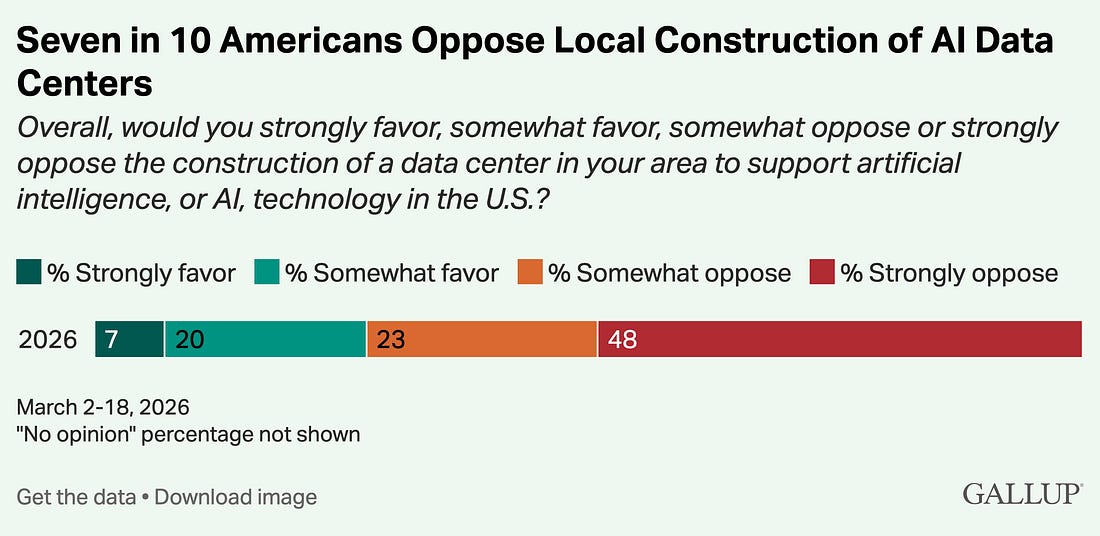
What is clear is that data centers have become an overwhelmingly unpopular issue for American voters. A Gallup poll from this month found that seven in ten Americans oppose the local construction of data centers for AI. Their concerns range from the environmental pollution to the increased utility prices generated by data center water and electricity use.

The Intelligence Services Bureau report briefly touches on these concerns and more, identifying “possible government use of AI to spy on Americans,” “environmental impacts,” “rising energy costs,” and “loss of jobs in certain industries” as reasons why Americans oppose their construction. The report does not examine why activism regarding AI and data centers is anything other than free speech.

Grasping for evidence of increased criminal dangers, the report dedicates a full page to threats made against OpenAI CEO Sam Altman, who is neither an elected official, nor within the purview of the Capitol Police.

Altman blamed the attack on “incendiary” news media coverage, writing in his blog that “I have underestimated the power of words and narratives.” In other words, AI leaders like Altman see the problem as one of controlling what the public says.

Congress, now in the intelligence business, is responding by focusing on the threat of the American public rather than the threat to the American public.

Subscribe if you wish Congress would pass laws, not intelligence dossiers