Showing posts with label music. Show all posts

Tuesday, August 25, 2026

Dolly Parton, an American Treasure. 1946-2026


By Sirantos Fotopoulos


Dolly Parton, 1946 — 2026. 


A small dilapidated cabin along the Little Pigeon River held 12 children and two parents who owned almost nothing but each other. The house had no electrical power, no indoor bathroom, and no running water. Water had to be carried from outside, and light at night sometimes came from fireflies caught in mason jars.


Dolly Rebecca Parton entered a household defined by scarcity, in a rural Tennessee economy where cash rarely circulated and survival depended on barter, kinship, and unpaid female labor. Her birth itself was paid for in cornmeal, a sack handed to a country doctor because currency simply had no place in that house. Appalachian subsistence life was stripped to its bones there, a family positioned entirely outside the wage economy yet fully subject to its verdicts.


Marxist analysis treats poverty as structural rather than moral, a product of land ownership, extractive industry, and the systematic underdevelopment of Appalachia by outside capital. Coal companies and timber interests had spent generations stripping the region's wealth while leaving its people without electricity, plumbing, or reliable healthcare. Dolly's family lived downstream of decisions made far away, by men who never set foot in Sevier County. Their poverty followed a clear economic logic, manufactured and sustained for profit that landed elsewhere.


She has said many times that deprivation itself was survivable. Cold nights, empty stomachs, secondhand everything, all of it could be endured within a family bound by love. What she named as the deepest wound was shame, specifically the shame of appearing in public dressed in rags stitched together by her mother, visible markers of class broadcast to children who had never chosen their station. Here sits the affective core of poverty under capitalism, where material lack becomes personal humiliation, where a structural condition gets misread by classmates and teachers alike as individual failure or moral defect.


Her father could neither read nor write, a fact she returned to across decades of interviews with an ache that never fully resolved. Illiteracy in Appalachia rarely reflected an accident of intelligence. It grew from chronic underfunding of rural schools, the demands of farm labor that pulled children out of classrooms, and a broader neglect of a region treated as a resource colony rather than a place full of people deserving investment. Watching her father live his whole life locked outside written language gave Dolly a direct, embodied understanding of 

how systems reproduce disadvantage across generations.


Her response bypassed charity in the narrow, condescending sense. In 1995 she launched the Imagination Library, mailing a free book every month to children from birth to age 5, a program that has since distributed hundreds of millions of books worldwide. Read through a class lens, the project functions as a redistribution of cultural capital, an attempt to hand working families a resource the market would otherwise price out of reach. She built it explicitly as a memorial to her father's exclusion, converting a private grief into public infrastructure.


In her home county during the 1990s she created a dropout-prevention initiative that paid cash to graduating students, conditioned on their helping a classmate stay enrolled too. The design carried real structural weight in how it worked. Rather than rewarding isolated individual achievement, it built solidarity into the incentive structure itself, tying one student's success to another's. Sevier County's dropout rate fell from above 30 percent to below 6 percent under the program, a collective result achieved through a collective mechanism rather than pure competition.


None of it required Dolly to adopt the vocabulary of theory. Her empathy operated instinctively, rooted in memory rather than doctrine, yet its structure lined up closely with a materialist reading of how poverty and dignity interact. She understood, from the inside, that the humiliation of poverty gets manufactured socially even when the poverty itself gets manufactured economically, and she spent decades building institutions that addressed both wounds at once.


We lost the wrong 80-year-old today. The other one is now busy trying to co-opt her legacy in his vain attempt to curry favor with white working class voters ahead of the midterms.


Pictured: Dolly Parton at her childhood home in Locust Ridge, Sevier County, Tennessee. 

Friday, December 26, 2025

The 60's Revolutionary Decade and the Emergence of Rock and Roll in the UK


Richard Mellor

HEO/GED

12-26-25


Sina is great. And as I watched and listened to this it reminded me of my youth back home. Music is such an important part of our memories. This for me is probably one of the best rock albums ever produced. It is more than rock to be honest. Classical rock? I'm not sure what to call it but it is a brilliant creation. And there they are at Abbey Road studios.

Last time I was in London with my dear friend Roger who has moved on, he went to that crossing. I didn't bother but wished I had, especially as I won't have an opportunity now. 

I grew up in the 1960's and what a decade it was. Revolutionary change all around me. Some of it I never grasped. Football felt it as Georgie Best with his long hair, (no more Brylcream for them) as the natural look took over, can’t run your fingers through Brylcream hair. The Beatles didn’t use it. The massive General strike in France, the Black Revolt and the women’s movement. The former colonies that were driving British occupation from their shores like the Mao Mao uprising in Kenya. The decade was on fire.


And then the music. The skiffle bands and Lonnie Donegan, along with the Ken Colyers group were early skiffle bands.  The blues brought over from America by Willie Dixon, who wrote “spoonful” and partnered with Long John Baldry once billed as the greatest “White Blues Guitarist” on one billing. Muddy Waters Memphis Slim, Big Bill Broonzy and of course the great Howlin’ Wolf (Chester Burnett) changed the music scene forever. Alexis Korner, Cyril Davies, Long John Baldry, Dick Heckstall Smith, John Mayall, were early pioneers. The list is along one. Elton John and others still popular today came out of this milieu.


My friend Rupe and I were talking the other night about how when we were young and in to this music we all wanted to be the lead guitarist. But now, 50 or 60 years later we would love to play the drums. It looks like such fun and a great way to release some creative energy. The drummer is the heart of the band, the time keeper, no?


I have lived in the US for a long time, and the people I have lived and worked with are precious to me. And it’s definitely my second home. We don’t judge a people by the actions of the ruling class. But when I touch down at Heathrow I have this special feeling that my roots are there, and the ride on Piccadilly line into the city, now it’s the Elizabeth line, gives me a warm welcoming feeling. I love that city.  As in all countries, we separate the government from the people. There are classes in society that are antagonistic to each other and we choose which side we’re on. 


And here we have a young German woman who lives in London and produces drum covers’ for You Tube. Carrying the torch for Rock and Roll.  Bless you girl.


Here's her website.

Tuesday, November 18, 2025

Ewan MacColl, Laborers and the Efforts to Obscure the Class Struggle.


Richard Mellor

Afscme Local 444, retired

HEO/GED

11/18-25


I posted Roberta Flack singing The First Time Ever I Saw Your Face to Facebook a few days ago. It has to be one of the most beautiful love songs ever written. The man that wrote it was Ewan MacColl, an English folk singer and Communist Party member. He also wrote, Dirty Old Town. And many other songs about working class life. He wrote the love song for Peggy Seeger, Pete Seeger’s sister and they eventually married.


I had a Ewan MacColl album a long time ago, or folk album at least, can't remember exactly, and I liked the song in the video above. The reason was it reminded me of the term labourer and that I was a labourer, both in factories and fields. At the time I had not long left a job laying sewer mains with Irish laborers in the Oxfordshire countryside. I was in teenage love with this farmers daughter once, what we'd call the rural petit bourgeois. When her father got wind of that he put a stop to it right quick.


I’m pretty sure on my first passport it said, labourer under “profession”. There was no shame in this although it was clearly seen as a low rung on the ladder in the British class system. I think my US wife’s parents must have had a fit when she brought home this guy who was not only a labourer, but an unemployed one; but they were always kind and accepting of me. I wasn't a skilled tradesman, no university education and if I went to the labor exchange they’d ask me what I was looking for, they'd tell me what labourer positions might be available. Normally though, one would just wander on to building sites or walk in to a factory to see if they had any openings.

Back in the 1980's when I was a delegate from my union to the Alameda County Central Labor council here in the San Francisco Bay Area, I noticed how language was changing. Organized labor had lost many battles throughout the 1980’s due to the refusal of the labor hierarchy to mobilize a generalized fightback against the employer’s offensive and efforts at labor/management partnerships gained traction. The hope was they might convince the boisses' to be less aggressive.


So there was a lot of talk about changing the culture, the adversarial culture between labor and capital that is portrayed as simply a matter of choice, as opposed to it being an integral part capitalism and class society. In its place, the Team Concept culture, that workers and bosses are partners, members of the same team, began to get a real hold.


There was a culture war on language. The term “worker” was being replaced by “team member” or “Associate” and similar terms that were meant to obscure the inherent antagonistic relationship between employers and workers, the buyers of labor power and the sellers of it.


Janitorial became “environmental services” and a Janitor, a “custodian” or at best, an environmental engineer.  I was in a store once and I saw this employee on his knees stacking a lower shelf with goods. I got his attention and he strained a bit as he looked up at me, a clear sign getting up and down was hard for him. He was an older black man and I noticed it said on his coveralls that he was an associate.


“You’re an associate are you?” I said with a wry smile. He got it and replied, “Yeah, but they don’t pay me mfu&%*in’ associate's wages”.


In 1995, after John Sweeney was elected president of the AFL-CIO in the first contested election in a century, he initially threatened some militant changes and initially talked of using direct action, blocking bridges like Martin Luther King. His first VP Richard Trumka boasted in 1995 that, “…the era of union busting, contract trashing and strike breaking is at an end.


Well that didn’t last long and, Sweeney went from blocking bridges to building them, not with the rank and file of the organization he headed, but with the bosses. One of his trusted advisors as president of the AFL-CIO was Bill Fletcher who is considered by some to be a militant labor activist, but he was, for the most part, an important member of the labor bureaucracy in this period. In other words, art of the problem from the dues payer's point of view.


We know what we are no matter all the attempts to convince us we are something different. I remember being insulted when I first came to the US and someone told me I was middle class. I never had any aspirations to be middle class, I am a worker. It shows the inherent fear the ruling class has of the working class that it has convinced millions of workers they are not workers. And the labor bureaucracy have embraced this deception.


Adding this later, but as it was over 50 years ago I might be mistaken above and the song might have been this one below but I couldn't find Ewan MacColl singing it.


I’m not a bible type, but one of my favorite quotes (I don’t know too many) is from Job: “Man is born to labor and the bird to fly.”. Job must have had an honorable job himself 


Most importantly, don't lose sight of the fact that labor is the source of all wealth----------mental and physical. Embrace it.

Saturday, August 16, 2025

Some people just don’t like music – it may be down to their brain wiring

Some people just don’t like music – it may be down to their brain wiring

Krakenimages.com/Shutterstock
Catherine Loveday, University of Westminster

When I ask a lecture theatre full of students how they would feel if they could never listen to a piece of music again, most are horrified. Many have been plugged into their headphones until the moment the class begins. But without fail, one or two will shyly admit that their lives would not change at all if music didn’t exist.

Psychologists call this “music anhedonia”, meaning an absence of pleasure for music. And a new paper from neuroscientists in Spain and Canada suggests it is caused by a problem with communication between different parts of the brain.

For many of us, apathy towards music seems unfathomable. Yet, for 5%-10% of the population, this is their norm.

I see it often in my own research and practice in people with memory loss, where I ask people to select favourite songs as a way of accessing significant memories.

It has always fascinated me that some people look at me blankly and say, “I’ve never been that bothered by music”. It is such a contrast to the majority who love to talk about their first record, or the tune played at their wedding.

Recent evidence shows considerable variation in the depth of people’s emotional response to music. Around 25% of the population are hyperhedonic, which is an almost obsessive urge to engage intensely and frequently with music.

Research in this field typically uses the Barcelona Music Reward Questionnaire (BMRQ), which asks people about the significance of music in daily life: how often they listen to records, whether they hum along, and if there are songs that give them a shiver down the spine.

Low scorers are classified as having music anhedonia and many researchers further verify this in the lab by measuring heart rate, sweat response and breathing while music is playing. For most of us, these physiological markers change dramatically during emotional songs. But in those with music anhedonia, there are often no physiological effects at all.

One theory is that reduced enjoyment for music may reflect a more generalised anhedonia, an absence of pleasure for anything. Often, this is linked to disruption to the reward pathways in the brain, in areas such as the nucleus accumbens, orbitofrontal cortex and insula.

It is a common feature of depression, which, along with other mood disorders, can correlate with a lack of response to music . However, this does not explain specific music anhedonia, where people happily enjoy other rewards such as food, socialising and films, but remain indifferent to music.

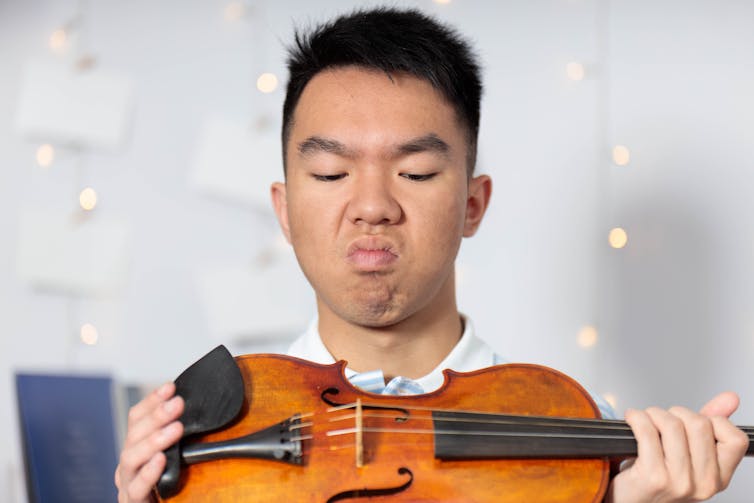
Man scowling at violin
Not every child made to take music lessons grows up to thank their parents. foto-lite/Shuttersock

An alternative possibility is that people with reduced interest in music simply don’t understand it, perhaps due to difficulties with processing melody and harmony. To test this, we can look at people with amusia – a deficit in music perception, which affects the ability to identify familiar tunes or detect wrong notes. This occurs when there is reduced activity in key regions in the frontotemporal cortex in the brain, which handles complex processing of pitch and melody. However, some people with the condition have an extreme and obsessional love of music.

In any case, other research shows that those with music anhedonia often have normal musical perception, with no problem recognising songs or distinguishing major from minor chords.

So, what is going on? The new paper provides a detailed analysis of all the research in this field to date. The researchers explain that while the brain networks underlying music perception and reward are both intact in people with music anhedonia, the communication between them is severely disrupted. There is little to no traffic between the auditory processing parts of the brain and the reward centre.

People with typical responses to music have significant activity in this pathway, which is higher for pleasant music than for neutral sounds. A 2018 study showed that you can increase music-induced pleasure by artificially stimulating these communication tracts using magnetic pulses.

The new analysis may give scientists insights into clinical conditions where everyday rewards seem to be reduced or enhanced, for example eating disorders, sex addictions and gambling problems.

These findings also challenge the common assumption that everyone loves music. Most people do, but not all, and the variation comes down to differences in the wiring of the brain. Sometimes it follows brain injury, but more often people are born this way, and a March 2025 study found evidence of a genetic link.

Music is everywhere – in shops, gyms, restaurants, healthcare settings – and it can be incredibly powerful. But perhaps we should resist the urge to see it as a panacea and respect the fact that for some, silence is golden.The Conversation

Catherine Loveday, Professor, Neuropsychology, University of Westminster

This article is republished from The Conversation under a Creative Commons license. Read the original article.

Wednesday, January 8, 2025

Taylor Swift. Mass Produced Pop vs Beatles Musical Talent

I often enjoy listening to Rick Beato and this is a great answer to an article he read that raised the issue of a comparison between the Beatles and Taylor Swift.  It is an example of how mass produced today's pop music is. I found this video very interesting. RM.

Wednesday, May 12, 2021

Working Class People: It's Cool to Love Bach

Richard Mellor
5-12-21

I don't read music but I love music and am never without it, particularly when I'm alone. I have thought music is best described as a period of time within which there are periods of silence and sounds of varying lengths. But what do I know and who cares. If it is pleasing to the ear, if it invokes within the listener emotions and feelings then it’s doing its job. Dizzy Gillespie commented that he didn’t care much for music, he just liked sounds. Either way, music is without doubt the international language.

I was fortunate being from a working class background that my parents both liked to listen to classical music. They were particularly fond of Johan Strauss and some of the lighter stuff but at least it wasn’t foreign to me and I began to develop a taste of my own. I remember the first album I got, Tchaikovsky’s 1812 Overture and with it was his piece Capricio Italien. I liked the power and grandeur of the 1812 and the canons and could imagine Napoleon’s forces being driven from Russian soil; the overture was Tchaikovsky’s contribution celebrating that victory.

Over the years I branched out and came to appreciate other composers and styles. But on listening to Bach for the first time I thought the man must have been mad or on some 17th century equivalent of today’s amphetamines. It just seemed so jumbled to me.

I have come to appreciate Bach more and I really enjoyed the video above. Not really understanding the mechanics, or theory behind music doesn’t mean we can’t enjoy it, after all, the end result is just sounds. But the science fascinates me and thanks to technical innovation and the Internet, not to mention You Tube, we have so much information and knowledge at our fingertips. Yes, there’s a lot of junk and we have to be selective but it’s there.

Bach was a composer of the Baroque Period, but what we call collectively classical music was not written for the masses of course. The patrons and money behind the composer were the feudal aristocracy and religious authorities and Bach wrote much of his music for the Lutheran churches of his time. In the main the music is religious based. But even for an atheist, anyone that writes music or produces any form of human expression lauding the force they believe is the creator of the universe, is bound to produce some powerful stuff.

Working class people often tend to think as classical music as alien to us; it belongs to others and it’s  highbrow. It’s like many art forms that are made possible through the backing of the ruling classes and not particularly encouraged among the masses. But no one owns music. I like music we are hearing today from the Sahara and Sahel, it is mine as much as it belongs to the Touareg people. It can originate in many places and cultures but belongs to any listener.

Some time ago I posted a video of a well-known cellist playing Bach’s G major cello prelude and that was a fascinating experience for people like me and I really encourage folks to watch it. When I watch something like that it makes me feel great love for humanity that we can produce such beauty. In the video above the narrator explains the genius of Bach when it came to music theory and his use of certain notes and chords. It seems to me when looked at this way, the composer is a mathematician of sorts, at least, it seems to be the case with Bach.

In the last analysis for the listener it is the sound and how it is constructed that matters. Beethoven’s impressive 9th Symphony, by some accounts the greatest symphony of them all, has in it 4th movement, the choir and the words of the German Poet Schiller’s Ode To Joy but this powerful piece has been used by Nazi’s the Stalinist regime of the former Soviet Union and no doubt others. Powerful images and sounds are not responsible for the aims and ideology of those using them.

At the end of video above, the narrator recommends a BBC documentary about Bach and his life, looking at it from a different perspective that is traditionally presented. It is titled, A Passionate Life and can be found at this link. https://www.youtube.com/watch?v=3ZVn9NZqyxs

Friday, February 5, 2021

In Memory of Anne Feeney: Singer * Songwriter * Political Activist

Anne Feeney
Singer * Songwriter * Political Activist
July 1, 1951 - Feb. 3, 2021
Anne Feeney
labor and protest singer and songwriter
from Pittsburgh, Pa.
has died of COVID
at age 69.

Live from the Fogartyville Community Media and Arts Center Sarasota, Florida. WSLR 96.5 Community Radio, 2017.


From the Pittsburgh Post-Gazette
By Scott Mervis
Music Writer

  • Born in Charleroi, Pennsylvania and raised in Brookline, Anne took early inspiration from her grandfather, William Patrick Feeney, a mine worker's union organizer and a violinist. In 1967, while still in high school, she bought a Martin guitar and did her first public performance, singing Phil Ochs songs, at an anti-war rally in 1969. She was arrested at the Republican National Convention in Miami in 1972 protesting the nomination of President Richard Nixon.


  • In 1972, while at the University of Pittsburgh, she co-founded Pittsburgh Action Against Rape. She graduated from the Pitt School of Law in 1978, worked 12 years as a trial attorney and served as president of the Pittsburgh Musician's Union. She also was president of a NOW chapter and served on the board of the Thomas Merton Center.

  • During that period, she married labor attorney Ron Berlin, with whom she raised two children, Dan and Amy. (They were divorced in 1995.)

  • In 1991, she hit the road hard, traveling around the country to perform at folk festivals, labor conventions and rallies, including the WTO demonstrations in Seattle, Solidarity Day in Washington, D.C., and the 2004 March for Women's Lives.

  • Her business card read: “Performer, Producer, Hellraiser.”

  • In 1992, she delivered her debut album, “Look to the Left.” Her subsequent albums in the ‘90s and ‘00s -- mixing original and traditional songs and blending folk, pop, Irish and bluegrass -- included “Union Maid," "Have You Been to Jail for Justice?" and “Dump the Bosses Off Your Back.”

  • Her songs were recorded by Peter, Paul and Mary and she shared stages with such legends as Pete Seeger, Billy Bragg and Loretta Lynn. Her song "Have You Been to Jail for Justice?" is featured in such documentaries as “This is What Democracy Looks Like” and “Get Up/Stand Up: The History of Pop and Protest.”

  • In reviewing one of her albums, The Fort Worth Weekly wrote, “Dissent is an essential element of the American ideal. Feeney has never shied away from expressing opinions that are unpopular with people who have the loudest voices.”

  • In 2005, she received the Joe Hill Award from the Labor Heritage Foundation in Washington, D.C.

2/4/2021 edited


Wednesday, December 16, 2020

Beethoven: revolutionary times

Michael Roberts has written a great commemoration of Beethoven, his work and life on the 250th anniversary of his birth. Music, like philosophy and science, is a product of the material conditions of the time and Beethoven lived through revolutionary times and it is expressed in his compositions. Enjoy.  Admin

Beethoven: revolutionary times

by Michael Roberts

It is the 250th anniversary of the birth of Ludwig Beethoven, who was born either on 16 or 17 December 1770; nobody was quite sure, including Beethoven himself.  Beethoven is considered the most musically revolutionary of ‘classical’ composers. And in my view, that was no accident of history because Beethoven was a man of his time.

He was born at the time of what has been called the ‘enlightenment’, when European thought broke from a subservience to religion and monarchy and raised the banner of free thinking, science and democracy – and there were the first glimmerings of a new economic order based of ‘free trade and competition’. Adam Smith published his seminal work, The Wealth of Nations, when Beethoven was six years old.  And the American war of independence took place, in which the formerly British settlers broke from the British monarchy, with the financial and military support of France to establish a republic with voting rights, exercised again this year.

In my view, Beethoven’s musical journey swung with the ups and downs of this revolutionary time that continued throughout his life, but particularly with the ebb and flow of the French revolution that ended monarchy, feudal rights and proclaimed equality, freedom and fraternity for all (men).  As a teenager, Beethoven, like many other young ‘middling’ people in Europe, was a strong supporter of the revolution from the beginning.

The son of a musician from a family of Flemish origin, his father, Johann, was employed by the court of the Archbishop-Elector of Bonn, Germany.  He gave his first public performance aged seven and moved to Vienna in 1792 to study with Joseph Haydn, who, with Mozart (who had died the previous year aged 35), had shaped the city’s musical tradition.

Vienna was under the rule of the Hapsburg absolutist empire.  But Beethoven was wrapped up in Napoleonic ideas of freedom. He became a staunch republican and in both his letters and conversation spoke frequently of the importance of liberty. He did not care for royalty. To one of his earliest patrons, Prince Karl Lichnowsky, Beethoven wrote: “Prince, what you are, you are by accident of birth; what I am, I am of myself.” Austrian monarch, Franz II allegedly refused to have anything to do with Beethoven, on the basis that there was “something revolutionary in the music”. And what friendship the composer had with great German writer and poet, Goethe, was ended abruptly in 1812 when, walking together in the park, they came across the Austrian Empress. Goethe bowed subserviently; Beethoven disdainfully turned his back.

This revolutionary spirit inhabits much of his work.  He propelled music into this new age. Bringing together the poetic power of the German literary scene and the French songs of revolution, he completely changed what music could be. “Beethoven is the friend and contemporary of the French Revolution, and he remained faithful to it even when, during the Jacobin dictatorship, humanitarians with weak nerves of the Schiller type turned from it, preferring to destroy tyrants on the theatrical stage with the help of cardboard swords. Beethoven, that plebeian genius, who proudly turned his back on emperors, princes and magnates – that is the Beethoven we love for his unassailable optimism, his virile sadness, for the inspired pathos of his struggle, and for his iron will which enabled him to seize destiny by the throat.” (Igor Stravinsky). Beethoven changed the way music was composed and listened to. His music does not calm, but shocks and disturbs.

I think we can divide up Beethoven’s musical work into four periods that match the economic and social ups and downs of his lifetime. His was the age of three great bourgeois revolutions: the industrial in England; the political in France; and the philosophical in Germany.  The first period of his life as young boy and then as a young adult was during a revolutionary upswing in Europe; but also a new economic upswing in capitalist development, leading to the apex of the French revolution with the ascendancy of the radical Jacobin administration in 1792 when Beethoven was 22 years old.

The second period from 1792 to 1815 was really one of setback for the revolution in France as the Jacobins were overthrown and the hero of the military defence of the revolutionary government, Napoleon Bonaparte, made himself dictator. But that also meant that Napoleon’s armies took the ideas and laws of the French revolution across Europe, overthrowing the reactionary semi-feudal absolute monarchies of Austria, Spain, Italy and Prussia. His victories made him an idol in Beethoven’s eyes.

It was in this period that a maturing Beethoven composed some of his greatest works. His magnificent 5th symphony is brimming with references to the music of the revolution. In its composition, Beethoven remarks that his symphony expresses the words written about murdered French revolutionary leader Jean-Paul Marat “We swear, sword in hand, to die for the republic and for human rights”. His only opera, Fidelio, tells of a lone woman freeing her husband, a political prisoner, from a Spanish jail (the setting having been moved from France for political reasons, reasons which included his hatred of the regime in Spain).

A revolutionary spirit moves every bar of the Fifth. The celebrated opening bars of this work (listen) are perhaps the most striking opening of any musical work in history. By coincidence, they are the musical equivalent of the Morse code signal for “V” meaning victory, used to rally the French people to fight the German occupiers in WW2. “This is not music; it is political agitation. It is saying to us: the world we have is no good. Let us change it! Let’s go!” (Nikolaus Harnancourt, conductor).

Another famous conductor and musicologist, John Elliot Gardener, has discovered that all the main themes in Beethoven’s symphonies are based on French revolutionary songs.  The “cry of alarm”, “Marchons, marchons” from “La Marseillaise”, the rallying call of the French Revolution, is echoed in the opening chords of the “Eroica” symphony. The Fifth Piano Concerto (“Emperor”) exudes “military energy”. The trumpet passages in Fidelio echo those in Handel’s Messiah that occur under the vocal line “the trumpet shall sound… and we shall all be changed”.

But this great period of musical energy was increasingly marred by Beethoven’s terrible and tortuous illness, as he gradually went deaf, possibly with a type of meningitis – which affected his hearing. This started when he was 28 years old and at the peak of his fame. Although he did not become completely deaf until his last years, the awareness of his deteriorating condition made him unpredictable, depressed and even suicidal.

There was also a deterioration in Europe’s economy from 1805, beginning with the blockade of France’s conquests by British naval power after the victory of its navy at Trafalgar, creating increasing shortages of food and staples.  And Beethoven was also depressed with political events in this period.  He had dedicated his 3rd symphony to Napoleon. But by 1802 Beethoven’s opinion of Napoleon was beginning to change. In a letter to a friend written in that year, he wrote indignantly: “everything is trying to slide back into the old rut after Napoleon signed the Concordat with the Pope.”  Beethoven’s admiration finally turned to resentment when Napoleon declared himself Emperor in 1804. When Beethoven received news of these events, he angrily crossed out his dedication to Napoleon in the score of his new symphony. The manuscript still exists and we can see that he attacked the page with such violence that it has a hole torn through it. He then dedicated the symphony to an anonymous hero of the revolution: the Eroica symphony it became.

The third period of Beethoven’s musical life matched a period of deep reaction and a shocking downturn in Europe’s economies.  With Napoleon’s defeat in 1815 with the old monarchies restored in Europe, Beethoven was in despair, composing little.  Everywhere progressive thought was in retreat: the great romantic poets of victorious England, Shelley and Byron, were forced into exile. Mary Shelley wrote Frankenstein, a novel that despairs at both bigoted superstition and racism as well as antagonism towards the uncontrolled scientific industrialism of the rising capitalist economy. This was the end of romanticism and revolution and now was the time for such as David Ricardo, more or less the same age as Beethoven, who in 1817 wrote his Principles of Political Economy and Taxation, the definitive work of bourgeois economics, a paeon to capitalism.

The years 1816-19 were terrible ones for the people of Europe, not dissimilar to this year of the COVID in 2020.  The European economy fell into a permanent winter, both literally and economically. 1816 is known as the ‘Year Without a Summer’ (also the Poverty Year) because of severe climate abnormalities that caused temperatures in Europe to drop to the coldest on record. There were failed harvests. This resulted in major food shortages. In Germany, where the crisis was severe. Food prices rose sharply throughout Europe. Though riots were common during times of hunger, the food riots of 1816 and 1817 saw the highest levels of civic violence since the French Revolution. It was the worst famine of 19th-century mainland Europe.

Suffocating in the reactionary atmosphere of Vienna, and despairing of any change for the better, Beethoven wrote: “As long as the Austrians have their brown beer and little sausages, they will never revolt.”

However, the final decade of Beethoven’s life from the 1820s saw a revival in the European economy as the capitalist mode of production spread and industry began to replace a mostly rural Germany and Austria. Indeed, there was the first capitalist economic slump in 1825; and later, the first signs of proletarian struggle which eventually led to the overthrow of the restored Bourbon monarchy in France in 1830 and the 1832 Reform Act in England, allowing better-off adult males the right for the vote for the first time.

And in 1824 Beethoven delivered his final masterpiece before his death in 1827. Beethoven had long been considering the idea of a choral symphony and took as his text the German poet Schiller’s Ode to Joy, which he had known since 1792 and was originally published in 1785 taken from a drinking song for German republicans. In fact, Schiller had originally considered calling the song an Ode to Freedom (Freiheit), but because of the enormous pressure of reactionary forces, he changed the word to Joy (Freude). Those words of Schiller became the centrepiece of the 9th symphony (which is used by the European Union as its anthem now). https://www.youtube.com/watch?v=Jo_-KoBiBG0

The ninth symphony has been called The Marseillaise of Humanity.  Beethoven revives the sound of revolutionary optimism. It is the voice of a man who refuses to admit defeat, whose head remains unbowed in adversity.


Saturday, May 9, 2020

RIP Little Richard


Good Golly Miss Molly. A tremendous influence in my life and millions of young English kids like me has passed on. Little Richard's influence on our music was phenomenal. Remember the Swinging Blue Jeans and Hippy Hippy shake? The Beatles and Long Tall Sally?  There's a great scene in the movie Hail Hail Rock and Roll made for Chuck Berry with Keith Richards throwing a party for him in St Louis. It's Little Richard sitting at the piano with Bo Diddley and (oh man, my memory) I  think without researching, Muddy Waters or one of the greats standing there talking about what it was like for them in that industry. Richard was talking about his song and how it was made and sold with I think Pat Boone or someone like that singing it. Sad but they were all laughing as Ricjard did a quick imitation of what that sounded like. You know he influenced Jerry Lee Lewis.

It's sad but great memories and thanks to this giant of 20th century music. The world, art and history has been richer because people like Little Richard was here. RIP Little Richard and thanks for everything.

Saturday, February 9, 2019

Those Gringo's Sure are Sneaky. Wait For It.


As many people that read this blog know, I am originally from England and now live in the US, California to be exact. We have many Latinos from different parts of Latin America here. As Mexico is on our southern border, Mexicans are probably the most numerous group, and of course, this state used to be part of Mexico until 1850 losing it in the Mexican American war. California is one of the largest agricultural producers in the world due primarily to everything being imported-----its water, its nutrients in the form of fertilizers and its labor power which is, and historically has been, Mexican, although other ethnic groups have migrated here and became agricultural laborers. A good book about California's agricultural history and its workforce is Carey McWilliams' Factories in the Field. For those living in the East Bay you'll read about pea pickers and others and attempts to organize them There were Sikhs, Japanese, Armenians and, Europeans escaping the dust bowl all here to work.

I tell this story because last night I stopped by and hung out with three Mexican, Mexican/American friends, solidly working class people, the "Salt of the Earth" which is a term my mum would use to describe basic folks. As an aside, there is a famous movie with that title about a strike of Mexican workers. It was banned in the US for 11 years or more as communist propaganda. It is worth watching, dated, but still very relevant today. You might find it in your local library as I did.

Rosa, Ricardo, Hector  (I changed the names to protect the innocent) and me were sitting around in the garage having a beer and chatting and Mexican music was playing on the You tube.  My Spanish is not conversational but I learn a little bit each time from them as they're trying to help me become more familiar with Mexican culture and the immigrant Mexican culture. We talk about our lives, how we came here, what our childhoods were like and so on. We have lots of laughs. There was a video on the computer with this Mexican man dancing to this music and Rosa tells me if I want to be a "real Mexican" I have to learn to dance like this as the man was sort of waving his feet around as well. She showed it on another video about dueling accordions that was introduced by Freddie Fender. I saw a film on Netflix once about a German guy who loved to play the accordion and ended up moving to Mexico because it is so popular there.

The guy in this video above is muy famoso apparently. His name is Flaco Jimenez. I found this clip and it's great and not only that, it's funny and political.

I talked with Jo when I got home about the wonderful time I'd had. I felt like I was immersed in this other culture completely and I shared my aspect on things as well. I felt that way when I was in Baghdad and in Basra as a young man where I sat in a cheap pensione with long haired traders from Goa, but I did have to travel a ways for that. I often hang out with Hector as his English is better than my Spanish but not great so we struggle through the communication web. How lucky I am that I don't have to travel to Mexico to feel like I'm immersed in its culture, or one side of it anyway. Mexico is a huge country with different traditions and cultures.

I watched this film some time ago about an undocumented worker who had to retire after working on
a chicken farm. Being undocumented he couldn't receive benefits despite years of  work. It's a bit slow for some US audiences as there isn't much raping, cars blowing up buildings collapsing and throats being slit to keep people interested. But it's a lovely film as far as I remember.

When I reflect on these wonderful exchanges between working class people that are wonderful experiences and memories for me, I think of that filthy degenerate in the White House. He is not alone in his policies which are nationalist and of course chauvinist. Obama was known as the deporter in Chief and also began the sanctions against Venezuela in order to undermine that regime that was not willing to hand over its state wealth to the US multi-nationals.  Hilary Clinton boasted of the friendship she had with the brutal Egyptian despot Mubarak, he was "like family" she said and Obama only reluctantly abandoned him when it was clear the Egyptian masses were going to rid themselves of him. We now have Michelle Obama cozying up to the mass murderer George W Bush referring to him as her "partner in crime" and a "friend". The ruling class and its political representatives understand class solidarity very clearly.

They are all representatives of capital and will defend US capitalism against its own working class and workers abroad that resist its invasions. We should not forget that workers were often shot for trying to form unions here. But Trump has undoubtedly, as we say here on this blog, brought  the whip of the counter revolution to the working class and forced people to sit up and listen. He has been positive in this regard.  As for his wall, he can stick it where the sun doesn't shine and I'm not talking of the Mariana Trench

But enough of this degenerate. The video is good with some unbelievable accordion playing and funny with it. I think I saw a couple of co-workers dancing in the crowd but who knows. Larry N would find them for sure.

Tuesday, September 11, 2018

Alice Coltrane. Making some Sounds For You.


As beautiful to watch as it is to listen to. Who says creating music is not a physical experience. The harp is part of her body.  Part of building a new society is that human talent and the beauty it creates can be found in all people and develop to its fullest. Here's more from her in a different style and instrument.

Thursday, August 16, 2018

Aretha Franklin: The Queen of Soul


I can't say much about this day as it comes to all of us. She meant so much to millions upon millions of people. To the black folks and black women, a historic figure and equally for all women. For me personally there's always that selfish aspect to it, another person whose art played such a prominent role in my life gone for good reminding me of my own mortality. But, as they always say, you can't destroy a legacy, she also sang opera as well.

Aretha Franklin also offered to pay Angela Davis' bail on charges related to the shootout at the Marin County Courthouse in 1970: “... not because I believe in Communism but because she is a black woman and she wants freedom for black people.” 

We all have our prejudices and I like to think that the era in which I grew up and the music that came out of it for me was the greatest period, I know that each era has it's great performers and Aretha Franklin is truly a giant of the 20th century, as much so as the classical composers and artists of an earlier period whose creations are still popular today.

Here she is in her beautiful performance in The Blues Brothers that surely must have captured the hearts of Black American women and women throughout the world. Humanity has just lost a great one.

Aretha Louise Franklin March 25, 1942 – August 16, 2018

Saturday, July 7, 2018

Music is HIstory. PBS show on North American Music

This was the episode I watched
Richard Mellor

Just wanted to point to the importance of history in music. Music is no different than a book or transcript, and when we talk about music before its written form its one of the oldest forms of preserving social history.

I was just watching, an episode of American Epic on PBS. It appears to be a music history, American, as in USA music of course. It had the inventor of the laptop steel slide and how this began in Hawaii and Cajun music, Hank Williams Jr. and country among others. I just saw in the "folk" section, Mississippi John Hurt. I have known of and listened to Mississippi John Hurt since my early teens back in England.

One of my best friends since my youth is as much an expert on this genre as those officially recognized as such. You know it's like "People made coats from time immemorial before there arose such a profession as Tailor."

I was no big folk fan early on but Hurt still had that element of a more raw blues to him. Was he a transition line between blues, jazz and folk. I really don't know and wonder how those who have studied music history would describe him.

Make Me a Pallet was a popular one with us. Jo Anne Kelly who was dubbed the Queen of British Blues, covered it and was a well respected native representative of this music.

I always thought or felt that John Hurt was a gentle, sweet man; he just gave that impression. I recall an album with him sitting by a fence and I looked at his hands, workers hands, hard workers hands. I cursed myself for making excuses why I wasn't a guitar player, excuses like, "I've got stubby workers fingers." Damn it wasn't because I didn't have slender graceful hands like a lawyer or John Williams why I couldn't play the guitar, maybe it was something else, like----not practicing.

At the end of the segment there was a short interview with him at some festival. And he was exactly how I imagined, an honest musical genius. An old friend ended by saying exactly what I thought, that he was a kind sweet man and that we could "do with more of him." I went to get an image of him and found this section of a BBC documentary on You Tube. I've never seen it, it's nice. 


You see, television is a good thing. The problem is that the working class, the largest group of people in society don't own it. It is owned by a tiny minority in society for the sole purpose of selling commodities and convincing people they need them whether they do or not. Television is a key instrument in ensuring that the capitalist class, the minority in society, keep their hands at the helm..

America Epic was on KQED in the San Francisco Bay Area.