Trump desperate for exit from Iran War
By John Pickard
In the first major rebuke for Donald Trump, the Republican-controlled House of Representatives passed a ‘war-powers’ resolution this week, blocking Donald Trump from carrying out more strikes on Iran without congressional approval.
Trump will ignore the resolution, of course, and being passed by a small majority of 215 to 208, it will be subject to presidential veto. But it is an indication – yet another straw in the wind – of the underlying shift in US politics that Trump has engendered by his ill-conceived war on Iran.
The war, now well into its fourth month, is costing the USA around $2bn a day and the burden of that – and all the rest of Trump’s policies – is being borne by American workers, in terms of higher living costs, greater insecurity and more uncertainty.
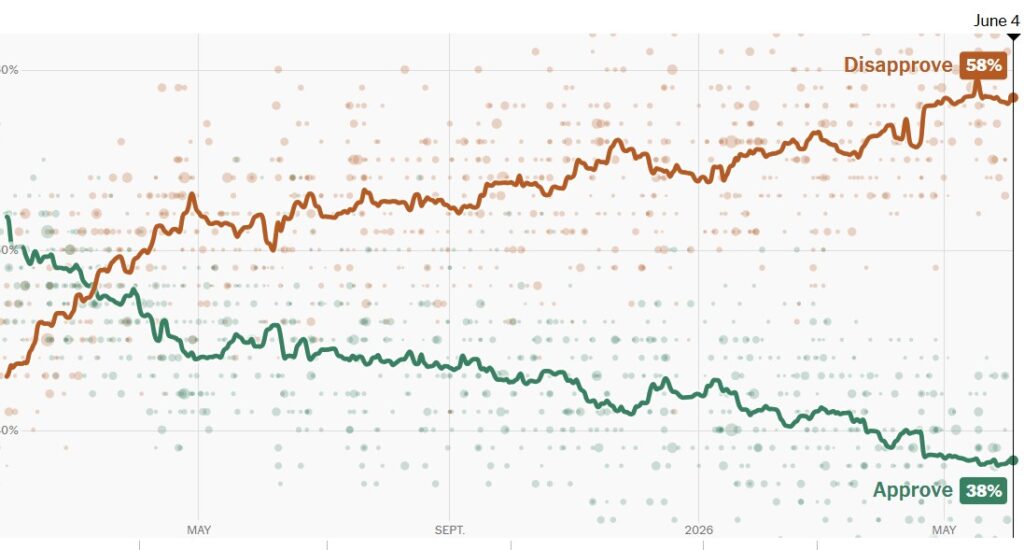
The war is extremely unpopular among US voters and even two months ago polls showed that 56 per cent of Americans “opposed” or “strongly opposed” the war. Now that Trump is in a position where he has clearly ‘lost’, in the sense that he has not ‘won’ and the Strait of Hormuz is still closed, those polling figures will have skewed even more against him. His own personal approval rating has fallen, according to the New York Times (June 4) to -20, with only 37 per cent approval.
Measuring their Iran adventure by bombs dropped, ordnance deployed and the destruction of military (and many civilian) targets, Trump and his ‘Secretary for War’, Pete Hegseth, are crowing non-stop about a great ‘victory’. But it has become clear that the Iranian regime, whilst being severly wounded, is far from defeated, and in some respects is in a stronger position than it was before the bombing began on February 28.
Unsophisticated and cheap armaments
Iran has discovered that with relatively unsophisticated and cheap armaments – and to some extent by bluff – it has been able to close the Strait of Hormuz, depriving the world, not only of crude oil, but of many by-products of oil refining that are essential to agriculture and industry. Perhaps persuaded by Netanyahu, the Israeli Prime Minister, Trump clearly thought the attack launched in February was going to be a short ‘regime-change’ operation, much like the kidnapping of Maduro from Venezuela. In the event, it has left Iran with a powerful lever – complete control over the Strait – which it did not have before.
Meanwhile, the OECD has warned that the war is causing huge damage to world capitalism. “Failure to resolve the energy crisis in the Middle East” the Financial Timesreport says, “would plunge the world into a ‘dark scenario’ of tumbling growth and sharply higher interest rates…”
Even if there was a full agreement between the USA and Iran, today, and even if the oil began to flow ‘normally’ from the Gulf, it would still take months before oil and oil-products were flowing as they were before the war. A drop in world economic growth is already baked into the projections outlined by the OECD. What we will see developing in the coming months is what future historians will call the “Trump recession” and the longer the Strait of Hormuz is closed, the deeper will be the recession.
Trump’s negative poll rating sinks to a new low
The OECD economic prognoses, as well as the unpopularity of Trump in the polls, will inevitably have an effect. The economic cost of the war and the increasing likelihood of it being translated into anti-Republican sentiment in the mid-term elections in November constitute a significant pressure on the White House.
Despite Trump’s narcissistic tendencies, his inability to accept criticism and his surrounding himself with yes-men, at least a part of the message from the polls must be getting through. The problem for Trump, however, is that it is very hard to dress up a catastrophic failure in policy as a roaring success.
But dressing up a huge failure as a victory is exactly what his negotiators are trying to do in their contacts with Iranian representatives. It is likely, therefore, that the current ‘truce’ will last some time, as Iran plays ‘hardball’ over the closure of the Strait.
Over the coming weeks, Trump’s team is likely to be forced into loosening sanctions on Iran and perhaps accepts Iranian/Omani control of the Strait yet being careful to not to appear to give too much ground. Even on the question of Iran’s nuclear programme, it is now unlikely that the US will get anything more than a few face-saving clauses written into an agreement. However humiliating the small print might be, Trump will shout loud and long about his great ‘victory’.
If Trump’s war on Iran seems to be approaching an ignominious end, it is also true that it has accelerated a general shift of US and world opinion against Israel, especially over its genocidal destruction of Gaza. Netanyahu, and a significant part of the Israeli right-wing establishment, believe that a policy of ruthless military aggression and expansion is in the best interests of the Israeli ruling class.
But Israel has depended over the decades on unstinting financial and military support from the USA, without which it would not be a Middle East super-power. Now that Trump is so desperate to extricate himself from the swamp of the Iran war, and with the Iranians demanding that Lebanese Hezbollah are part of any agreement, Trump has been obliged to sharply rebuke the Israeli leader over its policy in Lebanon.
Trump to Netanyahu: “you’re fucking crazy…”
According to a report in the Financial Times, Netanyahu called off a planned major bombing campaign in Southern Beirut, after an angry phone call from Donald Trump three day ago. “He later confirmed US media reports that he had told Netanyahu: ‘You’re fucking crazy.’ According to Axios, he added: ‘Everybody hates Israel because of this’ — an account that the White House did not dispute”.
Netanyahu and the Israeli military will go back on any commitment they might give to Trump. In wartime – and Israel is nowadays in permanent wartime – the IDF has always used ceasefires and truces as a means of gaining tactical advantage to use later. But in the longer run, the Israeli political establishment, and Netanyahu personally, will not avoid the earth-moving shift in world – and US – public opinion against them.
Shift in American sympathies from Israelis to Palestinians
The US Pew Research organisation revealed recently, that 60 per cent of US adults had an “unfavourable” view of Israel, up from 53 per cent last year. The figure is higher among younger Americans. In contrast, a Gallup poll found that more people sympathised with Palestinians than with Israel. Both polls indicate an ongoing shift in public opinion.
All the political processes we have outlined here are ongoing and, if one does not look carefully, may seem invisible and by their nature they are protracted shifts. It is likely that the Iran/US truce and associated negotiations will continue for many weeks before any agreement is reached. Likewise, in the short term, there is little possibility that the Israeli military aggression in Lebanon (or Syria) will end.
Gaza, meanwhile, has been utterly destroyed, leaving its two million population squeezed into an area around a quarter of its original land; living in tents and dependent on welfare just to stay alive They are still, we might add, subject to regular bombing by Israel. In the West Bank, Palestinians are subjected to constant state-sanctioned and settler-organised pogroms, driving thousands of Arabs off their land and farms.
It would be wrong to suggest that US imperialism, much less the current occupant of the White House, will make a U-turn on the policies it has pursued in the Middle East for decades, or to suggest that the Israeli right-wing, so dominant in its domestic politics, will somehow ‘moderate’ its goals.
But as Marxists we do need to recognise when important subterranean shifts are taking place, in the world and in the USA. These shifts will become more evident and be more significant in the future. As Marx once said, the “old mole of revolution”burrows away, and if we know what we are looking for, we can begin to see the tremors on the surface.


No comments:
Post a Comment