Witnesses Describe Horror Scene After “Double-Tap” Bombing Kills Over 20 at Popular Tehran Square
In Iran, the U.S. and Israel are employing tactics used in Israel’s genocide in Gaza, the “War on Terror” and Trump’s recent attacks on alleged drug boats in the Carribean.
|

Drop Site is a reader-funded, independent news outlet. Without your support, we can’t operate. Please consider becoming a paid subscriber or making a 501(c)(3) tax-deductible donation today.
 |
Reprinted from Drop Site News.
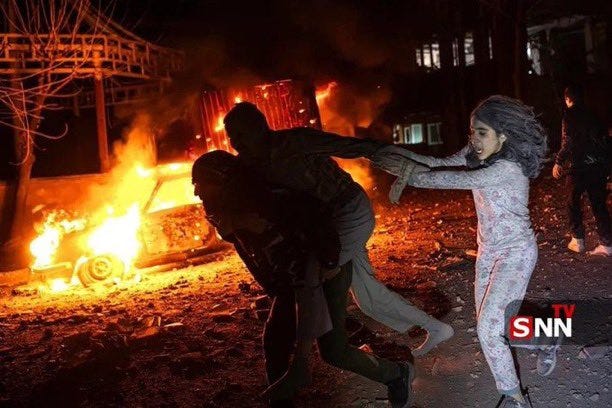
TEHRAN, IRAN—As groups of families and others gathered Sunday evening at cafes around Niloofar Square—a middle-class area in eastern Tehran—after breaking their fast for Ramadan, a series of explosions struck the area, leveling several buildings and killing over 20 people, according to witnesses at the scene and later reports from local news sources.
Witnesses who spoke to Drop Site said two explosions hit the area—a smaller strike in the vicinity, followed by a larger one that devastated much of the neighborhood, a tactic known as a “double tap” strike that is used to inflict maximum casualties.
Videos of the immediate aftermath of the attack showed several individuals dead and wounded as well as massive destruction on the street outside. In Cafe Ahla, next to the square, blood and debris soaked the floors. Several patrons who had been sitting there when the attack struck could be seen dead on the floor or with their mutilated bodies still sprawled across their seats.
“We were sitting here around 8:00-8:30 p.m. and suddenly there was the noise and explosion. We got up and a few people ran away. We turned around to get our belongings and we saw that blood was spraying everywhere. Someone’s hand had fallen on the floor, a head had fallen on the floor,” said Shahin, a witness who had been at the cafe and asked to be identified by first name only. “There were scalps torn off, hands severed, a few people were laying here all cut up and two people were martyred.”
As has been the case with nearly all of the bombings in Iran, it remains unclear whether this attack was carried out by the U.S. or Israel. Israel has used “double tap” strikes in Gaza, Lebanon, and elsewhere.
In one prominent incident, the Israeli military killed 22 Palestinians, including five journalists, in a double tap strike on Nasser Hospital in Khan Younis in August. The U.S. repeatedly engaged in double tap strikes during the so-called “War on Terror” in Pakistan, Afghanistan and Yemen and, most recently, in a September 2025 attack on an alleged Venezuelan drug smuggling boat in the Caribbean.
Survivors of the Sunday attack at Niloofar Square described a similar pattern in which an initial bombing was followed by a much larger attack a short time later.
“One hit and it wasn’t that bad but when the second one hit, suddenly everything exploded. The windows all shattered. Whoever had hookahs were thrown to the floor,” Shahin said. “One of my friends whom I don’t know that well he was sitting here. His hookah was in his hands until the last moment. He was severed in half. Half of him was thrown to the side. I put him back together and placed him where he was. A piece of his brain was thrown here on the floor.”
The bombing at Niloofar Square was one of a number of attacks on densely populated areas of the Iranian capital over the past 24 hours. A separate strike hit Ferdowsi Square—a major historical area in central Tehran—amid a broader campaign striking targets all across the city. Among the sites hit were police stations, government buildings, and offices of the country’s national broadcaster. Numerous videos circulating on social media showed widespread destruction on city streets including collapsed buildings and debris. Another strike reported by local media damaged the Golestan Palace—a UNESCO world heritage site.
At least 555 people have been killed in Iran so far in the U.S.-Israeli military campaign that began on Saturday, according to the Iranian Red Crescent Society. That number is believed to be an undercount given the large scale of the campaign targeting cities in numerous parts of the country.
“The worst thing that can happen in your life is this. You’re sitting here in peace, relaxing for an hour, and something like this destroys your whole life,” said Shahin, who survived the attack on Cafe Ahla. “You tried to hit the police and you killed average people. If this is how you want to kill, then kill us all. Every night we are seeing killings. We can’t sleep at night because we’re worried something will happen to our kids.”
Hospitals and other medical facilities have also been repeatedly targeted in the U.S.-Israeli strikes. On Monday, Fatemeh Mohammad Beigi, a member of parliament’s health commission, said on state media that nine hospitals have been attacked, including five in Tehran and four in other cities. The Gandhi hospital in northern Tehran was completely evacuated, with patients—including babies in incubators—being moved to other facilities after it sustained severe damage from airstrikes. Abuzar Hospital in Ahvaz was also hit and evacuated. Iran’s Red Crescent Society said its Comprehensive Rehabilitation Center in the Seyed Khandan neighborhood of the capital was seriously damaged, with photos showing shattered treatment rooms.
“Attacking a hospital is an attack on life, and attacking a school is an attack on a nation’s future,” Iranian President Masoud Pezeshkian wrote in a social media post. “Targeting patients and children is a blatant violation of all human principles, and the world must condemn it. I stand with the grieving nation; the Islamic Republic of Iran neither remains silent nor submits in the face of such crimes.”
Meanwhile, War Secretary Pete Hegseth dismissed claims of civilian casualties in a press conference on Monday saying, “No stupid rules of engagement, no nation building quagmire, no democracy building exercise, no politically correct wars. We fight to win and we don’t waste time or lives. As the president warned, an effort of this scope will include casualties. War is hell and always will be.”
The Trump administration has given mixed signals about its own motivations for the war and how long it will last—citing sometimes conflict claims about stopping the Iranian nuclear program, ballistic missile development, or even toppling the ruling government. At present there is no clear timeline for how long the fighting will continue, with Trump himself suggesting that the fighting could stretch on for weeks or more.
“All these people have died and they had nothing to do with nuclear bombs, they had nothing to do with missiles,” said Shahin.


No comments:
Post a Comment