Sunday, August 2, 2026

Boy George Misses A Golden Opportunity to Remain Silent


Richard Mellor


I know next to nothing about Boy George except he sang a song titled, Do you Really Want to Hurt Me, or that was a chorus lyric in one of his hits, that’s why, under normal circumstances, I would not bother to comment on him. 


But as he’s penned a song sharing his views about Apartheid Israel’s barbaric assault on the Palestinians in Gaza that has been accepted by numerous human rights organizations as well as G*nocide historians, Jewish and non Jewish alike, as a “G*nocide, I feel compelled to say something.


In the song that is titled, “We Will Dance Again” we have lyrics like:

“You say genocide, I say war/ When you’re attacked, that’s what the army’s for/ Does it get ugly? You bet it does/ When I know you wanna kill every last one of us.”. In addition to justifying Israel’s G*encode by describing it as a war, he also attacks the pro-Palestinian movement describing those opposing a crime against humanity as, like “sheep”.


Celebrities whose world is a parallel universe detached from the experiences of the vast majority of human beings, would do better to keep their mouths shut. And unfortunately many of them who oppose Israel's G*nocide have,  for fear of retribution, this is particularly the case with actors.


It’s hard to imagine that almost three years after the hundreds, perhaps thousands of Palestinians broke out of the confines of what has been described as the largest outdoor concentration camp in the world, under siege since 2007, that anyone can refer to the conflict as a “war”. 


Israel has one of the most powerful militaries in the world, backed and funded by the United States and other western allies. The Palestinian people, constantly under guard, have no navy, no air force, no army.


In response, to the October 7th attack, the Israel has destroyed Gaza completely and it is impossible to know how many thousands of innocent people lie beneath the rubble. Some estimates put the death toll as high as 500,000 including more than 60,000 children, though it is impossible to tell and the Israeli’s are still killing off the witnesses and refuse to allow independent journalists it to Gaza. The Zionists have now moved in to neighboring Lebanon and are razing villages there displacing over one million people.


The non-Jewish population of Israel, in the occupied territories, Israel proper or Gaza, have been attacked for seven decades. Much of the population of Gaza are refugees or children of refugees from villages the Zionist regime destroyed not miles from the camp’s fence and the resident driven in to the strip.


Boy George, whose real name is George Alan O’Dowd, is quite offended at the backlash that his song has generated among the wider public and has responded in a statement given to Britain’s Sun newspaper and published in the Independent.


“The suggestion that I feel no compassion for Palestinians is both untrue and absurd. I am devastated for the loss of the innocent lives on both sides of this war and I call for peace.”, he writes.


He was very disturbed by the attack on the music festival causing him to feel “deep emotions”,  “I could have been there and we know that there were people from more than 40 countries who were,”


Has Boy George wondered for one minute who on earth would attend a rock concert a couple of miles from a concentration camp, and what sort of people and country would allow it. 


George vomits out the Zionist line again and again arguing that the motive behind the resistance that broke out of Gaza and attacked their captors that day were motivated by a hatred of Jews. This has been the narrative from the beginning but Israel’s brutality has undermined it significantly. Even Piers Morgan, who spouted this line in the early days can’t avoid the obvious, Israel is committing a genocide.


The conflict in Palestine is not a religious war any more than the conflict in Northern Ireland, is. The Palestinians are an occupied people in their own land and have every right to resist occupation. Boy George is of Irish ancestry he should understand that better than most. The colonial people that fought the British in Kenya, Malaya, India, Ireland or any of the colonial possessions were not driven by a hatred of the English or British people; they were fighting their oppressors, the colonizers.


I understand that is uncomfortable to defend your friends when a war like this is raging but the woman who sells me bagels is not to blame, neither is my doctor or publicist, manager, ex-boyfriend or my thousands of Jewish friends. This song is for them.”


It’s staggering that three years on and witnessing the prominent role young Jews in particular are playing in the movement against the G*nocide and for Palestinians’ right to self-determination, he can have the opinions he does.


The lyrics in his song, he writes,   “…doesn’t mean that I don’t have compassion for Palestinians, it doesn’t mean that I agree with what's going on in Israel, but I am always going to defend the people that I love,” 


As I re-read his statement I almost feel sorry for him. You love Zionists? 


“I am a Jew loving, trans hugging queer hippy and my mother would be proud of me.”. he writes. 


If he cared for Jews he would oppose Zionism and its g*nocidal policies that are a danger to Jews throughout the world and fodder for anti-Semites.

Saturday, August 1, 2026

Capitalism in Crisis Throws Democracy Out the Window


By Mike Craig

Northern Ireland

I really wish the general public would pay attention to this.


We do not live in a democracy. Within the capitalist system democracy is always limited, but because global capitalism is teetering on the brink of collapse, those who own and control it will go to even greater lengths to try and save it at the expense of democracy and international law. 


Part of this battle is the attempt to take over the Middle East and remove all threats to Western hegemony. Israel is a key part of this project, and contrary to the idea that Israel controls western governments, the reality is actually the other way around. 


The USA, the UK and the EU need Israel as the attack dog against the perceived enemy - any country which doesn't lie down and accept western control, or any country which would threaten the primacy of the petrodollar in global trade. The West's attack dog is a settler colony which suffers from a serious case of siege mentality, the longer the colony continues to exist the more deeply imbedded this mentality becomes. 


The g*nocidal tendencies of this have reached a point where even the supporting western governments have become embarrassed by it, nevertheless they still continue to arm the g*nocide and cover for it.


Over the last few years we have seen George Orwell's predictions becoming a reality, nowhere more so than in the Middle East, where truth has been turned on its head. 


Israel is in breach of several international laws and countries who support it, like the UK, are also in breach of international laws for continuing to support its actions rather than carry out their duty which is to hold it to account.


In the UK too, truth has been completely turned on its head. The Government is a collective criminal, it's lapdog media and its leading judiciary are guilty too, yet they compound this by criminalising any protest against their delinquency.


This isn't just about Palestine Action, it is an assault on democracy and the real rule of law. 


Our Governments and their institutions are arch criminals who hold no value for human life. 


We are now entering the period of barbarism which we were warned about by Rosa Luxembourg. 

"The Anti-Zionist Left Must Lead the Fight Against Anti-Semitism"


By John Clarke

Toronto


Gail Asper, a noted ‘philanthropist,’ is ‘pausing funding’ to the Canadian human rights museum in an effort to undermine its Palestinian Nakba exhibit. This needs to be denounced and I've already done so but I’ve seen horrible responses from leftists on social media that go over to KKK like notions of ‘Jew money.’ This leads me to once again, address the issue of antisemitism. 


I want to focus on the role that antisemitism plays on both the political right and the left and to argue that ignoring it is entirely wrong. I define antisemitism as animosity towards Jewish people because they are Jewish and not as hostility to the political ideology of Zionism. 


The racism that developed out of European colonialism held that the colonized were on the low rungs of a hierarchy in the value of human life. When it came to Jews, however, the focus was on malevolence rather than supposedly stunted development. Notions of biologically determined treacherous qualities drew on religiously based myths about the Jewish ‘Christ killer.’


Fascist movements used antisemitism because it offered them a conspiring, unduly influential and dangerously powerful ‘enemy within.’ The Great Replacement theory that alleges that Jews are working to flood ‘white nations’ with Black and Brown immigrants is a striking manifestation of this.


Virulent antisemitism is by no means incompatible with support for Zionism. This was true of Arthur Balfour and Donald Trump still personifies it. That’s why vicious white supremacists disingenuously accuse the left of Jew hated, while Zionist organizations ignore displays of antisemitism that come from politicians who arm Israel to the teeth.


The MAGA movement is experiencing a rift on this issue, with racist isolationists and antisemites like Tucker Carlson arguing that US support for Israel should be curtailed. On the other side, the defenders of an imperialist role for the US value Israel as a garrison state that upholds Western interests, while getting rid of as many Jews as possible. This disagreement is playing out inside a racist movement within which antisemitism occupies an important place.


Leftists are hostile to exploitative and powerful elites and the depiction of Jews as such a formation is at the heart of right-wing racist constructions. Sadly, particularly at a time when the left is significantly weaker and less clear-minded than it has been, such illusions can resonate within it.


A powerful Zionist lobby, presented as the spokesperson for a supposedly monolithic ‘Jewish community,’ enables Israel’s crimes and exerts very serious influence in the West. Those who don’t properly understand the connection between imperialist interests and the support that is given to Israel can very easily fall prey to conspiratorial disorientation.


This leads to distorted ideas, particularly with regard to the question of Palestine. The most obvious of these is the conclusion that the tail wags the dog. Left social media spaces are full of assertions that Western governments are the dupes of a mysteriously influential Israel. 


The Zionist project has always been at the heart of an agenda of US led regional domination. Certainly, a settler colonial project is underway that is based on a supremacist ideology and some level of divergence between Western interests and Zionist aspirations occurs but Israel is utterly reliant on its sponsors and the tail doesn’t wag the dog.


Once the manipulative power of Israel’s leaders and supporters is seen as the driving force behind Western support, the next step is to focus on collective Jewish guilt. A section of the left has become almost obsessive on this question. Opinion polls are scoured for evidence of Jewish complicity. The fact that leading Jewish institutions, just like all the major institutions of the Canadian establishment, back Israel to the hilt is presented as the most damning evidence. 


Those who adopt such views are certain to reject any suggestion that we should challenge antisemitism. Yet there it is an historically rooted prejudice and there are virulently antisemitic and fascistic currents at work in this society. Threats and violence against Jewish people do happen. The notion that responding to them undermines Palestine solidarity is utterly incorrect in my view.


I fully understand that, unlike the period before WW2, Jews in Canada today don’t face the kind of discrimination or disadvantage that Black or Indigenous people experience. The threat of violence that hangs over Muslims is much greater than that which confronts Jews. I also realize that a realistic assessment of the scale of antisemitism is hampered by the use of the false conflation of anti-Zionism with anti-Jewish prejudice. 


Despite these considerations, I reject the notion that challenging real manifestations of antisemitism ‘gives comfort to the enemy.’ Actually, one of the great vulnerabilities of the Zionists is their dogged refusal to deal with real antisemitism. They pretended that Elon Musk’s infamous Nazi salute was an ‘awkward gesture’ and the Centre for Israel and Jewish Affairs (CIJA) peddled incredibly softly as the fascist led ‘Freedom Convoy’ displayed swastikas. 


This disgusting selectivity can be more effectively challenged by opposing real antisemitism than by maintaining that it doesn’t exist or that, if it does, ‘The Jews’ have brought it on themselves. Let’s shake off notions of the malevolent Jewish soul and take up a serious, principled and far more effective opposition to all forms of bigotry and hatred, including antisemitism. 

Friday, July 31, 2026

Theories of inflation: part one – the mainstream

Theories of inflation: part one – the mainstream

by Michael Roberts

Guglielmo Carchedi and I have been working on a theory of inflation for several years.  We completed a detailed paper some time ago which was accepted for publication by a Marxist journal.  However, publication takes forever, so I thought I would provide a shortened version of our work on my blog.

For the blog, I have divided the paper into various parts: 1) mainstream theories of inflation; 2) heterodox and other Marxist theories; 3) our theory, called a ‘value theory of inflation’; and finally 4) a discussion of the application of our theory to the recent spike in inflation since the paper was completed.

Let me start with part one: mainstream theories.  

What causes inflation has been a puzzle for mainstream economics. As Walter Munchau in the Financial Times put it in 2020: “central bankers do not really understand how inflation works. There are lots of theories and approaches, theoretical and statistical, but none that has been able to explain persistently what is going on in the real world.” Charles Goodhart of the London School of Economics was harsher in 2021: “The world at the moment is in a really a rather extraordinary state because we have no general theory of inflation.”  Why is this? It’s because conventional or mainstream theories of inflation have failed to provide any robust explanation of why there are changes in the prices of goods and services in modern economies. 

The mainstream view of inflation can be divided into three groups: 1) the monetarist theory; 2) the Keynesian ‘excess demand’/cost-push theories; and 3) central bank expectations theory.

The monetarist theory of inflation holds that inflation is purely a monetary phenomenon, i.e. that inflation is determined by changing money quantities relative to the changes in the quantity of output. Leading monetarist Milton Friedman argued that “inflation is always and everywhere a monetary phenomenon in the sense that it is and can be produced only by a more rapid increase in the quantity of money than in output.

The monetarist perspective is based on a mathematical identity 𝑀𝑉 = 𝑃𝑌, where 𝑀 represents the money supply, 𝑉 is the velocity of money (which measures how frequently money is transacted within the economy), 𝑃 is the general price level, and 𝑌 is the real output of the economy. MV adds up to money in circulation and PY adds up to the nominal amount of income in an economy. Monetarism argues that the left hand side of the equation drives the right-hand side. So, assuming that the velocity of money (V) remains constant, then if M rises faster than Y, there will be an inflation of prices. Thus, changes in M drive changes in P. 

But this equation is an identity; the causal direction cannot be assumed. Marx’s position was the opposite of the monetarist direction. For Marx, money is not value, but the representation of value. So it is changes in the value/price of commodities that determines the volume of money in circulation. “If the velocity of circulation is given, then the quantity of the means of circulation is simply determined by the prices of commodities. Prices are thus high or low, not because more or less money is in circulation, but there is more or less money in circulation because prices are high or low.” 

Changes in P (prices of production) determine changes in MV (money in circulation).And prices change as a result of value changes (Y), as measured in the amount of labour time used to produce all the commodities. If the value of commodities rises/falls (ie more or less labour is necessary for their production), more/less money is needed for their circulation. This is because money is the representation of value, not value itself, which comes from the expenditure of human labour, not from money.

Who is right, Friedman or Marx?  Do changes in MV lead to changes in PY, or vice versa? Is there a close correlation between changes in money supply (M) and changes in prices (P)? Figure 1 shows annual percentage changes in US money supply (M2) and inflation as measured by the ‘implicit’ GDP price deflator). The correlation between the two seems relatively close up to the 1990s.  But from then on, US money supply growth accelerated as a trend while the price deflator decelerated. There was even a negative correlation. Over the whole period from 1960, the correlation between money supply and prices was low (0.21).

Figure 1. Source: FRED, authors’ calculations

A key factor in the weak correlation between changes in money supply and changes in prices is that money supply and money in circulation are not the same. Money hoarding and use of money to make purchases of financial assets can make a considerable difference to the relationship between money supply and prices. Indeed, as Figure 1 shows, the rising gap between money supply growth and GDP deflator from the mid-1990s onwards suggests a diversion of money out of productive assets into financial assets. 

Thus Friedman’s monetarist theory does not hold to explain US inflation in the post-war period.  In a later post, I shall show how it is changes in prices of production (or the value of commodities) that drives ‘money in circulation’ – the opposite of monetarism.

The second mainstream theory is Keynesian. This is dominant among mainstream explanations. A classic example of the ‘cost-push version of this theory was recently offered by Jason Fulman, former US White House economic advisor: “When wages go up that leads prices to go up. If airline fuel or food ingredients go up in price, then airlines or restaurants raise their prices. Similarly, if wages for flight attendants or servers go up then they also raise prices. This follows from basic micro and common sense.” (Fulman, 2022). The causes of inflation, apparently, are rising raw material costs and attempts by workers to get higher wages. This forces companies to raise prices to maintain profits.  This is the cost-push inflation theory.

Marx answered this theory way back in 1865. When debating with the trade unionist Weston who argued that wage rises would cause inflation, Marx argued that rising wages are the “reaction of labour against the previous action of capital” and that “wage rises generally happen in the track of previous price rises.” (Marx, 1865).  Moreover, it escapes Fulman that the effects on prices of wage increases or of materials could be countered by less profits. Given a certain quantity of value, if wages rise/fall, profits fall/rise, prices can remain unchanged.  Fulman’s argument assumes that profitability must be maintained ‘at all costs’.

An IMF study in 2022 addressed this question by applying a cross-economy database of past episodes among advanced economies going back to the 1960s. It found that “wage-price spirals, at least defined as a sustained acceleration of prices and wages, are hard to find in the recent historical record. Of the 79 episodes identified with accelerating prices and wages going back to the 1960s, only a minority of them saw further acceleration after eight quarters. Moreover, sustained wage-price acceleration is even harder to find when looking at episodes similar to today, where real wages have significantly fallen. In those cases, nominal wages tended to catch-up to inflation to partially recover real wage losses, and growth rates tended to stabilize at a higher level than before the initial acceleration happened. Wage growth rates were eventually consistent with inflation and labor market tightness observed. This mechanism did not appear to lead to persistent acceleration dynamics that can be characterized as a wage-price spiral.” In inflationary episodes, wages just try to catch up with prices. But even then, wage increases do not cause ‘wage-price spirals’ – this echoes Marx’s view in 1865.

A variation of the Keynesian view is the ‘demand-pull’ theory of inflation, namely that inflationary pressure results from a positive ‘output gap’ – where actual GDP exceeds ‘potential GDP’, defined as output at the limits of productive capacity including full employment. So inflation results from ‘excessive demand’ in an economy (ie above the supply capacity limit). This ‘excessive demand’ could be due to an expansionary government fiscal policy or due to fast rising wages given full employment, compounded by a fall in ‘potential GDP’, possibly from supply chain constraints and energy shocks. 

What is the evidence for this ‘excessive demand’ theory? Keynesians refer to the ‘trade-off’ between changes in wages and prices and/or changes in unemployment and prices.The former would have a positive correlation and the latter an inverse correlation. In graphic form, this trade-off would take the form of curve, as was first argued by AW Phillips with his so-called Phillips curve in 1958. The evidence for the post-war US economy is that, far from being a curve (ie a trade-off), the Phillips relation is broadly flat.  Here is our own calculation for the US.

Figure 2. Source: FRED, author’s calculations

Other empirical studies also show the Phillips curve to be broadly flat – in other words, there is no inverse correlation between wages or prices and unemployment. President Daly of the Federal Reserve Board of San Francisco, concluded that “the relationship between unemployment and inflation has become very difficult to spot.”. BIS economist Borio agrees: “the response of inflation to a measure of labour market slack has tended to decline and become statistically indistinguishable from zero.” And more recently, he concluded that “inflation has proved unexpectedly unresponsive to economic slack – the Phillips curve is very flat.” (Borio 2021). The former Fed Chairman Jay Powell also acknowledged the problem: “There was a time where there was a tight connection between unemployment and inflation. That time is long gone.” (Powell 2021). This uncomfortable conclusion was also reached earlier by two prominent mainstream economists. Solow (2018) remarked that “the slope of the Phillips curve itself has been getting flatter, ever since the 1980s, and is now quite small.” And Gordon (2018) echoed this: “The slope of the short-run inflation—unemployment relationship has flattened.”

So why do economists and central bankers continue to peddle a theory that has little empirical support? Gavyn Davies, a Keynesian and former chief economist at Goldman Sachs, explained: “without the Phillips Curve, the whole complicated paraphernalia that underpins central bank policy suddenly looks very shaky. For this reason, the Phillips Curve will not be abandoned lightly by policy makers” (Davies 2017). ). But the theory is not made less shaky by denying the empirical evidence against the theory.

The third mainstream theory of inflation is even weaker. It is promoted by central banks and international agencies. It is the expectations theory of inflation. Here inflation is caused by the psychology of the economic agents. If prices rise, then consumers expectations for price rises also increase, leading to accelerating inflation. As the IMF puts it: “It is possible that changes in current and expected inflation are both driven by changes in expectations about the future state of the economy. For example, if firms and households expect that the economy will be in a recession in the near future and inflation will be lower than today, they will start cutting their consumption and investment expenditures now, putting downward pressure on inflation today.”

But the consumer or household expectations of a rise in inflation does not provide a theory for why prices are rising in the first place. Federal Reserve economist Rudd points out that “unsurprisingly, what little evidence we have suggests that firms pay little attention to forecasts of aggregate economic conditions, including inflation.”  Yes, if inflation over the long term falls, then ‘unsurprisingly’, households and firms will expect inflation to fall. So “there is a suggestive low-frequency correlation between an estimate of inflation’s long-run stochastic trend and survey measures of long-run expected inflation.” In the graph below, as inflation slows, so expectations or forecasts of slowing inflation also follow. But expectations follow inflation rates, not vice versa.

Rudd concludes: “economists and economic policymakers believe that households’ and firms’ expectations of future inflation are a key determinant of actual inflation. A review of the relevant theoretical and empirical literature suggests that this belief rests on extremely shaky foundations, and a case can be made that adhering to it uncritically could easily lead to serious policy errors.” Central banks should note.

So we have three mainstream theories of inflation: monetarism; Keynesian cost-push and ‘excess demand’; and expectations, none of which is convincing or borne out by the empirical evidence.  No wonder the mainstream has ‘no general theory of inflation’.

In the next part, I shall discuss heterodox and other Marxist theories of the cause of inflation. 

Thursday, July 30, 2026

Israeli society rotting from the inside

By John Pickard

There is nothing happening to Israelis that can in any way compare to the brutal and genocidal assault on the people of Gaza, where at least 75,000 were killed, overwhelmingly non-combatants, and tens of thousands of them children. The tiny sliver of land, onto which a quarter of a million Palestinians have been herded,  is little more than a camp, where men, women and children have no economy, education, little health care and no future. They exist entirely on humanitarian aid.

Likewise, none of the uncertainties or fears that might be harboured by the population of Israel can compare to the ongoing and continuous pogroms and ethnic cleansing of Palestinians in the West Bank. On a daily basis, the smaller towns, villages and farms, are attacked as Palestinian land and farms are seized, homes torched and livestock stolen by Jewish settlers. Not a single settler has been convicted or even charged for the dozens of murders of Palestinians in the West Bank.

Socialists in Europe and elsewhere look on in horror at these developments and the disgraceful lack of action, and even the absence of criticism, from most Western politicians. It beggars belief that so-called ‘Labour’ leaders have for years tolerated and empowered the Israeli government, on the grounds that this state is an ‘ally’ of Britain. The Labour Friends of Netanyahu are a powerful lobby in the Labour Party, even now, in Andy Burnham’s new cabinet.

But as we have explained in previous Left Horizons articles, Israel’s hostility, aggression and barbarity – which sum up its policy towards its near neighbours – will inevitably have repercussions internationally and internally.

The Israeli Defence Force, described by its supporters as ‘the most moral army in the world’, beats up women and arrests children in the West Bank. In Gaza, the West Bank and now in Lebanon, it uses the dynamiting of homes and ethnic clearnsing as prime military tactics. All of this has resulted in international support for Israel withering away. But what is also happening is that it is rotting Israeli society itself from the inside.

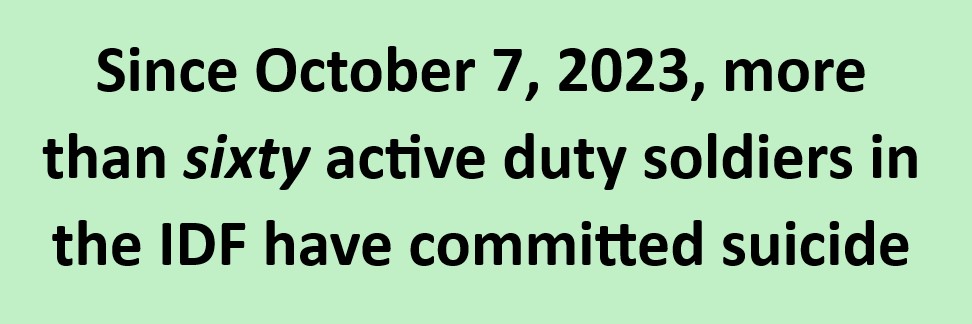
Two more Israeli soldiers commit suicide this week

An article this week in the liberal Israeli newspaper Haartez, reports on two more Israeli soldiers committing suicide, bringing the total of active duty soldiers committing suicide to 16 this year. “The figures,” the Haaretz article says, “point to a further rise in the number of suicides within Israel’s defense establishment, continuing a trend that began after the outbreak of the war on October 7”.

There is no parallel in any military establishment anywhere in the world with the psychological mayhem in the IDF. “In the decade before the October 7 war,” Haaretz explains, “the average number of military suicides was 12 per year. Since then, the number of suicides has risen. According to military data, from October 7, 2023, through the end of that year, seven active-duty soldiers died by suicide; in 2024, 21 soldiers died by suicide; and last year, the number stood at 22 – the highest figure in 15 years”.

An earlier article in Haaretz, dealing with suicides also noted the process of psychological decay in Israel. It referred to reservists being traumatised by three years of non-stop war, witnessing events that have driven many to the point of suicide. In recent weeks, it said, Haaretz conducted discussions with mental health officials who paint an “alarming picture”.

The numbers [of suicideal reservists],” explains Eyal Fruchter, chairman of the Israeli National Council for Post-Trauma, “leave no shadow of doubtIsrael faces a national crisis”. Haaretz then refers to figures from the Israeli defence establishment: “Before the war, the rehabilitation branch dealt with 62,000 injured, of whom 11,000 were dealing with mental health issues. As of last month, the numbers had shot up to 82,000 and 31,000 respectively.”

The problem of PTSD is not something that disappears when the war or the tour of duty is over. “The damage that we’re seeing today constitutes just a small part, even the tip of the iceberg, of what will be coming,” one expert, a world-leading researcher in the field of trauma, told Haaretz. “The research shows significant rates of delayed reactions. It’s precisely periods of quiet that allow traumatic content to erupt. Many discharged soldiers are ticking time bombs.”

Generalised social malaise in Israel

This is not just an issue that is affecting reservists who have seen active service. It reflects a generalised, social malaise, brought on in part by Iranian (and to a lesser extent, Hezbollah) missile and drone attacks. A significant part of the whole population is suffering PTSD, according to the experts.  “Israeli society is exhausted, feeling a sharply intense burnout. It’s grappling with moral questions, with a sense of betrayal by the state and its leaders.”

The generalised impact of forever wars, which is Netanyahu’s primary policy, has meant a recorded rise not only in suicides but also in domestic violence. Referring to a widespread rise in poor patterns of sleep, one of Israel’s leading psychiatrists commented, “This is not surprising; we live in a state of uncertainty. The phone might ring again in an hour, and missiles from Iran could be launched. We’re in survival mode – and this has consequences.”

Since October 7, the report notes, psychiatric hospitals have seen a 30 or 40% increase in self-referrals. The number of those being treated in so-called “resilience centers”, which provide support to Israelis in mental crisis situations has risen from 5,000 in 2022, to 36,000 in 2025.

As Israeli society rots from the inside, its international support has withered. US Vice-president JD Vance made an astonishing dig at the Israeli leadership this month, when he commented on the reluctance of Netanyahu to go along with the first ceasefire agreement with Iran. The USA, at least to an extent, is trying to force Israel into an agreement with Hezbollah and into accepting that its long-term aim of destroying the Iranian regime is not possible. Vance’s speech was a part of that process, as he reminded the Israelis who was ‘boss’.

Donald J Trump”, he said, according to CNN, “is the only head of state in the entire world who is sympathetic to the nation of Israel at this moment in time.” That is not strictly correct, given the craven support given to Israel by the like of Starmer and other European leaders. But nonetheless, Vance was letting the cat out of the bag.

“We are your only friends” – JD Vance

If I was in the cabinet of the Israeli government,” Vance continued, “I might not be attacking the only powerful ally that I have anywhere left in the entire world.” Here, Vance is acknowledging that world opinion has swung massively against Israel since its onslaught on Gaza was started, then to be followed up by ethnic cleansing in the West Bank.

On a global scale, the thousands of demonstrations against the genocide in Gaza, involving tens of millions of protesters, often week after week, we have seen the biggest political protest movement on a single issue in the whole of history. It has had a profound effect on Western politics, although not yet on the majority of the political leaderships and governments.

Even in the United States, where the American-Israeli Political Action Committee (AIPAC) once bought Democratic and Republican politicians with its extremely deep pockets, public opinion has swayed massively against Israel.

According to the magazine +927 (January 2026), over Israeli 150,000 citizens have left the country in the past two years, many of them with one-way tickets and no plans to return. It is taking a long time – far longer than most on the left would want – but the policy of the Israeli right wing is going to be demonstrable proven, even to Israelis themselves, to be unsustainable.

Military hegemony over the whole region, with a constant round of wars, occupations and aggression is not a route to a ‘safe and secure’ homeland for Jewish people. It is a road to psychological, political and social decay. 

With Karim Khan's dismissal, the elimination of the war crimes court is near-complete

With Karim Khan's dismissal, the elimination of the war crimes court is near-complete

Millions of people around the world will now find themselves even more exposed to the criminal actions of predatory states. Unlike Khan's accuser, they are unlikely to ever get their day in court.


Johnathan Cook July 30 2026.


The most important question we should be asking after Karim Khan’s dismissal last week as chief prosecutor of the ICC – the international war crimes court in The Hague – is not whether he is guilty of “sexual misconduct” against another staff member, identified as “Sarah”.

That can only be decided through a legal process – one, let us note, that has already taken place. A fact-finding body carried out a lengthy investigation of Sarah’s allegations over more than a year; its thousands of pages of evidence were then evaluated in detail by three senior judges.

Though you would not know it from the media coverage, they concluded that there was no evidence to suggest any kind of misconduct by Khan, sexual or otherwise.

Strangely, that determination was largely confirmed by an extraordinarily deferential “exclusive” CNN interview with Sarah, aired earlier this month.

She declined to give any meaningful details of what Khan had allegedly subjected her to, and celebrity interviewer Christiane Amanpour delicately avoided pressing her for any clarification.

No matter. The purpose of the CNN interview was never about excavating facts. It was designed to offer face-saving cover as an entirely political body called the Assembly of States Parties, comprising diplomatic representatives of the 125 states signed up to the ICC, entirely ignored the legal findings and dismissed Khan.

Paradoxically, it was the Assembly of States Parties that appointed the judges who had concluded that there was no evidence of misconduct or breach of duty by Khan. That inconvenient judgment was simply reversed, despite the Assembly members being in no position to weigh the evidence themselves. 

We should not forget that many of these states have an investment in weakening the only international court that can bring their own senior officials to trial for war crimes. 

In May 2024 – shortly before Sarah made her allegations – the ICC demonstrated that it was finally ready to prosecute western leaders for war crimes, not just those from the Global South or from the West’s official enemies, such as Russia’s Vladimir Putin.

Khan finally issued an arrest warrant for Israeli prime minister Benjamin Netanyahu and his former defence minister Yoav Gallant. Both are accused of crimes against humanity for starving the people of Gaza through a prolonged blockade of food, water and power.

Were Netanyahu ever to face trial – and found guilty, as he almost certainly would be – a lot of other leaders would have good reason to fear they might be found culpable next, not least for their complicity in Israel’s mass slaughter of Palestinians in Gaza. 

The question that needs answering now is not whether Khan is guilty of misconduct – that has been decided at a political level, not a legal one. No, we need an answer to an equally political, and far more troubling, question.

“Cui bono?” Or “Who benefits?”

The evidence is hiding in plain sight. The evidence is revealed both in the deeply politicised process that led to Khan’s downfall, and in what that process means for the future of the court.

Covert war

Khan is not the first ICC chief prosecutor to face extreme pressures – and, as with Khan, those pressures surfaced at the very moment Khan’s predecessor tried to take on Israel over its war crimes.

Fatou Bensouda faced a “covert war” waged against her by Israel for the best part of a decade, according to an investigation by the Guardian in May 2024, just as Khan issued his arrest warrant for Netanyahu.

The Guardian’s report, published nearly three years after Bensouda had completed her nine-year term at the ICC, revealed that, during that time, she had faced threats to herself and her family, the monitoring of her communications, and an intimidating visit to her home. 

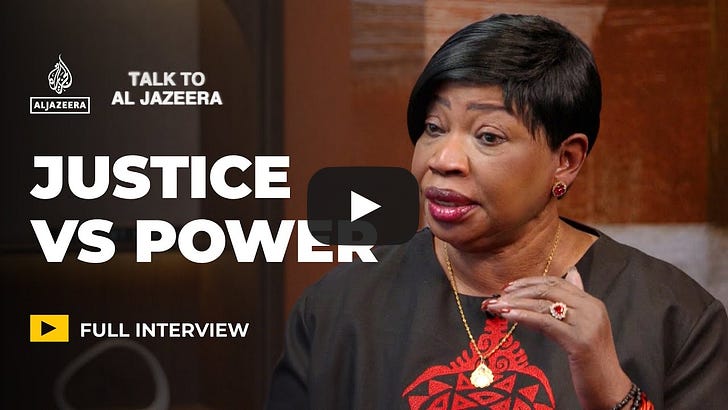
More recently, Bensouda has confirmed these accounts in an interview with Al Jazeera. Bensouda notes that she repeatedly reported Israel’s campaign of intimidation to the Dutch authorities, but they did nothing to investigate the threats or protect her. 

She also says certain “authorities” – she does not name them – warned her that she was going too far in investigating Israeli crimes and that “you could be harmed or you could be killed, or family members could be harmed in some way.”
The campaign of threats – instigated by Yossi Cohen, then the director of Israel’s spy agency, Mossad – intensified as Bensouda considered whether to open a formal investigation into Israeli war crimes and crimes against humanity in the illegally occupied Palestinian territories.

Israel’s crimes against the Palestinian people, we should remember, predate – by decades – Hamas’ attack on 7 October 2023. In fact, though no one is supposed to mention it, Israel’s sustained crimes of occupation are the self-evident cause of that Hamas attack.

An Israeli source told the Guardian that “the Mossad’s objective was to compromise the prosecutor or enlist her as someone who would cooperate with Israel’s demands”– that is, scrap the ICC’s investigation into Israeli crimes. Another source admitted that Cohen was acting on Netanyahu’s instructions.

During one contact, Cohen reportedly issued a Mafia-style threat to Bensouda: “You don’t want to be getting into things that could compromise your security or that of your family.”

The Guardian reported that the Mossad “took a keen interest in Bensouda’s family members and obtained transcripts of secret recordings of her husband, according to two sources with direct knowledge of the situation. Israeli officials then attempted to use the material to discredit the prosecutor”.

The paper also noted that there were fears among senior ICC officials that “Israel had cultivated sources within the court’s prosecution division” – the division Khan would inherit from Bensouda.

Cohen was described as “stalking” Bensouda, and personally “ambushed” her in a hotel room in New York in 2018. Afterwards he repeatedly phoned her, in a threatening manner that was said to have escalated over time. When Bensouda asked Cohen how he had obtained her phone number, he reportedly replied: “Did you forget what I do for a living?”

According to the Guardian: 

On one occasion, Cohen is said to have shown Bensouda copies of photographs of her husband, which were taken covertly when the couple were visiting London. On another, according to sources, Cohen suggested to the prosecutor that a decision to open a full investigation would be detrimental to her career.

Between 2019 and 2020, the Mossad had been actively seeking compromising information on the prosecutor and took an interest in her family members.

The spy agency obtained a cache of material, including transcripts of an apparent sting operation against her husband.

Israel used the materials to mount a “smear campaign” against her, but one that ultimately proved unsuccessful.

Concerted backlash

When Khan took up the role of ICC chief prosecutor in June 2021, he proved reluctant to pick up where Bensouda had left off on the Palestine case. Presumably, he was only too aware of the retaliation from Israel against her.

Bensouda had announced in December 2019 that she had grounds to open a full criminal investigation into allegations of war crimes in Gaza, the West Bank and East Jerusalem.

However, in the face of a concerted backlash from western states, she delayed opening the investigation. She first sought a ruling from a pre-trial chamber of ICC judges – presumably in the hope that it would serve as some kind of insurance policy – on whether the court had jurisdiction over the occupied Palestinian territories.

By February 2021 the judges confirmed what was already self-evident. The court did have such jurisdiction because Palestine had been signed up to the court since 2015.

Bensouda stepped down a few months later.

The door was now open for Khan to prosecute Israeli officials for war crimes. However, the new chief prosecutor gave every appearance – perhaps understandably – of preferring to sit on his hands.

It was not just Israel that had been fearsomely opposed to its officials being tried for war crimes. Washington was equally incensed at the prospect – sometimes, it seemed, more so than over the possibility that US officials might also face arrest warrants for crimes committed by the US military in Afghanistan and Iraq.

Between 2019 and 2020, during Trump’s first presidency, the US imposed severe visa restrictions and financial sanctions on Bensouda. Mike Pompeo, then US secretary of state, linked the sanctions to the Palestine case: “It’s clear the ICC is only putting Israel in [its] crosshairs for nakedly political purposes.” 

Khan might well have avoided pursuing Israel indefinitely had it not been for the events that followed October 7 2023.

Israel’s mass slaughter of Palestinian civilians in Gaza, its devastation of the enclave’s homes and infrastructure, and its starvation of the entire population were actions so criminally abhorrent that UN agencies, major human rights groups and Holocaust scholars were soon all in agreement that they amounted to genocide.

In May 2024, Khan announced arrest warrants against Netanyahu and Gallant, as well as three Hamas leaders subsequently killed by Israel.

Tsunami of threats

Shortly before Khan made that announcement, 12 senior US Senators had sent a threatening letter to the ICC: “Target Israel and we will target you.” The letter ended: “You have been warned.” 

Describing Israeli and US sovereignty as inseparable, the senators reminded Khan that Washington had demonstrated “the lengths to which we will go to protect [our] sovereignty.”

A 2002 law, popularly known as “The Hague Invasion Act”, authorises the US president “to use all means necessary and appropriate” to bring about the release US persons and any allies imprisoned or detained by the ICC. Those allies, it goes without saying, include Israeli leaders. 

Such threats, it should be noted, are a violation of Article 70 of the Rome Statute.

Following the issuing of the arrest warrants, there followed a tsunami of similar threats – and presumably more that have yet to become public – against Khan and the ICC.

A British-Israeli lawyer within the ICC – one known to have ties to Netanyahu’s legal adviser – warned Khan "they will destroy you and they will destroy the court" if the warrants were not rescinded. He urged Khan to “climb down the tree" and drop the case.

The UK’s foreign secretary of the time, David Cameron, phoned Khan to tell him Britain would defund the court and withdraw from the Rome Statute that founded the ICC if Khan did not back down.

Cameron warned Khan that he was “on the brink of making a huge mistake” and urged him to “take a step back and consider things”. He added that applying for arrest warrants for Israeli officials was tantamount to “dropping a hydrogen bomb”.

Meanwhile, Trump issued an executive order imposing aggressive financial sanctions against Khan and other ICC officials, including several of its judges.

Khan himself received warnings that Israel’s Mossad was continuing its operations in The Hague, where the ICC is located, to monitor and compromise the court’s investigators as they compiled evidence on Israel – just as it had done earlier under Bensouda. 

Khan publicly stated that retaliatory threats and intimidation were explicitly targeting members of his own family.

Untouchable criminals

What conclusions should we draw from all of this?

Quite aside from the matter of whether Sarah’s allegations of “sexual misconduct” are true or not, it is clear that Israel and the US have been digging for dirt – and apparently ready to fabricate such dirt – on any chief prosecutor who tries to hold them to account for their crimes.

Both have indicated that they are ready to manipulate legal and political processes to ensure the outcome they desire: that they remain untouchable .

We have a template for how this plays out. Julian Assange, founder of the whistle-blowing site Wikileaks, published details in 2010 of US and British war crimes in Afghanistan and Iraq. Almost immediately he found himself entangled in accusations of sexual misdemeanours – in his case in Sweden – that were similarly amplified by an uncritical western media. 

Assange faced years in various forms of confinement while the US and UK pressured Sweden to keep alive an investigation against him Swedish prosecutors at least twice sought to drop for lack of credible evidence. 

In fact, the US and UK never wanted the evidence tested – they were quite happy with a permanent, unresolved “investigation” – precisely because they knew it would have been unlikely to withstand judicial scrutiny. 

The point was simply to generate constant headlines about “rape”, turning Assange into a pariah, justifying his effective disappearance from public life, severely weakening Wikileaks as a whistleblowing platform, deflecting attention from the all-too-real crimes committed by the US and Britain, and paving the way to a political show trial to extradite him to the US on entirely confected “espionage” charges. 

This has been repeated in the case of Khan and the ICC. In Khan’s case, the evidence was tested and found inadequate. So the legal process has been replaced by a flagrantly political one. 

Khan has been turned into a legal pariah, even stripped of his right to work as a lawyer in the UK by the British Bar Association. 

The ICC has been further weakened, just as Israel and the US have expressly stated they wanted it to be. Marco Rubio, Trump’s secretary of state, has recently launched an official campaign to dismantle the ICC “brick by brick”. 

He says: “Now they [the ICC] are going to see the consequences”. Consequences of what? Of seeking to enforce international law against a key US client state. 

Meanwhile, accountability for the all-too-real crimes being committed by Israel in Gaza, Lebanon and the West Bank – and actively supported by western states like the US, Germany and Britain – recedes yet further into the background. 

As each brick protecting the ICC is dismantled, a brick is added to the wall of protection around Netanyahu and Israel’s genocidal war machine. 

Israel, meanwhile, is barely concealing that it has been masterminding the effort to destroy the ICC. 

According to Guy Azriel, the diplomatic correspondent for i24 News, Israeli foreign Minister Gideon Sa’ar “oversaw a dedicated task force and employed intensive diplomatic efforts aimed at securing Khan’s removal from office”.

Hillel Neuer, director of the Israel apologist group United Nations Watch, cheered what he called “our campaign to remove” Khan, and warned Francesca Albanese, the UN’s legal expert on the occupied Palestinian territories, “you’re next”. 

Like Khan, Albanese has been searching for practical, legal ways – not just rhetoric – to hold Israel and its western allies to account for the crimes in Gaza. 

Predatory states

The ICC claims its work will not be affected by Khan’s removal and that the arrest warrants against Netanyahu and Gallant will still be pursued under new stewardship. That seems doubtful. 

Israel and the US are cranking up the intimidation of the ICC, which has no tools to enforce its rulings or protect itself from the hostility of a rogue superpower.

Currently the court appears paralysed, allowing Israel to muddy the waters with interminable, and vexatious, appeals against the arrest warrants. 

Any lawyer who takes up the post of ICC chief prosecutor will be only too aware of the fate that befell Khan and the campaign of intimidation against Bensouda as soon as each tried to enforce accountability on Israel and its western patrons. 

It will take a very brave individual indeed to renew that task. Khan’s successor will understand that, in any further confrontation with Israel and Washington, the US will not hesitate to crush the ICC and, with it, remove the only effective restraint on criminality by powerful states. 

More likely, however, the Assembly of States Parties – the political body that ousted Khan – will privately require from his successor reassurances that the new chief prosecutor reliably defer to the principle of Israeli and western impunity. Only someone less willing to ruffle feathers stands any chance of being appointed. 

That was the clearest of messages sent by the Assembly when a majority of member states voted to be rid of Khan. The short-lived experiment in creating a mechanism for enforcing international law is over. We are back to the law of the jungle. 

Hundred of thousands of people around the world – more likely millions – will now find themselves even more exposed to the criminal actions of predatory states. Unlike Khan’s accuser, they are unlikely to ever get their day in court