Jensen Huang Spy Story Is a Hoax
How Marco Rubio cooked the books
Ken Klippenstein Nov 24 2026
 |
Another viral story based on bad intelligence. If you want journalism that’s written for you rather than clicks or awards, please become a paid subscriber (or chip in to my GoFundMe here.)
 Subscribed
U.S. intelligence never concluded that Alice Huang was a spy, sources tell me.
So how did the media get so spun up over the made-for-Hollywood story about Jensen Huang, one of the most powerful CEOs on the planet, getting honeypotted by a Chinese spy?
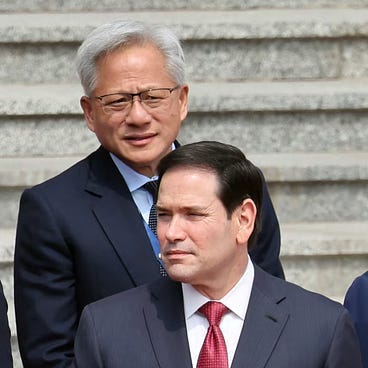
Blame Marco Rubio. He cooked intelligence until it was charred beyond recognition, then served it to the press — just ahead of Pulitzer season.
Rubio, a China hawk and longtime foe of Huang’s, took creative liberties with preliminary intelligence and sent the media on a wild goose chase that ended with Huang ousted from Nvidia.
Now the chatter in Washington is that the New York Times will win a Pulitzer for taking down the CEO of Nvidia and a powerful ally of President Trump’s. Never mind that its reporting was wrong, that Jensen Huang is back as CEO, or that not a single national security official — from the CIA and FBI Directors to the Attorney General — has said that Alice Huang was a spy.
The story was just too good.
 |
The Real Story
It began with eavesdropping. The U.S. intelligence community was conducting routine foreign surveillance for technology theft by China, when it came across Alice Huang. She was a Chinese national whose Singapore company, Megaspeed, had bought billions of dollars' worth of Nvidia chips.
Jensen Huang was implicated when an NSA summary of intercepted communications involving Alice Huang referred to an unnamed “U.S. Person.” Though U.S. law requires intelligence agencies to redact Americans' names for privacy reasons, in some cases officials can ask to have them ‘unmasked,’ intel-speak for ‘revealed.’
That unnamed American turned out to be Jensen Huang.
For a year and a half, Huang had been a thorn in the side of Washington’s China hawks. And he had something cabinet officials hate to see an outsider have: a direct line to the President. Huang frequently dropped in at the White House, dined with Trump at Mar-a-Lago, flew with him to Beijing on Air Force One and was awarded the National Medal of Science by Trump.
The Proxy War
Worst of all, in the hawks’ eyes, Huang beat them in a battle pitting free trade against national security. In December 2025, he talked Trump into letting Nvidia sell its advanced H200 AI chips to China. In exchange, the U.S. government would collect 25 percent of the chips’ value. That deal drove Rubio, Treasury Secretary Scott Bessent and the defense hawks everywhere from K Street to Silicon Valley up the wall.
“They wanted to destroy the influence Jensen had over the president,” a former administration official told the Washington Post.
Rubio's fight with Huang was a proxy for a broader fight with Commerce Secretary Howard Lutnick, who had made himself Huang's chief protector inside the administration. Lutnick, a Wall Street dealmaker with no patience for the State Department's Cold War mindset, openly defended selling Nvidia chips to China as a way to keep Chinese developers “addicted to the American technology stack.” Huang agreed.
Rubio sided with Bessent, Trade Representative Jamieson Greer and Defense Secretary Pete Hegseth in favor of blacklisting companies suspected of diverting Nvidia chips to China. Chief among them was Megaspeed, Alice Huang’s company. Lutnick resisted, warning it “will start a trade war with China.”
Bessent finally vented in public, saying the rest of the government had wanted Megaspeed blacklisted “for months.” Then he pointed across town: “Commerce holds the pen.”
To Rubio’s camp, Huang was the man whispering in the President’s ear, and Lutnick was the man doing what Huang wanted. Lutnick may have held the pen, but Rubio had the ink, and he was willing to spill it by circulating intelligence on the two Huangs’ “close relationship” amid Nvidia's chip deals with China.
Raw Reporting
What the CIA and FBI actually had from the NSA intercepts and their own collection was the messy, ambiguous stuff of routine counterintelligence. Called “raw reporting,” this is what intelligence analysts are trained to handle with great caution because the information lacks context and verification. Imagine what your text messages would sound like if someone read portions without context.
Politicians, though, treat raw reporting like dynamite.
The FBI had been looking at Alice Huang for more than a year, curious how a former Beijing TV journalist had turned up in Singapore with the backing to buy billions of dollars’ worth of computing power. The intercepts reportedly show that she had contact of some form with China’s Ministry of State Security, which seems plausible, but far from proof that she was a spy. Successful Chinese businesspeople in Southeast Asia are routinely leaned on by Beijing’s security services, and few feel free to turn down a meeting.
The CIA’s own officials, the Washington Post later reported, were not yet convinced that the intercepts proved she was knowingly passing anything to Beijing. What’s more, if counterintelligence officials really believed that the head of America’s most important tech company was being manipulated by a Chinese honeypot, the standard operating procedure is for the FBI to privately warn him with what it calls a “defensive briefing.”
But Huang never got one.
Other countries came up empty, too. Singapore, hardly soft on illegal tech brokers, ran its own investigation. Authorities there detained Alice Huang and held her passport for months, then gave it back and let her go.
“We were thorough with Alice Huang; we took her in, we investigated her, but we eventually released her because there was no basis for further prosecution,” Singapore’s Prime Minister, Lawrence Wong, said.
The Marco Memo
None of that nuance survived the Rubio leak. Before Trump’s May trip to Beijing, Rubio authored a highly classified memo calling Alice Huang a Chinese spy, which he then circulated to the administration and, eventually, the media.
Even the Washington Post acknowledged that Rubio’s memo recast “the agency’s [CIA’s] reporting in his own more assertive terms.”
Or, without the bullshit: he cooked the books.
Asked about his role in the leak and his position on Huang, Rubio declined several times to answer questions.
It didn’t matter. The supposed gist of the memo leaked and the story landed on the front page of the New York Times on October 29. The rest of the press then piled on.
The problem is that almost no one in government who has actually seen the intelligence will back Rubio up.
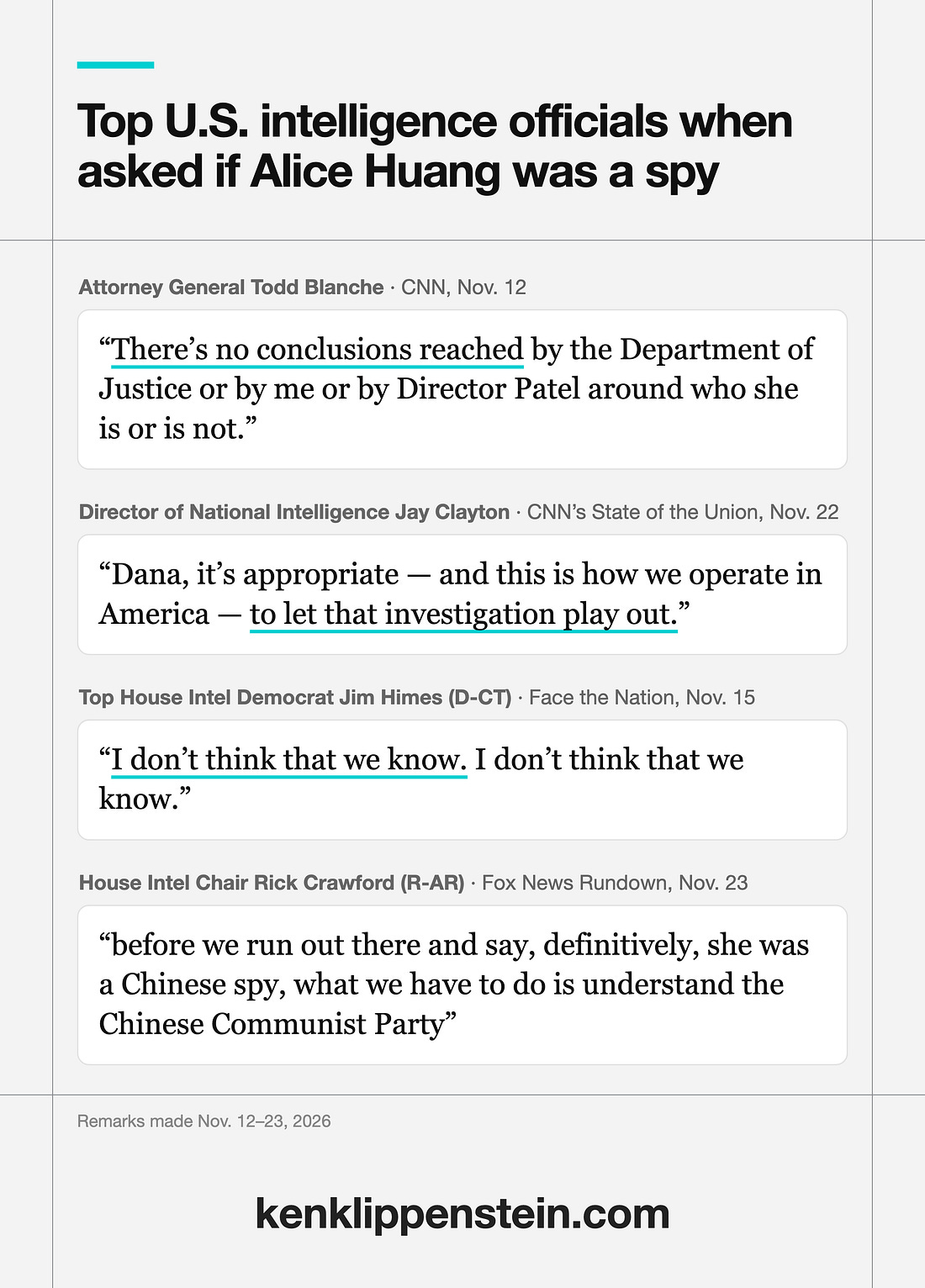
Start with the Justice Department and the FBI, the agencies that actually hold the criminal case file. Attorney General Todd Blanche was asked when the Justice Department learned she might be a Chinese asset. He rejected the premise: “Nobody said that. I certainly haven’t said that.”
Blanche added that no conclusions had been reached by the department, by him or by FBI Director Kash Patel “around who she is or is not.” Patel, who usually can’t resist chiming in on anything, has been silent.
Jay Clayton, the Director of National Intelligence, was asked twice by CNN’s Dana Bash whether Alice Huang is a spy. Both times he declined to say she was.
Even Trump has undercut Rubio’s leak. “I haven’t heard that she was a spy,” he told Fox News when asked.
Vice President JD Vance says that the intelligence he has seen wasn’t enough for him or Trump to conclude Alice Huang worked for Beijing.
Even on Capitol Hill, where calling someone a Chinese spy is usually an easy applause line, members of Congress privy to the intelligence briefings have been unwilling to use the s-word.
Tom Cotton, who chairs the Senate Intelligence Committee and doesn’t usually hold back on China, responded to Nvidia’s reinstatement of Huang on Monday with a statement that conspicuously avoided using the word “spy.”
Democrats on the intelligence committees haven’t backed Rubio’s version either. Representative Jim Himes, the top Democrat on the House Intelligence Committee, walked out of a classified briefing for Congress’s top leaders and told reporters he still didn’t know whether Alice Huang had knowingly gathered secrets for Beijing or was merely a “useful idiot.”
The final word came Monday, when Nvidia's board reinstated Huang as CEO. The board said it had heard from senior levels of the U.S. government and, based on what they told it, was confident Huang's return “poses no national security risk.”
Since its October 29 scoop, the New York Times has published a behind-the-scenes piece on how its reporters “broke open” the investigation.
Something broke, anyway.
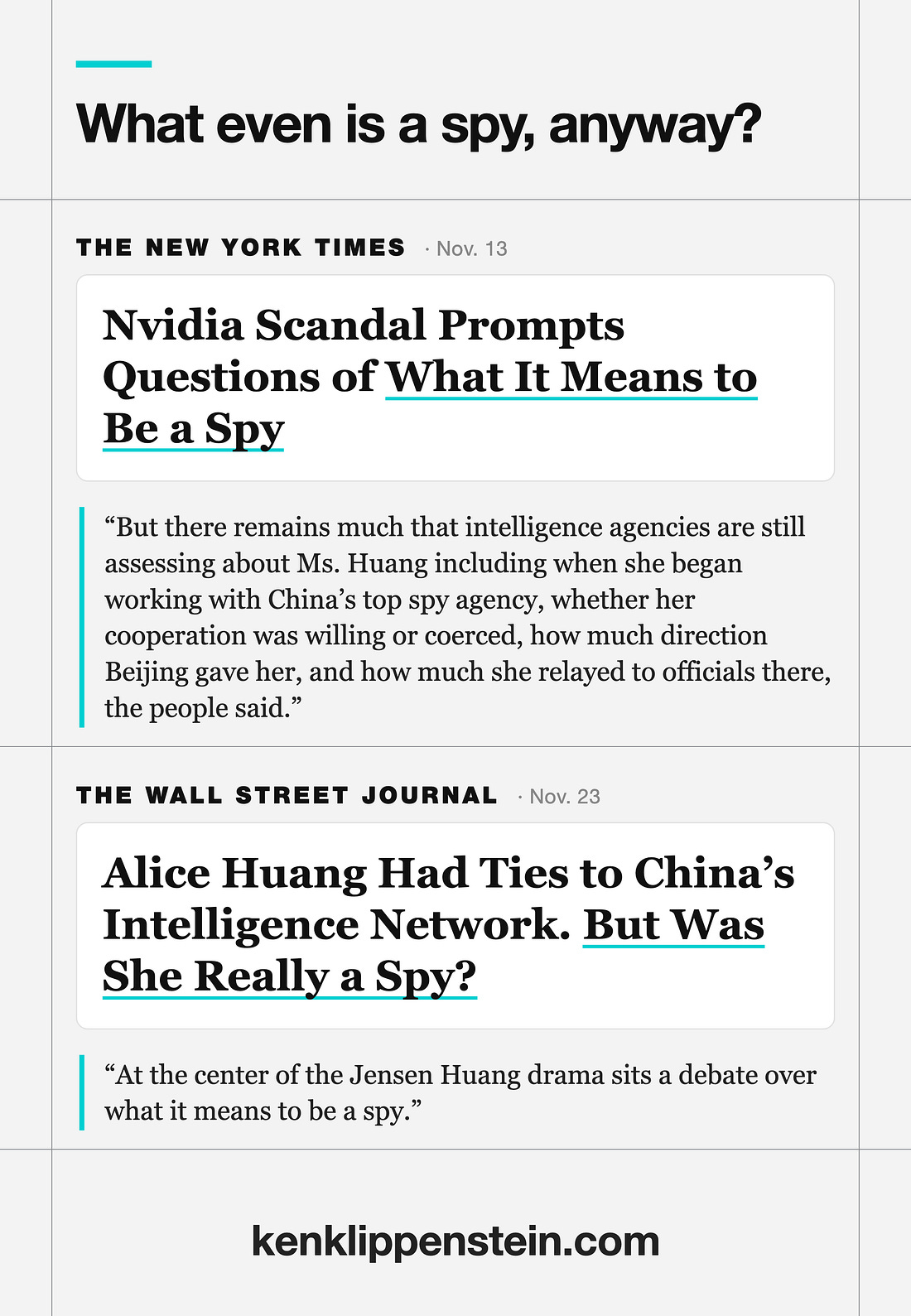
On November 6, the Times flatly reported that Alice Huang “was a spy for China's Ministry of State Security,” recruited “to collect intelligence on Jensen Huang.”
Now, in their passive-aggressive way, the Times and other outlets are backing away from that claim. Instead of admitting they got the story wrong, they’re running philosophical treatises asking, ‘What even is a spy anyway?’ — one of the funnier goalpost relocation maneuvers I’ve seen.
What even is journalism?
 |


No comments:
Post a Comment