WHEN AN HONORABLE JUDGE MEETS A CORRUPT GOVERNMENT
The ICE raids in Minnesota have brought about a conflict not envisioned by the Constitution
 |
 |
Jerry Blackwell was a winner. A Minneapolis kid, he went to a first-rate college on a scholarship, whizzed his way through law school, and went into private practice in his home town. At one point, the singer Prince was among his clients. He served as a pro bono prosecutor after the 2020 murder of George Floyd and delivered the opening statement and closing argument in the successful prosecution of Minneapolis police officer Derek Chauvin.
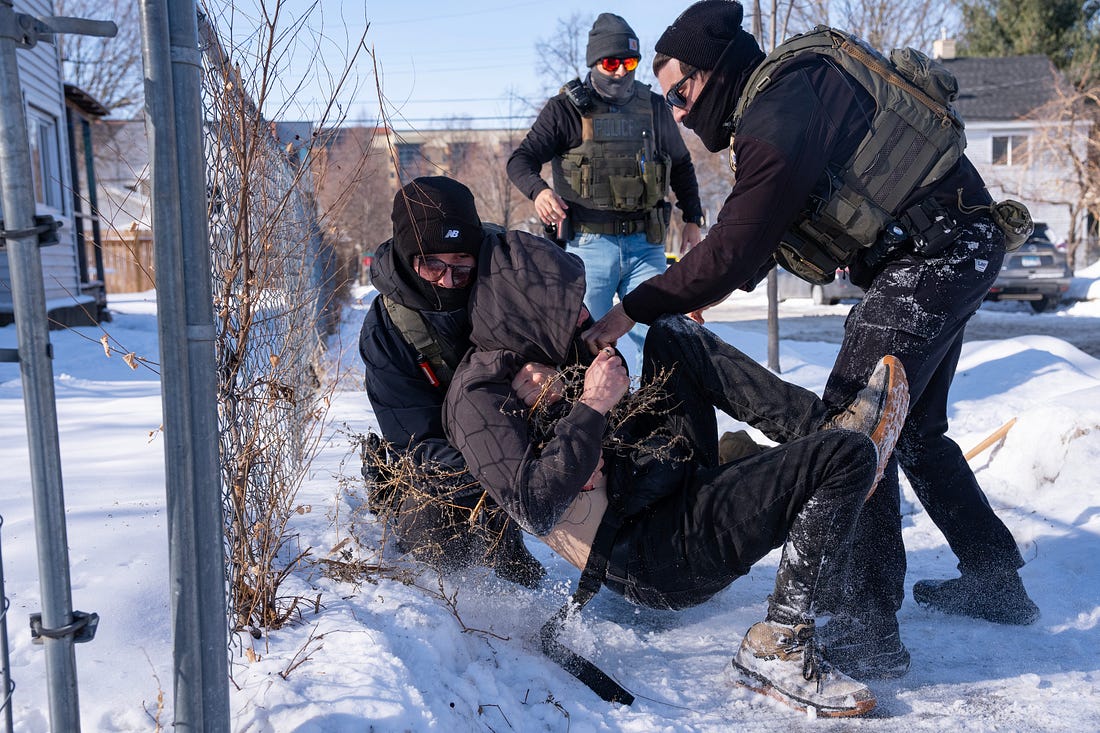
Blackwell was nominated in June 2022 by President Joe Biden to be a US District Court judge for Minneapolis. He was approved by the Senate and assumed office that December. He’s run a tight ship at a time of chaos in Minneapolis as ICE, supported by other federal agencies and President Donald Trump, began an all-out assault on suspected undocumented residents of the city. There have been mass arrests and violence, including two killings of protesters by federal agents. The protests are ongoing.
The issue before Judge Blackwell on February 3 was a narrow one, as the transcript makes clear. “The hearing this afternoon,” he announced, “concerns compliance with court orders; not policy, Just compliance. Nothing else.” There was no need to state the obvious—that the White House had decided to make a show of force in liberal Minnesota, with its large population of immigrants from Somalia, by doing what it has been doing elsewhere in America—bringing in ICE and other armed units to seize people of color. Since 1932, Minnesota has consistently voted Democratic in presidential elections, with the exception of 1972, when Richard Nixon won in a landslide.
Many immigrants without documentation in hand have been grabbed—literally forced at gunpoint out of a delivery car or van—and immediately deported, in Blackwell’s view, without any attempt to meet the legal and constitutional due process requirements.
There were two federal attorneys in Blackwell’s courtroom: Ana H. Voss, the experienced assistant US attorney in Minneapolis who would resign a few days after the hearing; and Julie T. Le, a young lawyer working for ICE in Washington who had been detailed to the Justice Department offices in Minneapolis, which were swamped with questions about illegal detainments. It was Le to whom Judge Blackwell complained about the failure of the Washington offices of the Attorney General and Homeland Security to release a detainee in Minneapolis whose age did not meet the minimum legal requirement.
The judge was pissed off by ICE’s failure to release detainees whose seizure did not meet constitutional requirements in the first place. He said: “I hope everyone here agrees and acknowledges that a court order is not advisory and it is not conditional. It is not something that any agency can treat as advisory as it decides how or whether to comply with the court order.”
After noting that the authority he cited is vested from Article III of the Constitution, Blackwell made a clear reference to the Trump-induced madness taking place on Minneapolis streets: “Detention without lawful authority is not just a technical defect, it is a constitutional injury that unfairly falls on the heads of those who have done nothing wrong to justify it. . . . When a release order is not followed, the result is not just delay. In some instances, it is the continued detention of a person the Constitution does not permit the government to hold and who should have been left alone, that is, not arrested in the first place.”
Blackwell turned to the lawyers’ explanation that there were just too many contested arrests for the federal government’s legal system to deal with. “If the government undertakes an enforcement action of this scale, one that results in the detention of large numbers of people, including individuals who are lawfully present in the United States, then the government assumes a corresponding obligation that each detention complies with the Constitution and court orders governing release. . . . But what you cannot do is to detain first and then sort out lawful authority later.
“In many instances,” the judge said, “I have had to not just issue an order, but another order, another order, another order . . . about seven or eight different touches sent to the government simply asking for the date, time, and location of someone who was ordered released, in many instances, a week or more in the past. . . . The requirements that the court has in place exist because individuals were being detained without lawful authority, they were being transferred contrary to orders, or released in ways that undermine the relief that was granted by the court.”
It took Le, the newcomer, to give the judge an inside view of what can only be seen as the Trump administration’s utter lack of regard for those seized illegally and later ordered released by a federal judge. She explained that she arrived from Washington to Minneapolis with no idea of what she was supposed to do on issues of due process. The judge, with what I hope was a smile, interjected. “Are you telling the court,” he asked, “that you were brought in brand new, a shiny brand new penny into this role, and you received no proper orientation or training on what you were supposed to do?” The answer was yes.
Le offered to share the documents she had been provided by the government regarding the case at hand with the court and was told that any information provided would need to be shared with counsel for the illegally seized person, known during the proceedings as “Oscar,” whose whereabouts were not being provided by the government, despite repeated efforts by the court to get him released. The judge said once again that the alleged illegal immigrant had no criminal record and had been ordered by the court to be released immediately more than a week earlier.
The judge said that for days there were inaccurate reports that the detainee was being scheduled for release and a flight back to Minnesota from El Paso, according to one message. A counsel for ICE later said that the detainee was in Albuquerque and was scheduled to fly to Minnesota two days later. During all of this back and forth chatter, the detainee remained in ICE custody, in direct disregard of the judge’s January 15 order that he be freed immediately. The detainee was returned to Minnesota and released on the afternoon of January 28. The official reason for the delay, Judge Blackwell said, was safety of the detainee amid never explained security concerns.
Where Oscar slept, if he did, and who fed him, if he was fed, is not in the court record.
It was during this period, Le told the judge, that she put in her resignation but remained on the job because no replacement could be found. And now, she told the judge: “I am here with you, Your Honor. What do you want me to do? The system sucks. The job sucks. And I am trying every breath that I have so that I can get you what you need.”
Blackwell’s response was empathetic and to the point. He told Le: “I want you to understand my goal in any of this is not to threaten you or anyone. What we really want is simply compliance, because on the other side of this is someone who should not have been arrested in some instances in the first place who is being held in jail or put in shackles for days, if not a week-plus, after they’ve been ordered released.
“And I know that the government has a concern about the growing number of requirements that the court puts in place upon release of individuals. That happens because of the things we learn. For example, if we say, ‘Release the person immediately,’ then we learn—having transported him back to El Paso or New Mexico, you don’t bring him back. We learn that somebody is put on the street with just the clothes on their back and have to figure out how to get back here when they never should have been arrested here in the first place, let alone flown halfway across the continent of North America.
“And then we say, ‘Alright. So you brought them back. We can’t have them released when it’s minus-fourteen outside. And now we have to address that. Don’t release them in the circumstances that might endanger their health or safety.’
“And so once that’s addressed, then we learn that they’ve been released, but now conditions have been imposed. That someone who should never have been arrested in the first place is now being told, ‘You’re going to be released if you wear an ankle monitor,’ which the court didn’t order because the person was unlawfully detained in the first place.”
The judge asked Le, “Do you understand that?”
She said she did and added: “And I share the same concerns as you, Your Honor. I am not white, as you can see. And my family is at risk as any other people that might get picked up. . . . But again, fixing a system, a broken system . . . I don’t have a magic button to do it.”
Somehow, amid all the suffering and fear that an irrational and ignorant president can create, here in the US and abroad, it is reassuring to hear an informed and honorable federal judge share his anxieties with a young federal worker in the wrong job in the wrong place, and try to reach a meeting point.
Julie Le, according to a report in the New York Times on Sunday, was fired from her temporary job in Minneapolis with the Justice Department. There was no immediate word about her permanent job as an attorney with ICE in Washington.
At the end of a long day for Judge Blackwell and the others in the courtroom, Kira Kelley, one of the public interest lawyers for Oscar, whose full name was not in the transcript, asked for a moment.
She had a lot to say about Oscar’s experience.
“Most of my clients,” she said, “are pulled over for how they look or where they are or for any number of things that don’t amount to probable cause. . . . His affidavit really just shows us what it’s like. . . . That he was without food. He was without clean clothes. . . . People are being treated like less than human. . . . I can’t tell you how many clients [once released] . . . who I had to go find who were left on the side of the road with no coat, no phone, no wallet, no hat . . . and it’s zero outside. We shouldn’t need a court order saying, ‘Don’t put someone’s life in danger.’ But here we are.”
Here we all are.


No comments:
Post a Comment