If you have opinions about the subject matter of posts on this blog please share them. Do you have a story about how the system affects you at work school or home, or just in general? This is a place to share it.
Note: I posted this last September but think it's as relevant 8 months on and in the midst of the protests and riots in response to the murder of black people by the police. The same old racist arguments, couched as genuine criticism are flying around. White Lives Matter in response to the Black Lives Matter movement. Then those that want to portray black folks as thugs and looters when the real thugs and looters carry out their looting under protection of legality. The critics, unable to overcome their own racial or color prejudice and the fear that instills in them are increasingly in a minority though I believe.
I did make a small error here saying "white" lives matter at one point
when I meant "blue". The other thing is that the point I make in the
video about the invention of the white race and what amounts to the
white skin privilege conferred on the European workers by the white
ruling class was clearly a concentrated effort to undermine working class unity
and has been very successful.
However, things have changed dramatically
as the assault on the white working class has intensified as well making
this more difficult. We are in an era where life expectancy for whites
is declining.
If we consider that 100 million Americans eligible to
vote did not participate in the presidential election in 2016, a
significant number of them must be white or workers of European descent.
They are not all Nazi's and neither are a significant portion of them
that did vote; life is complicated when choices are extremely limited
and there's an absence of leadership. Also, the US workforce is more
integrated than ever with more women in the workplace as well.
The
ruling class will always use racism to undermine unity between workers,
but it is definitely not as easy as it once was and would be harder
still if the heads of organized labor had a serious strategy to combat
it.
Feel free to comment or send me personal comments or questions or ask me to clarify what I meant by something I said. The e mail is we_know_whats_up@yahoo.com
Greek workers vote "No" to Troika's Austerity Program 2015
Capitulating to adults
During the pandemic lockdown, I have been able to read a range of
new economics books, some Marxist but most not. It seems that many
leading economists have published new stuff in the last two months. Over
the next few weeks, I shall post some reviews of these.
I shall start with Sellouts in the Room by Eric Toussaint. Originally published in French and in Greek in March 2020 under the title Capitulation entre Adultes,
the book will be available in English before the end of 2020. Eric
Toussaint takes us back to events of Greek debt crisis when the Troika
(the EU Commission, the ECB and the IMF) tried to impose a drastic
austerity programme on the Greek people in return for ‘bailout’ funds to
cover existing debts owed by Greek banks and the Greek government to
foreign creditors, as credit for Greece in markets dried up and the
government headed for default.
At the beginning of 2015, the Greek people elected the left-wing
Syriza party to power. Syriza pledged to resist austerity measures. The
new prime minister Tsipras appointed the already well-known leftist
economist Yanis Varoufakis as finance minister to negotiate a deal with
the Troika. As we subsequently know, Varoufakis was unable to persuade
the Troika and EU leaders to drop the austerity demands. Tsipras called a
referendum for the Greek people on whether to accept the Troika
demands. Despite a massive media campaign by the capitalist press and
dire threats from the Troika and the strangling of the Greek economy and
banks by the ECB, the Greek people voted 60% to reject the Troika
plan. But immediately after the vote, Tsipras caved into the Troika and
agreed to their demands.
Varoufakis resigned as finance minister and later he wrote an account of his negotiations with the Troika, called Adults in the Room.
Éric Toussaint was also in Greece at the time. He was coordinating the
work of a debt audit committee set up by the president of the Hellenic
Parliament in 2015 to look at the nature of the debt that the Greeks
owed to the likes of European banks, hedge funds and other governments.
He “lived nearly three months in Athens between February and July
2015, and in the context of my work as scientific coordinator of the
audit of Greece’s debt, I was in direct contact with a number of members
of the Tsipras government.” Toussaint has now written an
alternative view of those events from that recounted by Varoufakis. And
it amounts to a devastating critique of the Syriza government and of
Varoufakis’ strategy and tactics during 2015.
Does it matter what happened? Toussaint reckons it does because there
are important lessons to be learned from the Greek debt crisis. The
common view now is that Syriza had no alternative but to submit to the
Troika as otherwise the Greek banks would have collapsed, the economy
would have fallen down an abyss and Greece would have been thrown out of
the European Union to fend for itself. For example, Paul Mason,
British leftist broadcaster and writer, wrote in 2017 that “I
continue to believe Tsipras was right to climb down in the face of the
EU’s ultimatum, and that Varoufakis was at fault for the way he designed
the “game” strategy.”
Toussaint’s denies the narrative of TINA (‘there is no alternative’),
arguing that there was an alternative strategy that Syriza could have
followed and, in particular, Toussaint singles out Varoufakis for
failing to recognise or adopt this in his role as finance minister. In
Toussaint’s view, Varoufakis started from the premiss that he had to
persuade the Troika to act as “adults” and aim to convince them to reach
a reasonable compromise. From the very beginning Varoufakis made
extremely minimal counter-proposals to the Troika austerity measures: “Varoufakis
reassured his opposite numbers that the Greek government would not
request a reduction of the debt stock, and he never called into question
the legitimacy or legality of the debt whose repayment was demanded of
Greece.” He never asserted the right and the determination of the
Greek government to conduct an audit of Greece’s debts, says Toussaint.
And Varoufakis not only said that the government he represented would
not call into question the privatizations that had been conducted since
2010, but even allowed for the possibility of further privatizations.
Indeed, Varoufakis repeatedly told the European leaders that 70 per cent
of the measures called for by the Troika’s Memorandum of Understanding
were acceptable. While Varoufakis discussed with these ‘adults in a
room’, the Syriza government continued to pay off several billion euros
in debts between February and 30 June 2015, while the Troika did not
make a single euro available. The public coffers continued to be
emptied, principally for the benefit of the IMF.
Varoufakis and the inner circle around Tsipras, in reaching an
agreement with the Troika in late February 2015 to extend the second
Memorandum of Understanding, never showed evidence of the slightest
determination to take action if the creditors refused to make
concessions. And the latter gave every evidence of contempt for Greece’s
government.
Most important, says Toussaint, the Syriza government ministers did
not take the time to go out and meet the Greek people, to speak at
rallies where the Greek population was represented. They did not travel
around the country to meet and talk with voters and explain what was
going on during the negotiations or the measures the government wanted
to take to fight the humanitarian crisis and re-start the country’s
economy. They utterly failed to appeal to the working people of Europe
and elsewhere for support. Instead, Varoufakis and the other Greek
ministers involved to conduct ‘secret diplomacy’ in rooms, thus
encouraging the Troika to “persist in using the worst forms of blackmail.”
The referendum of 5 July 2015 was the culmination of those
negotiations. Clearly, Tsipras expected the Greek people to bow to the
pressure of the media and the threat of economic disaster and expulsion
from the EU by accepting the Troika demands. But they did not. Toussaint
says that the referendum results was a perfect opportunity to mobilise
the Greek people to reject the Troika’s blackmail, refuse their
ultimatums and instead respond by suspending further repayments of debt
pending an audit. The government should have announced the
nationalisation of the banks and implemented capital controls to stop
capital flight and take control of the payments system.
As Toussaint points out: “When a coalition or a party of the Left
takes over government, it does not take over the real power. Economic
power (which comes from ownership of and control over financial and
industrial groups, the mainstream private media, mass retailing, etc.)
remains in the hands of the capitalist class, the richest 1 per cent of
the population. That capitalist class controls the state, the courts and
the police, the ministries of the economy and finance, the central
bank, the major decision-making bodies.”
That was ignored or denied by the Syriza governemnt, including its
rockstar finance minister. They started from the premiss that
representatives of capital in the Troika could be persuaded to be
reasonable, to act as adults. The class nature of the struggle was
omitted. As Toussaint says: “In reality, a major strategic choice
of the Syriza government–one which led to its downfall–was constantly to
avoid confrontation with the Greek capitalist class. It was not simply
that Syriza and the government did not seek popular mobilization against
the Greek bourgeoisie, who widely adhered to the EU’s neoliberal
policies. The government openly pursued policies of conciliation with
them.”
Toussaint offers an alternative strategy in his book. The Syriza government “should
have resolutely followed the path of disregarding the European treaties
and refusing to submit to the dictates of the creditors. At the same
time they should have taken the offensive against the Greek capitalists,
making them pay taxes and fines, especially in the sectors of shipping,
finance, the media and mass retail. It was also important to make the
Orthodox Church, the country’s main land owner, pay taxes. As a means of
reinforcing these policies, the government should have encouraged the
development of self-organization processes in existing collective
projects in various domains (for example, self-managed health
dispensaries to deal with the social and humanitarian crisis or
associations working to feed the most vulnerable people.”
That brings us to the issue of Greece’s membership of the European
Union. Up to the point of the referendum, apart from the Communist
party, no party stood for leaving the EU as a solution to the crisis.
The vast majority of Greeks did not want this. After the capitulation of
Syriza, the party leadership split and those opposed to the
capitulation (with the exception of Varoufakis) called for Grexit as the
main policy proposal and solution. In the subsequent election, these factions failed to make any headway into parliament and the Tsipras government was returned intact.
In his book, Toussaint reckons that the Syriza government should have
opted for triggering Article 50 in the EU constitution as a way of
getting out of the EU. This Article is what the UK government
subsequently used to achieve its exit after its referendum to leave in
2016. Toussaint reckons that using this instrument would have given
Greece two years to argue the toss with the EU, while it refused to pay
any more debt etc. I am not so sure that this would have been a good tactic.
As Toussaint points out, no EU member state can be thrown out and there
are few sanctions that the EU could impose on a Greek government
anyway, apart from the ECB blocking credit, something they were doing
anyway. By applying for Article 51, Syriza would have been telling the
Greek people that the government aimed to leave the EU voluntarily
(something the majority of Greek did not want); and also giving the EU
leaders an easy way out of getting rid of Greece, something that, as
Varoufakis points out in his narrative, German finance minister Schauble
was keen on doing. In my posts during the Greek crisis,
I argued that the Syriza government should have refused to pay the
debt; taken over the banks and large Greek companies, mobilised the
people to occupy the workplaces and introduce workers control; blocked
the movement of funds by the rich and corporates; and appealed to the
labour movement in Europe for support against the policies of their
governments. Let those governments try to throw Greece out; but do not
give them constitutional weapon to do so.
The main emphasis in Toussaint’s book is on the role of Varoufakis,
not because of any personal animosity, but because this ‘erratic
Marxist’, as Varoufakis calls himself, was at the centre of events and
went on to write his best-selling personal account of what happened.
Varoufakis then formed a pan-European wide political party DIEM 25, and
was eventually re-elected as an MP in the Greek parliament in the recent
2019 election that led to the Conservative party taking back power.
Why did Varoufakis from the beginning as finance minister adopt the
strategy of trying to persuade the Troika leaders to be reasonable,
rather than mobilise the Greek people for a fight against the Troika
demands? The answer, I think, lies in Varuofakis’ view of the
possibilities for socialism. Before he was appointed finance minister by
Tsipras, he had not been a member of Syriza; he had been an academic.
Back then, he wrote, “You see, it is not an environment for radical
socialist policies after all. Instead it is the Left’s historical duty,
at this particular juncture, to stabilise capitalism; to save European
capitalism from itself and from the inane handlers of the Eurozone’s
inevitable crisis”. He had written what was called a Modest Proposal for Resolving the Euro Crisis
with Social Democrat academic Stuart Holland and his close colleague
and friend, post-Keynesian James Galbraith, in which Varoufakis was
proud to say “does not have a whiff of Marxism in it.”
This ‘erratic Marxist’ saw his task as Greek finance minister “to save European capitalism from itself” so as to “minimise
the unnecessary human toll from this crisis; the countless lives whose
prospects will be further crushed without any benefit whatsoever for the
future generations of Europeans.” Apparently, for Varoufakis, socialism cannot do this because “we
are just not ready to plug the chasm that a collapsing European
capitalism will open up with a functioning socialist system”. By ‘we’, he means working people, but in practice he meant himself.
Varoufakis went further. You see, “a Marxist analysis of both
European capitalism and of the Left’s current condition compels us to
work towards a broad coalition, even with right-wingers, the purpose of
which ought to be the resolution of the Eurozone crisis and the
stabilisation of the European Union… Ironically, those of us who loathe
the Eurozone have a moral obligation to save it!” Thus he campaigned for his Modest Proposal for Europe with “the
likes of Bloomberg and New York Times journalists, of Tory members of
Parliament, of financiers who are concerned with Europe’s parlous
state.”
In Sellouts in the Room, Eric Toussaint scathingly exposes this
wrong-headed approach of the ‘erratic Marxist’. It’s a painful read in
many ways, as Toussaint chapter by chapter recounts Varoufakis’ sorry
progress, or lack of it. In a recent interview, Varoufakis was asked “what
would I have done differently with the information I had at the time? I
think I should have been far less conciliatory to the Troika. I should
have been far tougher. I should not have sought an interim agreement. I
should have given them an ultimatum: “a restructure of debt, or we are
out of the euro today”.
Unfortunately, there is never much benefit in hindsight, except to to
avoid the same mistakes when another opportunity arises. Toussaint’s
book is a guide to that. In the meantime, the Greek people now face yet another round of austerity and depression after the coronavirus crisis,
following the terrible years before and after the capitulation of 2015.
The IMF forecast for 2020 would take Greek national income back to the
level of 25 years ago!
So I got corrected today because I didn’t stress on social media that the
people gathering at a Target store in Minneapolis and others that took
merchandise from another Target store in the area were “looters”. Well, technically, they were “looting” if we are to comment on this situation from the comfort
of our homes.
I don’t know how black folks
maintain their calm when someone (almost always a white person) says such
things. The eruptions taking place in US
cities today, are in response to yet another another black man, George Floyd, murdered
by the police while pleading for his life; “I
can’t breathe” he said. The list of these murders is too long to go in to.
But here in my area Oscar Grant was shot in the back laying face down on the
floor, four or five transit cops over him.
Years ago I was closely
involved in the case of Jerrold Hall who was shot in the back of the head by a
transit cop here in the Bay Area. He was unarmed and walking away form the cop
at the time. Here I am 25 years later and black people, especially males, are
being murdered almost daily by state security forces.
In Louisville, just a short
time before George Floyd was murdered by the police, Breonna
Taylor was shot 8 times by Louisville police. Her boyfriend, Kenneth Walker,
was asleep with her when the cops stormed in to their apartment under the
protection of a “No knock” warrant.
Despite having this type of warrant, the police say they announced their
presence, Kenneth Walker and neighbors say they didn’t Consequently, the
couple thought they were experiencing a home invasion and the boyfriend,
Walker, shot at the intruders, wounding a cop. He was initially charged for
this. In response, the cops fired, 25 rounds into the building, killing Taylor.
Some rounds entered other apartments; they just don’t care.
A short time before this, a
black man, Ahmaud Arbery, was basically assassinated by three white men in
Brunswick Georgia, all connected in one way or another to the police.
There are too many incidents
of this nature to list here but this is the environment in which the present
protests are occurring. It is the most frustrating thing to hear people complain
about looting and lecture the black community about the need to work within the
established institutions. However, when they don’t work, other measures have to
be taken.
In addition to this climate,
we have right wing racist organizations becoming more open about their views
bolstered by the racist and sexual predator Donald Trump who resides in the
White House. As Martin Luther King pointed out, riots are the language of the
unheard. When the so-called democratic institutions fail, then people have no
recourse but to express their anger in another way. Even so, smashing up a
corporation that, here in the US has the same rights as a person, is not the
same as damaging a local hamburger joint or community business. The corporation
is correctly seen as a representative of the system that that is at the heart
of the matter, the institutionalized racism and violence that accompanies it.
I am an English immigrant. I
can’t imagine how I would feel if I was reading about “English” people being killed by the cops as black people are; or
if it was Catholics or Jews. The country would be in an uproar.
Of course, taking ones
frustration out by attacking a corporation, even one like Target that is
anti-union, anti-worker and abuses its employees is not the most productive way
to deal with this situation. But being criticized by people who have said
nothing about the objective situation that has brought this about holds no
water at all.
I put this video on this blog
and my Facebook page today showing a man dressed in black and his face covered
by a gas mask smashing store windows. The
difference I would have with the title is that the saboteurs may well
be white skinned, But they are a certain type of white people. This one was confronted by a black person at
the protest who asked if he was a cop. This guy is either a cop, a provocateur,
or a member of white nationalist or fascist organization. The goal is to
discredit those who are protesting the murder of George Floyd. This is why
after the initial anger has died down some, it is important to organize and
direct the resistance and use this power of workers and all oppressed people,
organized and unorganized against capitalism and the perpetrators of racist
violence. In this way we can also police ourselves and keep provocateurs out.
The cities and economy can be
shut down easily but it takes organization. This would be the way to deal with
any social injustice but in the absence of a powerful independent social force
based on working people, the marginalized and specially oppressed sections of
the working class, the initial response is anger and lashing out. This is to be
expected and we should take no criticism of this from armchair social critics
or racists.
In the aftermath of the
Katrina events which was a market (capitalist) driven catastrophe, we witnessed
the beginnings of working class communities and working class self organization
and defense teams developing. The state fears this.
US working class history is a
rich and militant one.We have not had
national working class parties like workers in other countries have. We have
won what we have through direct action and battles in the streets against the
most brutal bourgeois or ruling class in history. Native Americans are still
here and fighting despite the genocidal wars against them. The Africans that
were brought here have fought since slavery and on in to the modern era to be
free from one of the most brutal and violent regimes that ever existed. And the
great battles to unionize and win the right to organize from the early days of
the formation of the AFL to the rise of the CIO on the 1930’s is out history
and the struggle is not over yet.
I spoke to a friend in
Louisville very briefly tonight. At times, I have sensed a tone of desperation
in her voice as the attack on people like her, on black folks just doesn’t let
up. Many black friends share this view including some small business people, they are just so accustomed to it they wonder if it will ever end. “Don’t
you know I’m in the middle of a social disturbance” she said. “Oh dear…,”
I replied,“…I’m so privileged, I’m sitting on my porch
drinking a beer.” She laughed. But there was excitement in her voice, she
was in a good mood. This is what happens when we fight back, even when the
strategy isn’t always the one we’d choose. But when one is in a war, all is
fair, as the saying goes. We don’t always get to choose the path.
For that glorious moment we
are not the victims. That will move us forward but we should etch Malcolm X's statement toward the end of his life when he had many experiences under his belt and had drawn certain conclusions about the world. He said that "you can't have capitalism without racism." He was a person that thought about his words and we should heed them.
This guy is either a cop, a provocateur, or a member of white nationalist or fascist organization. The goal is to discredit those who are protesting the murder of George Floyd. This is why after the initial anger has died down some, it is important to organize and direct the resistance and use this power of workers and all oppressed people, organized and unorganized against capitalism and the perpetrators of racist violence.
The effects of the COVID-19 pandemic will be felt for decades to come.
US capitalism will shift the cost of saving the economy on to the backs
of the US working class, our children and our children's children.
Trump is threatening to pull the Republican National Convention from
North Carolina if the governor does not abolish social distancing
measures. He is willing to let people die to open the economy as the
economy is the only issue he feels will save him from defeat in
November.
I read this morning some expected news, the heads of organized labor in the US, the top international presidents and officials that make up the leadership of the AFL-CIO have endorsed Biden. Once again, the US working class has no voice in the upcoming elections and the labor officialdom once again pushes on the working class a political party that tens of millions abandoned long ago. Not form some personal whim, but because history has taught them that both these parties of capitalism, Republicans and Democrats are against their interests. Our material well-being and living standards have suffered no matter which party is in power.
The failure of the labor hierarchy to fight has not only delayed a mass movement to change society or improve our lives, it bears much of the responsibility for the rise of Trump and the increase in racial attacks that we are witnessing at the moment.
I should add that I do not consider the police, who are in the public sector officially, are workers. The police are a social force under control of the capitalist state whose primary function is to defend capital and the capitalist system
Michael Bloomberg Loves Home Care Workers Now. Don't Buy It
Source
Richard Mellor
Afscme Local 444, retired
So Trump is desperately trying to cover his ass over his pathetic response to
the coronavirus pandemic. He’s blaming Obama, blaming Pelosi, blaming the
Chinese threatening sanctions against Beijng in response to the undemocratic
response to the protests in Hong Kong. And no doubt there will be more
sanctions. To any observer, Trump and his folks in Washington DC are making the
word less safe and pushing China in to a new cold war. Trump, a slumlord,
sexual predator and racist is concerned about democracy in China. This is the
guy who told the world that among Nazi’s and the KKK, there are some decent
people.
No wonder he is worried. He
is prepared to risk more US lives opening the economy up in such a way that
keep it going until November. The economy is his only hope he believes. He has
threatened to pull the Republican National Convention out of North Carolina if
the Democratic governor won’t guarantee that the state’s social distancing
rules will be removed and the Convention can take place “at full capacity”. He is also opposed to mail in balloting because
it increases his chance of losing.
Trump has a lot of blood on
his hands. COVID-19 is ravaging US society with over 100,000 deaths so far. The
vast majority of these deaths are poor people, essential workers and
disproportionately people of color. Poor people can’t usually work form home.
I have seen more than one
estimate but somewhere between 25% and 40% of the deaths are in nursing homes.
But as Bloomberg/Businessweek pointed out in its current issue, “The
true figure might be a lot higher.”
The virus has spread to 7000
nursing homes the magazine adds, and long-term care facilities are a hotbed of
coronavirus activity. Older people are more vulnerable, and like hospitals in
general but more so, people are crammed in to these facilities. The saying that
hospitals are not healthy places to be in was never truer than it is today.
I remember years ago walking
many picket lines as Service Employees (SEIU) local 250, at the time, the largest
local union in the Califoria, was aggressively trying to unionize nursing
homes. Had the entire labor movement thrown its weight behind organizing these
places, things would be different today. But these are old people, many dying
already, they don’t spend money so are not really worth the effort.
So we have a situation where
some of the lowest paid workers are to be found in these places. What does that
say about our society? Consequently, care workers more often than not work two,
sometimes three jobs. This also means that they work in more than one facility
spreading the virus from workplace to workplace.
BusinessWeek points out that
nursing assistants earn around $13 an hour, a number that has , “…barely budged over the past decade.”. The
pandemic has shaken capitalism to the extent that Michael Bloomberg (he owns
BusinessWeek) who has a net worth around $30 billion, thinks that brothers and
sisters working in nursing homes are underpaid and overworked.
“They are the backbone of any functioning nursing
home, making up nearly 40% of all staff….” BW continues, “…..yet many
struggle to stay out of poverty. One in 3 nursing assistants receives federal
benefits; 1 in 4 receives food stamps. Some 40% have no employer-provided
health insurance, and 15% have no insurance at all.”
It’s nauseating in a way to
read articles like this that only appear because capitalism is in crisis and
the shabby state of affairs in capitalist society are threatening to eat in to
profits and halt further capital accumulation.The US is so business friendly that in Texas, care workers tare
encouraged to work at only one facility but how disconnected is that given that
these workers can’t live on the wage of one job. Some Canadian provinces have
banned long-term care workers from working more than one job and are at least
covering their income losses.
After a decades long assault
on workers living standards, smashing the private sector unions, cutting public
sector services and jobs, the billionaire Michael Bloomberg and others like him
want to “ensure that care workers are
paid fairly.”.Well isn’t that
nice. “Front-line nursing-home employees
— and the 1.4 million Americans they care for — deserve nothing less.” Bloomberg
writes ending on a high note.
However, Medicaid is the
largest funder of Long-Term Care facilities but Medicaid, like Medicare and
other social programs are under assault. The economic fallout from the shutdown
means that states and cities are not only losing revenue, but are being hit
with massive unemployment costs, health care costs and so on. Another problem
is that states and cities can’t run deficits like the federal government can,
so, as the Wall
Street Journal reminds us today, “…the
gap must be filled by spending cuts, tax increases or both.”
To get some idea of the level
of attacks that US capitalism will be forced wage against its own working class
in the coming period, no matter under Trump or Biden, consider that we are
looking at a trillion dollar bill for the pandemic, a market induced crisis
that is ushering in a new era, and estimates of $500 billion in cuts over the
next two years according to Moody’s Analytics. What chance spending cuts or
increased taxes in this scenario without major social turmoil.
As with the airlines,
retailers like Amazon, UPS, and Federal Express, the care of society’s infirm,
sick and aged, should not be left to the market and hedge fund managers. The
entire health care industry has to be taken out of private corporate hands,
from investors and social parasites like Trump and Bloomberg, and made public
institutions, serving the needs of a society not profiting from it.
I urge workers interested in knowing more about the present Pandemic and its affect on the world economy, to read Michael Roberts' latest commentary. It is longer than it looks due to the graphs but it is crucial reading in my opinion. More importantly, we have to draw conclusions about society and what we must do differently if we are going to survive as a species. Robert's gives his view at the end of the piece. Richard Mellor Admin
Coronavirus, the economic crisis and Indian capitalism By Michael Roberts
Below is the transcript of the presentation that I made on
30 April to the Indian Students Forum (TISS) in Mumbai. It has been
published by Students’ Struggle, the monthly bulletin of the Students Federation of India,
a student organisation associated with the Communist Party of India
(Marxist). It is a little out of date on the COVID-19 cases and deaths
but I am republishing the presentation to blog readers as i think it
still sums up my position on the nature of coronavirus crisis. It is
very long. But this is an exception to the rule. It was transcribed for us by Goutham Radhakrishnan, a research scholar at TISS. Here we are, on the 30th of April, with a recession around the world,
where there are now millions of cases of coronavirus which has hit
almost all regions, making it a pandemic. We also have an increasing
number of deaths, particularly in the United States and Europe. The
number of cases is also increasing in other parts of the world — in
Latin America, Asia, and to some extent, also in Africa. Clearly, the
disease is spreading across the world and it is not over yet. We need to
analyse what it means and also how it is impacting the economy.
With this particular virus, the
question that is often asked is if it is really like a flu or if it is
no worse than a flu. We have the flu every year, at least in the
northern hemisphere and also elsewhere, usually in the winter period.
Lots of people die from the flu, particularly elderly people and
influenza remains, among other diseases, important contributor to annual
deaths in the world. Some people argue that the current coronavirus is
much like the flu. The first thing to say is that all these pathogens
including flu have become much more prevalent in the last decade or so
because of the increasing connection between the human beings into the
remote parts of the world including forests, which are home to wildlife,
particularly wildlife that has held many of these pathogens for
thousands of years.
Now through the inexorable expansion
of human activity — logging, fossil fuel, exploration, urbanisation in
general — these wildlife species carrying these pathogens have come much
closer in contact to human beings. It is spreading through industrial
farming of animals in closed areas, which has led to these pathogens
transmitting themselves from the wildlife to industrial farmed animals
into human beings. We know this particular virus started, it seems, in a
wild life market or at least in an area around the wildlife market in
Wuhan in Hubei province in China.
This is not just the case of China but
elsewhere also with the development of markets. But why are there
wildlife markets? Often because poorer people find it difficult to get
food from the industrial farming process and they look to other ways to
provide them with sufficient food. Wildlife catching has also become a
market under capitalism and has become more prevalent which has led to
the risk that these pathogens will spread in human beings as they
clearly have done.
And it is not like the flu. We look at
the infection rate of COVID-19, its 2-3 times more infectious that the
annual flu. It incubates over a longer period which is dangerous
because it means we don’t know it is happening until it has already hit
us and it has spread around. The hospitalisation rate for COVID-19 is
much greater than it is for flu, maybe 6 or 7 times more. As far as we
can tell, the fatality of infected people on a global scale is coming in
after the lock down at about 1%, maybe a little less. But if the
pathogen was to spread to the mass of the population at a 1% mortality
rate, at a rate of infection 6-10 times more than the annual flu, then
millions of people are likely to die.
Now, this disease and other pathogens
have been brought to the attention of the governments around the world
for some time. We can go back several years but the WHO has been warning
the danger of these pathogens turning into pandemics around the world
and infecting human beings. But governments have really ignored this.
They have taken the chance that nothing is going to happen, and it is
not going to be dangerous and they don’t need to prepare or spend any
money on it. Just only in September the UN Global Preparedness
Monitoring Board pointed out that preparation by governments is totally
inadequate and a pandemic is coming, and unless they do something about
it and get ready, the health systems are going to be overwhelmed and
could escalate into a disaster. Well, here we are just a few months
later in the middle of such a disaster.
At the same time, it is worth
considering that over the last 10 or 15 years when these pathogens have
become much more serious and spread on a pandemic basis, nothing is
really being done to use resources to find out more about them and to
prepare the vaccines that could save us from serious illnesses and
diseases around the world. Vaccine is obviously the answer but there is
no vaccine for this virus. A universal vaccine for influenza — that is
to say, a vaccine that targets the immutable parts of the virus’s
surface proteins — has been a possibility for decades, but never deemed
profitable enough to be a priority.
Big pharma does little research and
development of new antibiotics and antivirals, although this is what
benefits public health. Of the 18 largest US pharmaceutical companies,
15 have totally abandoned this field. Heart medicines, addictive
tranquillisers and treatments for male impotence are the profit leaders
and very little attention is given to defences against hospital
infections, emergent diseases and traditional tropical illnesses. Hence,
part of the problem has not only been that the governments did not
care, but also that research has not been done by the big capitalist
pharmaceutical companies around the world because it is not profitable.
Sober-minded epidemiologists suggest
that somewhere between 20% to 60% of the world’s adult population could
catch this virus. The death rates are very dependent on the level of
lock down, but is certainly coming in at around about 0.5 – 1% of
everybody who is infected probably by the time we get to the end of it.
While the exact death rate is not yet clear, the evidence so far does
show that the disease kills around about 1%, making it ten times more
lethal than the annual flu.
That sort of level of cases and
hospitalisation is overwhelming or likely to overwhelm most healthcare
systems in the world as is proved to be the case, because they will have
no capacity for dealing with this. No testing, no contact and trace,
and no ICU beds sufficient to deal with a huge increase in the number of
people becoming ill and needing hospital treatment, particularly old
people who can hardly move very much. Since there is no vaccine to
combat it, nor any approved therapeutics to slow the course of its toll
on the human body, current the situation could continue for some months
or even longer ahead. Here is a graph (Fig. 1) which makes the point
clearer.
Fig.1: Mortality Rates
The blue part of this graph is the
normal annual mortality rate in various countries. And you can see how
many people died in a year per thousand population in these countries.
If this pandemic is allowed to spread without any containment, any
control or without any protective measures, then the number would more
than double in many countries or at least double the amount of people
who would die. Depending on how far up the dotted white bit you can go
to the top, you could have 35 – 50 million deaths in this pandemic. But
of course, that is not what has happened. Health systems and governments
everywhere have desperately tried to contain the impact of the
pandemic. The little red block (in the graph) shows how successful they
have been. If you take Spain or Italy, you can see they have not been
that successful and the number of deaths has been way above the normal
rates. In fact, only this week, figures are now coming out across the
board in many parts of the world how much increase there has been in
excess deaths over the normal annual deaths, even with the lock down and
containment policies.
Another argument presented often is
that only the old and the sick die from this pandemic. 80% or more
deaths are above 70 years and if you are a child up to 9 years there are
no deaths. Right up until you get to 50 or so, number of deaths are
very less, even among those hospitalised. Vast majority of people
infected would show no symptoms at all and if they do it is very mild.
So, what is all the fuss about, is the argument.
Let us leave aside the question of
whether it is right to let the old and the sick die, which within the
financial circles I work in, a lot of financial executives and people
who advice governments and so on, quietly and privately, seem to agree
upon. They argue that if all the old people and sick people died from
the pandemic, we can boost productivity, because these people cost us
money and they produce nothing. In some ways it would be better if they
were “culled” from the world, so that we have a more productive human
population. This is an old theory of Thomas Malthus from the early 19th
century, that there was no way to improve the lot of the majority of
people, because there were too many people and it was better to let
plagues and other things “cull” all the unfit and you would have a more
productive workforce. And that had to be done progressively.
This disgusting and grotesque theory
still has an echo, even now, among people who claim that it does not
matter if the old and sick die and we should do little about it and let
the young people just be infected. However, that is not a view that is
possibly politically acceptable for any government, and moreover health
systems would be overwhelmed, disrupting their ability to deal with
existing patients and people with other illnesses; and probably causing
an increase in such secondary mortality rates (and this time in younger
fitter people too), especially in countries more severely affected.
The efforts therefore have been to try
and “flatten the curve”, as it is called. In other words, if you look
at this graph (Fig. 2) the black line tells that if nothing is done, you
are going to have a massive increase in the number of beds that you
need compared to the red line at the bottom which is what most countries
have got. There is a massive difference.
Fig. 2: Curve Flattening
Therefore, you have to contain this in
some way otherwise there will be people dying in beds outside hospitals
all over the place. Containment can mean anything from social
isolation, isolating and quarantining infected people and shielding the
old, going further and start closing schools and universities down, to
going all the way down to a total lock down of all economic and social
activity and movement which is represented by the blue line that is the
flattened curve. The latter means that the infections are reduced,
spread out over a longer period and hospitals can therefore cope and
therefore not many people will die. But of course, going all the way
into a lock down is a serious disaster. If a country had full testing
facilities and staff to do ‘contact and trace’ and isolation; along with
sufficient protective equipment, hospital beds including ICUs, then
containment along these lines would work — without significant lockdown
of the economy.
Only a very few countries have been
able to achieve enough testing. Countries that have done the best have
used contact and trace and so on, and have been able to suppress the
spread of this infection and reduce the cases. Some of the biggest
countries of the world have done the least testing and are at the bottom
of the table, as they did not have such testing facilities, and
therefore have been unable to operate any testing basis. Also, they have
not had the required hospital space because most health systems in the
last 30 years have drastically reduced their spending on facilities and
staffing in order to save money for governments so that they can spend
it on other things such as weaponry or helping capitalists profit. They
are not prepared to provide decent healthcare across the board. As a
result, there is no spare capacity. Any crisis like this then just
becomes overwhelming.
The only solution then is to flatten
the curve by a huge lock down of everything that is moving. This graph
(Fig. 3) produced by another Marxist economist in Greece, demonstrates
the trade off now between lives and livelihoods as a result of this
crisis. The more you flatten the curve on the health front (red to blue
on the top part), the more likely you are to widen and increase the
negative curve below for the economy (red to blue at the bottom part).
Heavier the lock down to flatten the curve, the more you are going to
have a recession and a collapse in the economy.
Fig. 3: Trade-off Between Lives and Economy
Lock down and economic slump
We are currently in a lock down and a
slump. We just had figures earlier this week showing the United States
down around about 5% in the first quarter and we have not even gone into
this quarter which is going to be much worse. Europe too is down by 3 –
5 % depending on the country and we are going to see even worse
figures. 2.7 billion workers are now affected by full or partial lock
down measure, representing around 81% of the world’s 3.3 billion
workforce, and they are now facing a massive reduction in their income
and employment. Any sort of measure we have had from the IMF, World
Bank, OECD and the private forecasters are projecting anywhere around a
5% reduction in the global GDP this year which will be way more than the
global recession of 2008.
That was called the Great Recession,
this will be even greater in its damage to the world economy. Outputs in
most sectors will fall by 25% or more according to OECD, and the lock
down will directly affect sectors amounting up to one third of GDP in
the major economies. For each month of lock down, there will be a loss
of 2% in annual GDP growth. This short could exceed any collapse in
global output that we have seen in the last 150 years! IMF projects
that over 170 countries would experience negative per capita income
growth this year. This is how severe the situation is.
Of course, the hope is that the
collapse will only be short. Just a couple of quarters and then
everything will be brought into control and we can recover and go back
forward. The stock market in the US is rocketing upwards for two
reasons; i) US Federal Reserve has intervened to inject humongous
amounts of credit through buying up bonds and financial instruments so
that banks and institutions can keep their heads above water and, ii)
they believe that this lock down will be over soon and then world
economy will recover and it will be back to business as usual. We will
see whether that turns out to be the case over the next few months. This
is in stark contrast with the figures we are seeing about the collapse
in the real economy in terms of national output, investment and
employment, in all sectors. But the stock market thinks things will soon
be fine and they are looking over the drop into the next mountain
hoping everything will be up and away again.
The current situation is one of a huge
supply shock. The following figure shows (Fig. 4) that this is not a
financial collapse of the banks and the financial institutions like we
had in the Great Recession. It starts on the other end, as a supply
collapse. We have this so-called exogenous shock. I don’t think it is a
shock because we should have predicted these pandemics and done
something about it, but it led to a shutdown of normal life and
manufacturing. This huge supply shock has now spread to demand because
if you are locked down at home, you cannot spend any money or perhaps
you haven’t got any money to spend. This demand shock could feed through
eventually into a financial collapse with companies that cannot sell
going bust and then banks who lend them money also getting into
trouble. At the moment the central banks are trying to shore-up that
bottom block (on financial shock) in this figure. But they have not been
able to do anything about the demand shock or the supply shock which
exist.
Fig. 4: Anatomy of a Crisis
Above all, what this demonstrates, to
bring a short quote from Marx, is that what matters in an economy is the
workers working. As Marx said: “Every child knows a nation which ceased to work, I will not say for a year, but even for a few weeks, would perish” (Marx to Kugelmann, London, July 11, 1868). This is obvious now.
I live in the UK and work in the
financial circles and I was trying to ask myself what are the important
things that make our economy work and keep us going forward? Who are the
workers that matter? Workers that matters are the health workers, the
teachers, the drivers, the manufacturing workers, service workers of all
sorts, retail shops and so forth. What occupations do not matter?
Finance executives, real estate executives, hedge fund managers,
advertising executives and marketing executives. When all these people
stop work, we would not even notice. But when the workers that matters
stop work, we really do notice. It is something worth remembering when
you are thinking about who creates the value in our world, in order to
provide for the things, we need and the services we require.
As mentioned, we have this massive
lock down across the world and a huge loss in production in most
countries if not all. The red section in the below graph indicates the
loss of production that is taking place now. Even if the economy starts
recovering in 2021, this loss can never be recovered. Once you have that
loss of output, employment and incomes, the gap remains permanently. It
is like digging a hole in a ground that you can never fill again. You
just have to climb over to the other side and the hole is still there.
All those resources are being lost to people around the world
particularly the people who needed it the most, the poorest people.
Fig. 5: Output Losses
In particular, it is the so-called
emerging markets that are taking a real tumble. For the first time,
since records have begun, the total amount what is called the emerging
markets or developing markets in the world are going to see a slump, on
average across the board. That includes China and India, for the first
time. If we take out China and India out of the emerging markets, we get
a relatively low growth rate. But now even including them, we are going
to have a slump in this year coming through as a result of this
collapse in the world economy and lock downs.
There has been a massive flight of
capital away from the poorer countries (Fig. 6) who depend, in the
capitalist system, on the inflow of capital from the big companies and
financial institutions. The investors have taken all their money back to
where they brought it from and something like a 100 billion dollars
have disappeared from the emerging economies. This means they have no
credit and facilities in order to expand and it adds to the danger of
their own currencies, financial institutions and companies collapsing as
a result of flight of the private capital, which is not being replaced
by any public capital. The IMF and the World Bank is giving some money,
but on the whole, there is no international coordination from the richer
countries to help the poor counties in this crisis. They have just been
left to fend for themselves and indeed the only way they get some money
is by taking out more debt and loans which could put them in even more
difficult problem later on as we shall see.
Fig. 6: Capital Flight
Millions of jobs have disappeared
globally according to the ILO. The COVID-19 crisis is expected to wipe
out 6.7% of working hours globally in the second quarter of 2020 – an
equivalent of 195 million full time workers. The labour income loss is
around 3.5 trillion dollars (maximum) in 2020. Hence, huge amounts of
people are going to be pushed back into poverty. According to Oxfam,
under the most serious scenario – a 20% contraction in income – the
number of people living in extreme poverty would rise by 434 million to
932 million worldwide.
The same scenario would see the number of people
living below the US$ 5.50/day threshold rise by 548 million people to
nearly 4 billion. Even at more acute level, we are entering a real
danger of millions of people just being hungry, starving to death, in a
way that should not happen in 21st century. It happens anyway as we have
seen in years before (Fig. 7), but we are going to see a doubling of
the number of people who are basically in a position of starvation over
the next year or so.
Fig. 7: Food Crisis
There are some who argue that the lock
down is solely to blame for the economic crisis. But we ought to
realise that the capitalist economy on a global scale was not doing very
well even before we got to this pandemic. It was on a sharp slowdown.
Europe was more or less stagnant, Japan was in recession, many important
economies in the global south like Argentina, Mexico, Turkey and South
Africa were in a slump already and even the US was beginning to slow
down to a very low rate.
It has been the longest expansion in
the history of the US economy since the Great Recession ended in 2009
but it has also been the weakest expansion. Growth has hardly been more
than 2% in the US, less in Europe and Japan, and only the emerging
economies like India and China has had a reasonable growth rate. Most
emerging economies have also had a very poor growth rate compared to the
position before 2009. So this has been a very weak growth and it was
beginning to come to an end. It was on a cliff edge.
From the graph (Fig. 8) we see that
growth was beginning to slowdown, both in emerging and advanced
economies, and then we had the pandemic and now it has just dived off
the edge of that cliff. But it was already reaching there. I want to
make that point because some claim that it was all just a bolt out of
the blue. It is not, as most economies were getting weaker and they were
not ready to deal with this pandemic.
Fig. 8: Global Growth Trend
If we take the US, something like a
10% fall in GDP over the next year or so as a result of the pandemic
would happen at the minimum. That will be the largest decline since
1930’s and way more than anything seen even in the Great Recession of
2008-09 (Fig. 8).
Fig. 9: US GDP Decline
Why have most major economies been
weak? The answer in my view, something which I am always trying to bring
home to people in my work, is that underneath the movement of outputs
and incomes, the key question for a capitalist economy is whether it is
profitable to produce, invest and employee people. That is the only
reason they produce things. The big motor car companies around the world
do not produce cars just because people want them, but they only
produce if it makes profit for them to do so. That is the nature of the
capitalist economy. They compete with each other to get a bigger share
of the market and bigger amount of profit and they use their workforce
to try and keep the cost production down as much as possible in order to
make a profit, to accumulate that profit, partly to reproduce new
things but also to have a good life and be a billionaire.
So, profitability is key to
capitalism. Below figure (Fig. 10), shows the profitability of major
economies over the last 50-70 years. You can see that on the whole
profitability is really quite low compared to what it was back in the
1960’s. There was a big fall followed by some recovery during the last
30 years and workers really had to take a hit for it.
Fig. 10: IRR on Capital
Now profitability was extremely weak
as we led up to this crisis, and it suggests that they were in no
position to cope with a major collapse in the health systems and
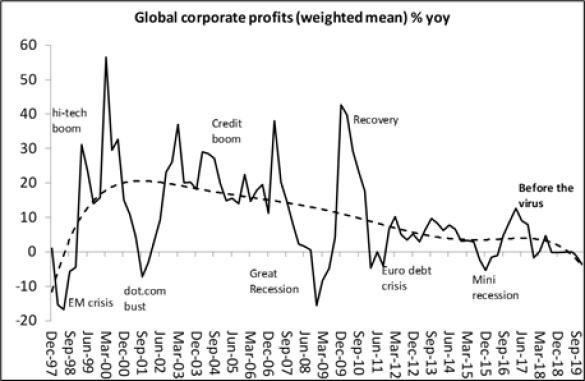
economies. In fact, if we look at total global corporate profits (Fig.
11)and not just the amount of profits per investment (i.e.
profitability), we see that the total amount of profits had ground to a
halt in the major economies as we entered the pandemic. The world
economy was already about to enter a slump of some proportion but now of
course the pandemic has worsened the slump.
Fig. 11: Trend in Global Corporate Profits
A part of the problem to overcome the
low profitability was that the companies were borrowing more, increasing
their debt, taking loans from the bank and trying to keep going
particularly the smaller companies which had to take a lot of debt
compared to the sales that they were making in order to keep moving. And
that has increased the weight of burden on them. If anything should go
wrong, they are left with huge amounts of debt. They have to pay and if
they default, not only these companies will be in trouble but also the
lenders. Emerging markets have seen a dramatic increase in debts while
the growth has been slowing down. The point where the two curves
intersect in the (Fig. 12) shows that most emerging economies are in
serious trouble as a result of the pandemic.
Fig. 12: Debt Vs Growth
Figures for India (Fig. 13) shows a
sharp drop in profitability of Indian capitalist sector
post-independence till the early 80’s followed by a recovery through
globalisation and expansion of neoliberal policies. But also, since the
Great Recession, levels of profitability have been generally depressed
although in the first couple of years of the Modi administration there
was a recovery as they applied measures to try and boost capitalist
profitability at the expense of workers. But on the whole, the
profitability is nowhere near as it used to be in the 1960s in India.
Fig. 13: Profitability – India
This means that even a country like
India, which has been one of the more successful expansive emerging
economies, has faced the same difficulties when it comes to
profitability. We see that in the dramatic slump in the growth rate from
6-7% claimed by the government back in 2016-17 – although many argue
these figures are not accurate. But now, even in the official figures
growth just before the pandemic had dropped quite significantly to 4.7%,
a very low figure by Indian standards over the last 10-15 years.
Here is a measure by the IMF only this
last week (Fig. 14) where they expect India’s growth rate of 4.2% in
2019 to drop to 1.9% this year. I think that is probably optimistic but
nevertheless that is a demonstration of how severe the effect of the
pandemic, lock down and the collapse of the global economy is hitting
India. Of course, they expect a recovery in 2021 but one has to wait and
watch how it turns out. The green line in the graph shows how much has
been already lost in the Indian economy as a result of this crisis.
Fig. 14: India’s GDP ForecastRisk for India
The risk for India from COVID-19,
according to me, still persists. Yes, it may be less than in other
countries but even so, if 65 percent of the population gets infected
without any vaccine or a lock down, even with a lower death rate
(assuming 0.3% similar to Germany) because of the younger population,
still 2 million people could die from this pandemic. Remember, only 0.8%
of the population may be above 80 (nearly 75% are below 40), but they
still face the real dangers of the pandemic.
When people are so poor, it
increases the likelihood that they will be infected and suffer severe
illness or death from the disease. Many Indians, although young, if
they are poor and are unable to have good diets or maintain a healthy
distance, then they are also liable to be severely impacted by the
virus. The rate of heart diseases in India is almost twice that of Italy
and the prevalence of respiratory diseases is one of the highest in the
world. India is also home to one-sixth of the total diabetic population
in the world which increases its vulnerability of Indians.
Thus, India is not safe from the
pathogen and anyone who says otherwise is not looking at the facts.
Latest figures on the daily COVID-19 deaths in India shows that it is
not really coming down at the moment. There is gradual increase in the
number of infections and deaths per day and it is well up from where
they were a month ago. There has been no mass testing in India and there
are very few respiratory systems (40,000 for a total population of 1.3
billion), isolation beds (1 per 84,000 people), doctors (1 per 11,600
patients) and hospital beds (1 per 1826 people). Therefore, things are
not under control in India yet.
India’s and upper-middle-class may be
comfortably barricaded inside their capacious homes but the poorest and
most vulnerable slum-dwellers live cheek-by jowl and are extremely
vulnerable to contracting the infection. Not just the slum-dwellers but
also the ordinary working people in Indian cities who have to live and
work in small spaces are also at severe risk or catching the virus or
losing their jobs. Sky high urban real estate prices mean plenty of
working-class families, even those with two earning members, can only
afford the tiniest of homes. India is one of the most unequal countries
in the world when it comes to wealth.
Top 1% own more than 50% of the
India’s personal wealth, and the top 10% hold almost 80%, which is only
beaten by countries like Russia and Thailand on this list. India is more
unequal in terms of wealth compared to the US which is the worst of the
advanced capitalist countries. Number of people living in slums is over
100 million which is way more compared to other countries in South and
Southeast Asia. This population is at risk at all times in this crisis.
What is the Indian government doing
about this crisis? Here is a quick look at the figures from IMF (Fig.
15)which shows how much each country is spending both in providing loans
and equity injections to banks and companies (in grey) and how much it
spends in providing support for the households and health systems (in
orange). India is right down at the bottom in terms of
government spending. Only South Africa which is in a serious economic
situation is lower than India in this graph according to the IMF.
Fig. 15: Expenditure by Countries
The Modi government is spending little
on the emergency. It has a combined state and central fiscal deficit
hitting 10% of the GDP as against the budgeted 6.5% and is unwilling to
borrow any more for emergency funds. That is because there is a huge
debt to GDP ratio and at 70%, this is about the highest in its peer
group. After this crisis you can expect the government to attempt to
squeeze back the increase in debt that has taken place. The government
needs to spend more but it is spending less than 1% of GDP currently on
the crisis. I would leave this to you whether Kerala is doing better in
terms of healthcare because it is what we are hearing in the Western
media. According to reports the state is has the best healthcare system
in the country and they have kept the mortality rate low and recovery
rate high.
What is to be expected?
Finally, I would like to discuss what
is going to happen. Are we going to return to normal after a few
quarters as the stock exchange in the US believes? Here (Fig. 16) is an
indication of how far away now the US economy is from its previous
trends in the 20th century. When the Great Recession hit in 2008-09, the
real GDP per capita fell and the recovery was much slower than the
trend and there is no sign that it returned to trend at all during the
period 2010-2020.
Fig. 16: US Economy – Historical Trend Vs Current
Similar trends were reported by the
World Trade Organization (Fig. 17) which show that the trajectory of
world trade fell after 2008 and after the slump they set on a new
trajectory which was lower and weaker than the original trajectory. And
with this pandemic we are going to slump again and quite like will have
new even lower trajectory of world trade. When we come out of this
crisis many economies, particularly those that depend on world trade –
manufacturing and, selling commodities and services – would be severely
affected and if there is no restoration of the global value chains,
there will be no return to normal trajectory and we could remain on this
low trajectory forever or at least till the foreseeable future.
Fig. 17: World Trade
That is why I consider the last ten
years before the virus as a long depression as it was marked by low
growth, low productivity and low wages in many countries. It looks as
though we are about to enter another leg of this long depression. In the
19th century there was a long depression that lasted for about 20 years
from 1870’s to the 1890’s (Fig. 18).It seems to me that we are about to
enter another leg of depression that could last for another 10 years
with low productivity, suppressed wages, weak growth, low investment,
lack of jobs and training, and low income. The public sector will be
under tremendous pressure to be squeezed by capitalism to pave a way out
of this pandemic. That is the situation we are likely to enter in the
next period.
Fig. 18: A Long Depression
The Lessons
To sum up just a few lessons we have learned.
First, it is capitalism that has
generated this crisis and not nature as such. It is a combination of
industrial farming, climate change and all the other things that have
produced this pandemic.
Second, the market has failed to cope
with this pandemic. Everywhere governments based on capitalist markets
have failed abysmally, whether it is their pharmaceutical companies or
their health systems marked by fund cuts. They have had to interfere in
the most emergency and direct ways rather than prepare for this.
Third, COVID-19 has exposed that it is
the workers who are most exposed to this infection. It is those workers
whose jobs that are most undervalued by this system who we rely on the
most, and not the ones making money on the stock market.
Fourth, with the total failure of
private healthcare and big pharma, what we need around the world is
coordinated free public health system, with mass public investment in
research and production of medicines and vaccines, to ensure that these
pandemics when they come again can be dealt in a much more efficient way
with minimal loss of life.
Fifth, instead of bailouts of big
business and banks, which is what the big economies around the world are
starting to do, we need to take over these companies and plan them so
that they don’t go back to the “normal’ of being driven solely by
profitability.
Sixth, it is staggering to me that a
company like Amazon, which is now making huge amounts of money, ten
thousand dollars a second by delivering things around the vast economies
is not publicly owned. This is a company that requires control by
democratic decisions of the people. Besides, key services like mail,
broadband, and social media should be public operated to meet the need
of the people and not just make profits for the few.
Finally, above all, the debts of poor
economies should be cancelled and profits from tax havens should be
moved out in to governments so that profits of big MNCs can be used to
improve and maintain public services.
These are the lessons we can learn
from this crisis. This is not going to be an easy period and we are not
going to come out of it very quickly. We in the labour movements and
working people must recognise the things that we need to do and struggle
for, once the lock downs and the pandemic is over, as capitalism will
try to return to business as usual.
Just a few personal comments about the daily, every minute of every day,
struggles in the workplace.
There are two sources of power in the
workplace just as there are in society----the bosses and the organized
working class. The battles against the landlords if your a renter,
against the police if you are a victim of police abuse, if you are a
student fighting the administration, or any time one comes up against
the forces of the state, these are are important battles. But in my
humble opinion (I'm not going to use the acronym) the battle in the
workplace is the great educator.
This is where the rubber meets the
road. Along with this is the internal struggle between different
ideologies and views as to how this battle should be conducted. This is
the harder struggle as it is an internal one. Then there are the
opportunists, bootlickers, social climbers and so on. They are generally no threat as every worker, given the opportunity, recognizes them. If the rank and file are not present of course, that's different. When the working class moves in to struggle no matter whether it comes first inside or outside of organized labor, the present leadership will be dislodged, like rotten apples on a tree that appear to be stable but fall to the ground in the face of a strong wind.