Thursday, April 30, 2020

Book review: Virolution, by Frank Ryan


Order

I came by this book, Virolution, by Frank Ryan, as a Christmas present, from someone who knew my background and interest in Science. In the light of the coronavirus pandemic, it was moved forward in my ‘reading queue’ and has proved to be a very interesting read.

The book is not an easy read for non-scientists, particularly its later chapters, but it raises some extremely interesting points and the author suggest that viruses may be linked to sudden jumps in the evolutionary development of plants and animals, including humans.

Switching genes on and off
It is probably useful at first to give an overview about the mechanisms of inheritance and about how viruses work. It is common knowledge that inheritance is coded in a complex molecule, DNA, which is found in all living cells. DNA is organised into large structures called chromosomes and all human cells have 23 matching pairs, ie 46, with other organisms having different numbers. Each one of a ‘pair’ is not quite identical because one has come from each parent.

Sections of a chromosome, called ‘genes’, are responsible for the inheritance of all an organism’s features like appearance and shape, but also for more ‘hidden’ features to do with internal metabolism, like digestion and respiration.

Every cell in the human body has an identical set of genes. What is still unknown to genetics – and is at the forefront of a lot of modern research – is why and how some genes are switched off and others are switched on in a cell. The switching has to happen, otherwise every cell would be identical and there would not be different liver, muscle, nerve, kidney, skin and other cells. For a cell to be able to do its job as part of some particular tissue, only some of its genes have to function and the rest need to be switched off. Thus, certain genes are “expressed” (ie switched on) and if the switching mechanism fails, it can cause cancers and congenital conditions.

Humans: 20,000 genes in the genome
In practice, genes rarely work individually, but interact with others, so by means of genes, or complexes of genes, characteristics are inherited from generation to generation. Humans have about 20,000 genes. All organisms are said to have a genome, which is the sum of its genetic structures.

If a particular gene can impart a useful ‘value’ to a living organism – a feature that improves the likelihood of it being able to procreate in its given environment – then that feature and gene responsible for it are passed down the generations.

Richard Dawkins coined the expression the Selfish Gene, as an illustration of how genes are selected by nature to survive, because the characteristic they impart is selected. The term was a literary device – Dawkins did not suggest that genes had ‘thoughts’ or ‘intentions’. But he explained that for a gene to be perpetuated down the generations, it must impart some advantage to its ‘host’ organism. It is as if genes ‘want’ to survive.

Bacteria different to viruses
Coming to viruses, we need to distinguish them from bacteria, which are living cells and which often function in isolation from other cells and organisms. Viruses are a lot smaller than bacteria, but their key difference is that they cannot ‘function’ on their own behalf.

Outside of any other cells, viruses are completely inert and individual viruses are referred to as virus particles. A virus particle is rather like a ‘packet’ of DNA (or a related molecule, RNA) surrounded by a protective protein coat. Its precise shape and structure depend on the type of virus, but all of them follow the same pattern.

On its own, unlike a bacterial cell, a virus particle cannot engage in any metabolic activity. It just ‘sits’ there, as it were, doing nothing. It is for that reason that there are arguments about whether a virus is really ‘alive’ in the same way as other living organisms. Viruses only come ‘alive’ inside ‘host’ cells. They can only reproduce inside living cells, including, by the way, bacteria.

Viruses are all around us
There are a lot of viruses, inside us, on us and all around us and an uncountable number of different types. According to the virology website “If we assume that the 62,305 known vertebrate species each harbour 58 viruses, the number of unknown viruses rises to 3,613,690…if we include the 1,740,330 known species of vertebrates, invertebrates, plants, lichens, mushrooms, and brown algae. This number does not include viruses of bacteria, archaea, and other single-celled organisms. Considering that there are virus particles in the oceans – mostly bacteriophages – the number is likely to be substantially higher”. 1031 for the non-mathematicians, is a 1, followed by 31 zeros. A lot of viruses. Scientists have even been successful in extracting viruses from frozen tissue collections and in extracting DNA from fossil organisms 

At least one virus can be created from scratch
Viruses are classified according to things like their shape, their preferred ‘hosts’ and their genetic make-up. One type of viruses are the “retroviruses” so-called because of the way they ‘capture’ and manipulate host DNA…more of which later. 

Some viruses are very simple. “If you know the genetic formula of a virus,” Ryan, explains in Virolution, “you can reconstruct it” and in fact, he gives the chemical formula of a polio virus as follows:
C332,652H492,388N98,245O131,196P7,501S2,340

It was as long ago as 2002, he points out, that a scientist in New York became the first person to reconstruct the polio virus “from mail order components back in his lab.”
Once a plant or animal cell is successfully invaded, the virus particle releases its own DNA into the cell, to effectively take over the DNA of the cell and therefore the management of its metabolism. Instead of continuing its ‘normal’ functions, the cell is commandeered to making millions of copies of the virus particle, which are then released to infest other cells. Eventually, the host cell dies, by which time, not only has it failed its host by not carrying on its proper function, but it has released millions more viruses to infect other cells.

No advantage in killing the host
Because of their capacity to commandeer and manage the host DNA, viruses can mutate extremely rapidly, much more so than other organisms. Using the Dawkins ‘selfish gene’ metaphor, we can imagine a virus particle ‘wanting’ to be modified so as to be more successful in passing on its genes.

In relation to coronavirus, or any virus, therefore, there is no evolutionary ‘advantage’ in killing its host. For its own genes to survive and be procreated, it is far better for a virus to mutate towards being more infective, but less dangerous to its hosts.
According to the early reports of different coronavirus strains, that is indeed what seems to have happened, with the later strains being more easily transmitted but less dangerous than the first.

Now we come to the interesting part and the focus of Frank Ryan’s book: the  suggestion, in effect, that viruses have played a key part in evolution, especially where there have been significant and rapid ‘jumps’ in evolutionary change. He argues that “Analysis thus far has shown a very tight correlation between the evolutionary tree that illustrates the history of the mammalian host and the evolutionary tree that illustrates the history of viruses…” Ryan’s book links human DNA (and other organisms, but we’ll stick to humans) directly to viral DNA. “What if both the virus and its mammalian host,” he asks, “are influencing one another’s evolution, one evolutionary tree, interacting with the other, over the vast time periods of their co-evolution?”

Right out of Dialectics of Nature
In a passage that could have come right out of a modern-day equivalent of Engels’ Dialectics of Nature, he challenges the idea of a species being separate at all. He suggests that “terrestrial life is a dense web of genetic interactions”.

In fact, it is already well known that humans are in a close symbiotic relationship with billions of bacteria in the gut. For every single ‘human’ cell walking around in a ‘person’, there are ten bacterial cells in the gut. The human microbiome is another part of cutting-edge medical research and it is now realised that an unbalanced microbiome can lead to many form of ill-health.

But Frank Ryan takes this a whole step further. “…is it possible”, he asks, “a virus could have a beneficial effect on an animal species…if the presence of a virus might help a host survive?”. Ryan, along with other virologists, now talk about that branch of biology that looks specifically at symbiotic relationships as symbiology.

Ryan offers a mechanism whereby a virus can play a role in influencing the evolution of the host. The process begins with an “aggressive infection” of an exogenous (ie “outside”) retrovirus, often from a closely related or similar species. That infection might ‘cull’ large numbers of the host species, perhaps the big majority, but over a period of time two things happen. Firstly, a fraction of the host species with an in-built genetic immunity will survive and thrive, eventually to become the main population.

Secondly, the virus itself will mutate in such a way that it becomes less lethal to the host and is therefore more likely to be passed on…think ‘selfish’ gene. At this end point, the virus is no longer an aggressive invader but an endogenous and harmless virus, living perpetually inside the host. Exogenous has become endogenous.

Most of our DNA was thought to be ‘junk’
There is ample evidence for this process taking place across many species, but no less so than in human DNA. Looking at all the DNA in a normal human cell, there are no more than 20,000 genes and much of the chromosomes are composed of what used to be called ‘junk’ (ie useless) DNA. Science has now discovered, and in relatively recent years, that, as Ryan says, “the vertebrate component of our genome – the part we normally associated with what makes us human – amounted to a mere 1.5% of the whole.”

But Science is beginning to realise that what used to be considered ‘junk’ is far from it. Large sections of human DNA are identical to sequences of DNA found in retroviruses. In fact, although it is part of the ‘human’ makeup, these are now referred to as the HERV sections – Human Endogenous RetroVirus – of the human genome. “Today we recognise that our retroviral legacy is made up of vast numbers of copies of human endogenous retroviruses…”

Virus gains a kind of ‘immortality’
It is as if a virus has found the perfect way of continuing its own genes, by completely incorporating them in the host genome. This process, Ryan explains, “involves the exogenous virus giving up its freedom for longevity, perhaps a kind of immortality, as a component part of a new genome”. The evolution of the host, therefore, is not just the evolution of the original species genome, but a co-evolution of a new, combined genome.

In relation to the human species, Ryan suggests, the evidence is that the majority of the HERV elements in our DNA were incorporated 10 million years ago in our evolution, during a stage of primate evolution. But there are also important sections believed to have more recent origins. This is not the time or place to discuss the complexities and ramifications of human evolution, but a viral modification of genes is certainly a plausible mechanism for sudden accelerations in evolution at any point. Selection may be the ultimate arbiter but given selection pressure on a species in a given environment and location, a viral alteration of important genes may have a sudden and dramatic affect.

Strong argument put forward
What genes would be affected by such an evolutionary “lightning strike” as it is put in the book? Going back to the unknown mechanisms that turn genes on and off, Ryan puts forward a strong argument suggesting that as much as 34% of the human genome are “retroviral derived or controlled.” That word ‘controlled’ is important. He cites instances where it is known that HERV elements in the genome are active in gene control (‘switching’) and it is in that whole area of modern genetic research that HERV elements are being looked at. Thus, a dialectical approach to evolution – where long periods of relative stability are interrupted by sudden and rapid leaps forward – is given a genetic mechanism to account for it.

There are other important elements in the book that look at mechanisms of evolution outside of the mutation-selection model of traditional Darwinism. Readers will have to find these themselves in the book. Suffice to say that at the end of the process the success or otherwise of evolutionary modifications still depend on natural selection – does the new, changed organism have a greater or a lesser chance of successful procreation in the given natural conditions?

The human microbiome is now a well-known feature of medical research and even in treatment today. Ryan’s book opens a door to another particularly important element of the microbiome and one that is normally overlooked: that part of the microbiome that is viral…and at the same time a part of us. Well worth the read.
                

Wednesday, April 29, 2020

Central American Families Hit Hard by US Layoffs.


Mexico: Under pressure from the US, Mexican National Guard attack economic refugees. Source
Richard Mellor
Afscme Local 444, retired


I helped make Mexico, especially Tampico, safe for American oil interests in 1914. I helped make Haiti and Cuba a decent place for the National City Bank boys to collect revenues in. I helped in the raping of half a dozen Central American republics for the benefits of Wall Street. The record of racketeering is long. I helped purify Nicaragua for the international banking house of Brown Brothers in 1909-1912. I brought light to the Dominican Republic for American sugar interests in 1916. In China I helped to see to it that Standard Oil went its way unmolested.
War is a Racket,
Major General Smedley Butler.

The capitalist mass media uses language very carefully, especially when it is reporting on events. During a transportation strike, a TV reporter once asked a member of the inconvenienced public how it felt to be “held hostage” by the striking workers. That’s not biased is it?

The US Predator in Chief has waged a successful war against immigrants and undocumented workers who he and other xenophobes call “illegals”.  Despite there being 500,000 undocumented workers from Europe in the US, the focus has been on workers from Mexico and Central America. Trump will be intensifying his assault on people from this region as the election draws closer. Immigrants from below our southern border are almost always people of color which is a bonus, as they can be attacked on the basis of nationality and color. These economic refugees face all sorts of personal attacks. Trump and right wing politicians have called them criminals, murderers, a cover for Islamic terrorism and so on.

The economic crisis brought on by the coronavirus pandemic is having a devastating affect on these immigrants from the south. The 2 million immigrants from Guatemala working in the US sent about $10.5 billion home in 2019 equal to about 13% of the nation’s gross domestic product. According to Bloomberg BusinessWeek , * transfers to Guatemala fell 9.7% last month and for El Salvador, “….remittances, which account for roughly 21% of GDP, dropped 10.7%...”

This money means life and death for the families these immigrants have left behind, “My mother counted on that money, and now I’m not able to support her,”, one woman from Guatemala working in New York City tells Business Week.  Her mother and son are dependent on it.

 “It’s frustrating….”, she says, “….You have goals, and you want to save as much as you can, because with the immigration situation you never know when they are going to say ‘bye-bye,’ and then you’re left with nothing.”

Michael Bloomberg who was a candidate for the US presidency for a minute or two owns BusinessWeek. In a 100-day campaign to get the Democratic nomination he spent $900 million. He spent $466 million in February alone. To put this in perspective, the International Monetary Fund, the global capitalist institution that demands austerity and forces neo-liberal economic policies on countries in crisis through its Structural Adjustment Programs, has approved $389 million in emergency aid for El Salvador and $143 million for Honduras.

When we read or hear about Central American countries like El Salvador and Guatemala in the US capitalist mass media, it is not a pretty picture. Many people from this region flee north to escape the instability and violence in their countries and the US government is spending billions of dollars building a wall to keep them out. Trump, this degenerate piece of human filth, an accident of history who has risen to the top of the putrid US, body politic, has threatened Guatemala with sanctions, remittance fees and cutting off the meager aid the US provides to this tiny country if it doesn’t do more to stop economic refugees from heading north. In other words, the US government wants this tiny poverty stricken country to bear the burden of the poverty that is a direct product of US imperialism’s role in the region.

Business Week ignores this history when it reports on the conditions that exist in this region. The mass dailies always do. “Low wages, poverty, and gang violence have forced millions of Central Americans to migrate to the U.S.”, Business Week writes. This is the normal narrative when it comes to Central America and the countries in what US capitalism considers its own backyard.

But why are these countries poor?  Why the violence? Why are people willing to risk life and limb and leave their families to come north?

Much like European colonialism considered Africa its own backyard, US capitalism has the same view of Mexico, Central and South America. US capitalism has plundered these regions, has assassinated leaders or overthrown or undermined any government that threatened the interests of US capitalism’s profits in the region.

Guatemala
In 1954, a CIA sponsored coup overthrew Guatemala’s democratically elected government of Jacobo Arbenz on behalf of the United Fruit Co. and other big landowners.  Arbenz had introduced land reforms that threatened the domination of the United Fruit Company over Guatemalan society. Only 2% of landowners owned 72% of the arable land, much of it unused.  United fruit alone held 600,000 acres of mostly unused land.  The Guatemalan colonel that the CIA selected to replace Arbenz immediately outlawed hundreds of trade unions and returned more than 1.5 million acres to United fruit Co.

Similar situations occurred throughout Central and South America as rebellions against the domination of U.S. corporations over society were suppressed by the U.S. government and its stooges.  It is important for us to understand this aspect of the migration north of working class people; particularly the indigenous population that was viciously persecuted by U.S. sponsored regimes.

El Salvador
Supported by El Salvadore's Catholic Church a movement toward democracy developed in the late 60's and 70's that gave El Salvadorians some hope for a better future.  But the more this movement developed the more repressive the oligarchy and its military dictatorship became. A civil war erupted in 1979 after an army coup aborted the results of a democratic election.  During the next two years right wing death squads supported by the U.S. hunted down any dissidents; more than 8,000 trade unionists were murdered or abducted during this period. Siding with the El Salvadorian oligarchy, the U.S. government provided them with $3.7bn in aid from 1981-89, 70% of this money was for weapons and war assistance.  Such was the terror in El Salvador that thousands of people fled north to the U.S. to escape death ands torture. **

People do not leave their country, their communities and their homes because they reject their culture. People will risk life and death to feed their children and offer them a future. The poverty and the social crises in US capitalism’s “backyard” have roots in the predatory colonial policies over centuries; first with European colonialism and then US imperialism.  Firstly, these nation states, just like those in Africa, were created from without by the occupying capitalist powers to serve their economic interests.

They never developed organically from within like the nation states of Europe. Tribal communities were corralled in to a geographical area whose borders meant nothing to them.  It is not unlike the enclosure of common land in England.

There is at this juncture a real national consciousness as most people feel El Salvadorian, Guatemalan or Honduran but their economies are completely dominated by US imperialism and, despite being referred to as developing or emerging economies, will do neither.

It is not in the interests of global capitalism to explain its own history to the masses of the population. Here in the US, as in all capitalist countries, the history of the working class and our struggle to build unions and improve working conditions is not taught in a serious way. The conditions savaging minority communities cannot be understood without having a materialist understanding of the world and how capitalism works.

Poverty will never be eradicated by capitalism it is an integral part of it. Black American’s totally excluded from society for centuries or Native American’s shuttled off in to reservations can never overcome the legacy of this history within the framework of capitalism.

If we do not understand how society works and the developments that brought us this far, we can fall prey to racist or nationalist ideology, that these nations are in the state they are in because of their ethnic composition or religious views. This is the purpose of Trump’s wall mania. This excuse was used to explain the economic backwardness of Ireland for centuries up until the 1960’s, not the occupation of the country by English/British capitalism for centuries using it as a source of cheap labor and food.

The present pandemic and the abject failure of the so-called free market’s response has changed the world. Here in the US, Trump and co. will increase the xenophobic attacks, continue to blame foreigners, socialists, the US worker, China, for the crisis. But lessons will be learned from this experience. Governments are not going to have such an easy time of it passing the costs of this bailout of capitalism, the second time in a decade, on to the backs of workers, the middle class and the poor. There are going to be some major class battles up ahead.

Workers can win these battles. But we can’t win them within the confines of the nation state. International solidarity and action across borders is the answer. Collective control over the economic life of society is the answer. The immigrants, undocumented or not, that Trump is blaming for capitalism’s failures play a valuable role in the day to day working of US society; they are among the most exploited section of the US working class. They do not leave their homeland voluntarily; they are economic refugees, victims of global capitalism just as we all are. Uniting with them in their struggle to improve their material well being and conditions at home is what will save them from the horrors they face trying to escape north and the super exploitation they face if they make it to their destination.

The solution to this madness of the market is not capitalist globalization, it is socialist globalization
** Sources on Guatemala and El Salvador from, Harvest or Empire: A History of Latinos in America by Juan Gonzalez 

Monday, April 27, 2020

Gulf States Use Coronavirus to Increase Repression

Gulf states use coronavirus threat to tighten authoritarian controls and surveillance

 April 21, 2020 9.11am EDT
A man is tested for coronavirus at a drive-through facility in Dubai, the United Arab Emirates. Mahmoud Khaled/EPA

Matthew Hedges, Durham University
Governments across the Middle East have moved to upgrade their surveillance capabilities under the banner of combatting COVID-19, the disease linked to the new coronavirus.

Overtly repressive policies have been commonplace across the Middle East for years, notably in Egypt, Iraq and Syria, where violent measures have been taken to control populations.

As a result of technological advances, an increase in political engagement and changes of leadership, the states of the Gulf Cooperation Council (GCC) – Bahrain, Kuwait, Oman, Qatar, Saudi Arabia and the United Arab Emirates (UAE) – have also upgraded their form of authoritarianism in recent years.

This has seen policies of partial economic liberalisation and market-based reforms used to obscure an increase in repression and surveillance, for example by containing the work of civil society groups.
Following the pattern in which authoritarian states tend to exploit common threats, some of the GCC states are now manipulating the current pandemic to enhance their social power and control – as I’ve explored in a recent article as part of a contribution for the Project on Middle East Political Science at George Washington University.

New controls

In Dubai, nationwide curfews have been put in place and enforced by the security services and surveillance. Authorities in the UAE have also introduced criminal penalties for the dissemination of information about the virus deemed to be false. Meanwhile, Bahrain introduced electronic tags for patients who had tested positive for COVID-19. In Saudi Arabia, people have been arrested for violating strict curfew laws.

Beijing’s recent admission that more people had died than originally reported in Wuhan, the original epicentre of the pandemic, shows the fragile nature of information and truth within authoritarian states. Likewise, it’s difficult to assess the scale of who has been affected so far across the GCC.

According to official government statistics as of April 21, there were 10,484 reported cases in Saudi Arabia and 103 deaths from COVID-19. The UAE had reported 7,265 cases and 43 deaths, Qatar 6,105 ases and nine deaths and Kuwait 2,080 cases and 11 deaths.

China’s handling of its own early COVID-19 whistleblowers showed how authoritarian states often react promptly to the dissemination of news which could undermine their authority. Of course, the curtailing of “fake news” during this time is important to prevent hysteria and panic.

But from my own experience of being forcibly detained for six months and falsely accused of spying charges in the UAE, I know full well how these laws can be abused and twisted for ulterior purposes. The real test will be to see if all of these preventative laws are relaxed once the pandemic is under control.

The inherent weaknesses of GCC states are also being further exposed through this pandemic. GCC citizens only inadvertently hold the power of accountability over their monarchies, due to the lack of formal political mechanisms that generate and provide legitimacy in democracies. In essence, the monarchs hold power until they don’t.

In response, Middle Eastern states have introduced programmes in recent years that emphasise cultural traditions in an attempt to further centralise power using key figures within their regime. A recent anti-corruption drive in Saudi Arabia, which climaxed with the Ritz-Carlton incident in which more than 30 elite figures were detained in a luxury hotel, highlighted the ascendancy of Mohammed Bin Salman, the crown prince.

In the UAE, the security state has been intensified through the creation of conscription programmes which emphasise national identity under the patronage of Abu Dhabi Crown Prince Mohammed bin Zayed.

Biopolitics

Central to the current messaging around COVID-19 is the heightened value of “purity” within the nation. This notion has been promoted through the prism of the family, with the region’s rulers extending the meaning to include the nation in an attempt to retain cohesiveness. In the current context, for example, only one member of a family is allowed to pick up food during the lockdown in some Gulf states, and there have been greater protections imposed for nationals than non-nationals, many of whom have been deported.

But this comes at a moment when the so-called purity of the family unit is under threat as dowry costs, marriages to foreigners and divorce rates are all increasing across the GCC. This has helped maintain a heightened significance of the family within GCC politics. As a result, issues such as homosexuality, marriage to foreigners and now even COVID-19 are seen as a threat which has the potential to dilute the national gene pool.

The GCC states are also capitalising on a new vein of conservative nationalism across the region that is highly personalised and driven by security concerns. An era of assertive foreign policy from Riyadh, Abu Dhabi and Doha is now playing out as a matter of principle and survival. As a result, Saudi Arabia and the UAE have fortified their political and military engagements. Their closer ties with regional players such as Libya’s General Khalifa Haftar and pro-government Yemeni forces have helped keep these conflicts alive within a reduced footprint.

Back home, the GCC states have exploited the underlying threats of the virus to bolster their own survival strategies. In the past, authoritarian states such as the former Soviet Union often relied on crude illustrations of force alongside state propaganda. But the modern authoritarians in the GCC take a more co-optive route to manage their populations. They have been able to enact policies which undermine civil liberties, perpetuating their current political designs and generating no protest from their populations. So it’s crucial to understand how these practices are maintained, why they have the population’s consent, and upon what basis they will continue to be applied.The Conversation

Matthew Hedges
, Doctoral Research Candidate in the School of Government and International Affairs, Durham University

This article is republished from The Conversation under a Creative Commons license. Read the original article.

Sunday, April 26, 2020

The U.S. in the Trump Era. How Others See It.

Here is an article from the Irish Times. A look at how some in the rest of the world are reacting to the present state of affairs in the US. FFWP shares it for our readers' interests and don't necessarily endorse all the conclusions, the size of Trumps base for example. But it is a very interesting article.  The original can be read here. The image is not from the original. Admin.

Trump with the Saudi's. Source: New York Times

THE WORLD HAS LOVED, HATED AND ENVIED THE U.S. NOW, FOR THE FIRST TIME. WE PITY IT

IrishTimes
April 25, 2020 By Fintan O’Toole

Over more than two centuries, the United States has stirred a very wide range of feelings in the rest of the world: love and hatred, fear and hope, envy and contempt, awe and anger. But there is one emotion that has never been directed towards the US until now: pity.

However bad things are for most other rich democracies, it is hard not to feel sorry for Americans. Most of them did not vote for Donald Trump in 2016. Yet they are locked down with a malignant narcissist who, instead of protecting his people from Covid-19, has amplified its lethality. The country Trump promised to make great again has never in its history seemed so pitiful.

Will American prestige ever recover from this shameful episode? The US went into the coronavirus crisis with immense advantages: precious weeks of warning about what was coming, the world’s best concentration of medical and scientific expertise, effectively limitless financial resources, a military complex with stunning logistical capacity and most of the world’s leading technology corporations. Yet it managed to make itself the global epicentre of the pandemic.

As the American writer George Packer puts it in the current edition of the Atlantic, “The United States reacted ... like Pakistan or Belarus – like a country with shoddy infrastructure and a dysfunctional government whose leaders were too corrupt or stupid to head off mass suffering.”

It is one thing to be powerless in the face of a natural disaster, quite another to watch vast power being squandered in real time – wilfully, malevolently, vindictively. It is one thing for governments to fail (as, in one degree or another, most governments did), quite another to watch a ruler and his supporters actively spread a deadly virus. Trump, his party and Rupert Murdoch’s Fox News became vectors of the pestilence.

The grotesque spectacle of the president openly inciting people (some of them armed) to take to the streets to oppose the restrictions that save lives is the manifestation of a political death wish. What are supposed to be daily briefings on the crisis, demonstrative of national unity in the face of a shared challenge, have been used by Trump merely to sow confusion and division. They provide a recurring horror show in which all the neuroses that haunt the American subconscious dance naked on live TV.

If the plague is a test, its ruling political nexus ensured that the US would fail it at a terrible cost in human lives. In the process, the idea of the US as the world’s leading nation – an idea that has shaped the past century – has all but evaporated.

Other than the Trump impersonator Jair Bolsonaro in Brazil, who is now looking to the US as the exemplar of anything other than what not to do? How many people in Düsseldorf or Dublin are wishing they lived in Detroit or Dallas?

It is hard to remember now but, even in 2017, when Trump took office, the conventional wisdom in the US was that the Republican Party and the broader framework of US political institutions would prevent him from doing too much damage. This was always a delusion, but the pandemic has exposed it in the most savage ways.

Abject surrender

What used to be called mainstream conservatism has not absorbed Trump – he has absorbed it. Almost the entire right-wing half of American politics has surrendered abjectly to him. It has sacrificed on the altar of wanton stupidity the most basic ideas of responsibility, care and even safety.

Thus, even at the very end of March, 15 Republican governors had failed to order people to stay at home or to close non-essential businesses. In Alabama, for example, it was not until April 3rd that governor Kay Ivey finally issued a stay-at-home order.

In Florida, the state with the highest concentration of elderly people with underlying conditions, governor Ron DeSantis, a Trump mini-me, kept the beach resorts open to students travelling from all over the US for spring break parties. Even on April 1st, when he issued restrictions, DeSantis exempted religious services and “recreational activities”.

Georgia governor Brian Kemp, when he finally issued a stay-at-home order on April 1st, explained: “We didn’t know that [the virus can be spread by people without symptoms] until the last 24 hours.”

This is not mere ignorance – it is deliberate and homicidal stupidity. There is, as the demonstrations this week in US cities have shown, plenty of political mileage in denying the reality of the pandemic. It is fuelled by Fox News and far-right internet sites, and it reaps for these politicians millions of dollars in donations, mostly (in an ugly irony) from older people who are most vulnerable to the coronavirus.

It draws on a concoction of conspiracy theories, hatred of science, paranoia about the “deep state” and religious providentialism (God will protect the good folks) that is now very deeply infused in the mindset of the American right.

Trump embodies and enacts this mindset, but he did not invent it. The US response to the coronavirus crisis has been paralysed by a contradiction that the Republicans have inserted into the heart of US democracy. On the one hand, they want to control all the levers of governmental power. On the other they have created a popular base by playing on the notion that government is innately evil and must not be trusted.

The contradiction was made manifest in two of Trump’s statements on the pandemic: on the one hand that he has “total authority”, and on the other that “I don’t take responsibility at all”. Caught between authoritarian and anarchic impulses, he is incapable of coherence.

Fertile ground

 But this is not just Donald Trump. The crisis has shown definitively that Trump’s presidency is not an aberration. It has grown on soil long prepared to receive it. The monstrous blossoming of misrule has structure and purpose and strategy behind it.

There are very powerful interests who demand “freedom” in order to do as they like with the environment, society and the economy. They have infused a very large part of American culture with the belief that “freedom” is literally more important than life. My freedom to own assault weapons trumps your right not to get shot at school. Now, my freedom to go to the barber (“I Need a Haircut” read one banner this week in St Paul, Minnesota) trumps your need to avoid infection.

Usually when this kind of outlandish idiocy is displaying itself, there is the comforting thought that, if things were really serious, it would all stop. People would sober up. Instead, a large part of the US has hit the bottle even harder.

And the president, his party and their media allies keep supplying the drinks. There has been no moment of truth, no shock of realisation that the antics have to end. No one of any substance on the US right has stepped in to say: get a grip, people are dying here.

That is the mark of how deep the trouble is for the US – it is not just that Trump has treated the crisis merely as a way to feed tribal hatreds but that this behaviour has become normalised. When the freak show is live on TV every evening, and the star is boasting about his ratings, it is not really a freak show any more. For a very large and solid bloc of Americans, it is reality.

 And this will get worse before it gets better. Trump has at least eight more months in power. In his inaugural address in 2017, he evoked “American carnage” and promised to make it stop. But now that the real carnage has arrived, he is revelling in it. He is in his element.

As things get worse, he will pump more hatred and falsehood, more death-wish defiance of reason and decency, into the groundwater. If a new administration succeeds him in 2021, it will have to clean up the toxic dump he leaves behind. If he is re-elected, toxicity will have become the lifeblood of American politics.

Either way, it will be a long time before the rest of the world can imagine America being great again.

Saturday, April 25, 2020

Ireland: Exploitation of Migrant Workers is Global Issue.


Richard Mellor
Afscme Local 444 AFL-CIO retired

Workers here in the US will find this interesting. It is an interview with migrant workers by a representative of the Irish Union UNITE.  Keelings is an Irish fruit company that has been using workers from the poorer countries of Eastern and Southern Europe to pick fruit.

There has been some controversy as the company flew in Bulgarian workers and the issue of the pandemic has arisen and the safety of these workers and the Irish population as well. Shipping workers 2000 kilometers to do what is is considered non essential work in the middle of a pandemic threatens everyone.

The workers are recruited by an agent in Bulgaria, flown by the Irish airline Ryanair to Dublin and then housed and sent to work in the fields. Michael O’Leary, Ryanair’s owner is a billionaire.

The workers pay about one month’s wages in Bulgaria for a contract that supposedly lasts 12 weeks but with an 8-week probationary period. They earn about $300 Euro’s a week and out of that but they have to pay 95 euro’s a week for their accommodation and they have other deductions. The union rep calculates they earn about 200 euro’s a week after deductions.  In the wake of the pandemic, a mandatory 300 euro a week wage has been introduced.

So the agent in Bulgaria earns money off them. Ryanair and its billionaire owner, gets a cut, Forbes as it does with parasitic characters in its billionaire club refers to them as “self made”. Keelings the fruit company gets a cut and whoever else is in on the deal. So these workers put a lot of money in the pockets of people who do no work.

While the living conditions described by these two workers do not appear to be as bad as the immigrant workers that are used here in California by agribusiness, though I am not sure of that, the nature of the arrangement is the same.  Capitalism seeks the cheapest labor power and also the most vulnerable and desperate. The euphemism for a desperate worker used by the mass media is “willing”. They are more “willing” to accept lower wages as well as poor and uncertain labor conditions.

Eastern and Southern Europe has more poverty and less opportunity than the north so capital, just like it does with our southern border, sucks out these desperate workers.

There are a couple of other aspects of this that are similar. There are always the xenophobic and racial or national arguments. Immigrants are blamed for taking jobs away from the local people and in the midst of an economic slump there are Irish people who would welcome work but are kept from it due to the social restrictions brought about by the pandemic. In my early life experience, it was the Irish workers, many of them rural people, who were attacked in the most vicious racist fashion and blamed for coming to the UK, taking English jobs and placing downward pressure on wages.

This strategy has its origins in the capitalist class that always needs to keep workers in a state of desperation and uncertainty and unhealthy competition with each other for jobs and life’s necessities and uses race, nationalism color, religion and whatever means at their disposal to make this divide and rule strategy work.  And it is to work in a way that hopefully avoids breaking in to the open which always opens up the possibility of class unity and threatens the interests of the ruling class. In other words, the same social force that uses them as cheap labor blames them for being cheap labor.

No matter what the color, religion or nationality of the people on California’s southern border are, (I live in California) as long as labor power is cheaper and opportunity for profit abundant, capital will flow there.  Capital does not respect and does not want borders.

It’s a good video and I encourage workers to watch it. International class solidarity and united action is what will change this situation. If this pandemic teaches us anything it is that workers of the world have the same interest so workers of the world should unite internationally to protect and advance our economic wellbeing. Wait, didn’t someone say that once?

Here is the statement from the UNITE Faceboook Page

The Keelings experience in workers’ own words.

This is a long but important video for anyone concerned with workers’ rights.

Unite first became aware of the situation facing migrant workers working for Keelings around three years ago, and even before that Unite’s Rhona McCord had been supporting migrant workers in her role as a parliamentary assistant.

While there was outrage at Bulgarian workers arriving recently in the middle of the Covid-19 emergency, migrant workers have been facing an emergency for years.

Watch former Keelings worker Milko and translator Georgi talk to Unite about poverty pay, precarious contracts, substandard accommodation, and a network of exploitation which stretches all the way back to recruitment agents in Bulgaria. “If you’re not together, you can’t help yourselves” is Georgi’s conclusion. Unite will continue supporting all workers organising together to fight exploitation. Workers’ rights will not be respected until all workers’ rights are respected.

Unite would like to thank the Larkin Unemployed Centre for their support in our work with migrant workers.
 

The Greek Tragedy: Act Three

by Michael Roberts

On Thursday night, EU leaders again failed to agree on how to provide proper fiscal support for hard-hit member states to cope with the health costs of the coronavirus pandemic and collapse of their economies from the lockdowns.

The EU leaders have already agreed to a €540bn package of emergency measures.  This sounds a lot but is really just a bunch of loans from the European Stability Mechanism, which lends only on strict conditions on spending and repayment by member states who borrow.  Only E38bn has been offered without conditions for health system support across the whole Eurozone.  The so-called coronavirus mutual bond where the debt is shared by all is a dead duck.

At Thursday’s meeting the countries hardest hit, backed by France, demanded a massive direct fiscal boost.  But the ‘frugal four’ of Germany, Austria, Netherlands and Finland again rejected straight grants in any proposed ‘recovery fund’.  While the EU Commission President von der Leyen talked about a E1trn fund, this would be mostly just more loans.  Guy Verhofstadt, a former Belgian prime minister, said piling more loans on embattled countries risked causing a “new sovereign debt crisis”. “Grants are like water in a fire fight while loans are the fuel,” he said.

Lucas Guttenberg of the Jacques Delors Centre said there was a temptation for the EU to come up with huge headline figures for the fund, but this needed to be backed with significant transfers of cash to the worst affected countries, not just guarantees for private investment projects and loans that added to their debts.  “The question is do we want to create an instrument that gives Italy and Spain significantly more fiscal space?” he said. “That requires a lot more real money on the table.” 

But Germany’s Merkel insisted that any funding borrowed on the markets must ultimately be paid back. There were “limits” on what kind of aid could be offered, she told leaders, adding that grants “do not belong in the category of what I can agree”. So the recovery plan looks like offering just more loans plus guarantees in return for increased investment by private sector companies.  But “we are at a moment where companies are not going to invest because there is a lot of uncertainty,” said Grégory Claeys, a research fellow at Bruegel, the think-tank. What economies needed was direct public spending, he added, because the private sector will do little.

The EU Commission is going to fund its plan by doubling the EU annual budget from 1% of EU GDP to 2% along with some borrowing in capital markets.  But as I argued in a previous post, this will be far too little to turn Europe’s weaker economies around once the lockdowns are over.  What Europe needs is an outright public investment programme, budgeted at around 20% of EU GDP.  This should by-pass the banks and launch directly employed public projects in health, education, renewable energy and technology across borders in Europe.  But there is no chance of that.

While the EU Commission ponders what to do and reports back next month, Europe as a whole, and the weaker economies of the south in particular, are spiralling into a slump that will exceed the depths of the Great Recession in 2008-9.  Much has been talked about the impact on relatively large economies like Italy and Spain.  But there is less talk about the country that was crushed by the Great Recession, the euro debt crisis and the actions of the Troika (the EU, ECB and IMF) – Greece.

I followed the Greek drama in a dozen posts on this blog since 2012 (search for ‘Greece’).  Now the tragedy of the Greeks has become a drama of three acts.  The first was the global financial crash and ensuing slump that exposed the faultlines in the so-called boom of the early years of Greece’s membership of the Eurozone.  The second was the terrible period of austerity imposed by the Troika to which the left Syriza government eventually capitulated, despite the referendum vote of the Greek people to reject the Troika’s draconian measures.

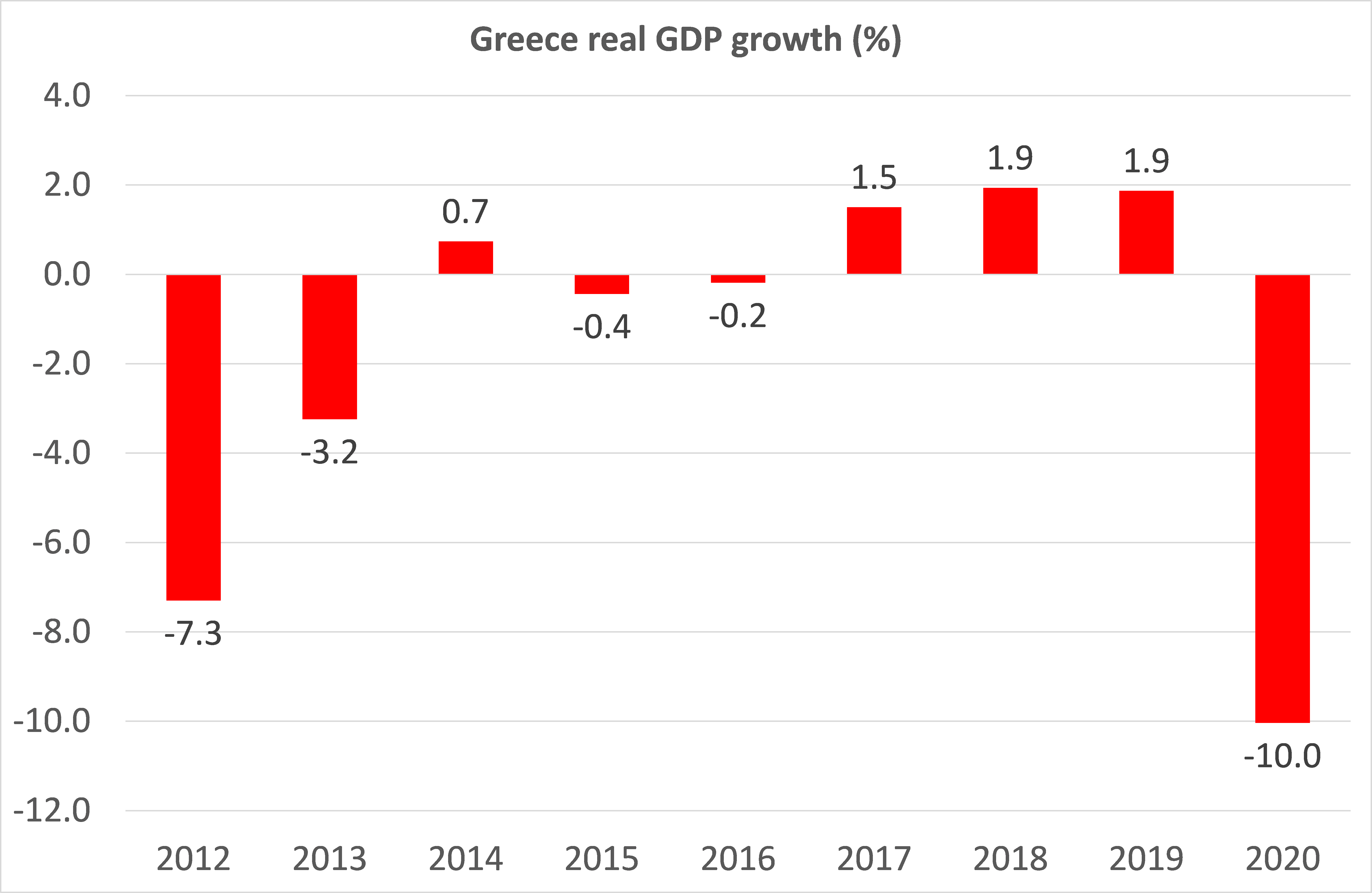
Since then, the Greek capitalist economy has struggled to recover.  By 2017, the deep depression ended and there was some limited growth.  But the real GDP level is still some 25% below its 2010 level.  And real GDP growth started to slow again (as it did in many countries) just before the pandemic hit. Productive investment has been flat for seven years, while employment is down by one-third because so many educated Greeks (half a million) have emigrated to find work.  Large parts of the capitalist sector are in a zombie state – over one-third of loans made by Greek banks are not being serviced and Greek banks have the highest level of non-performing loans in Europe
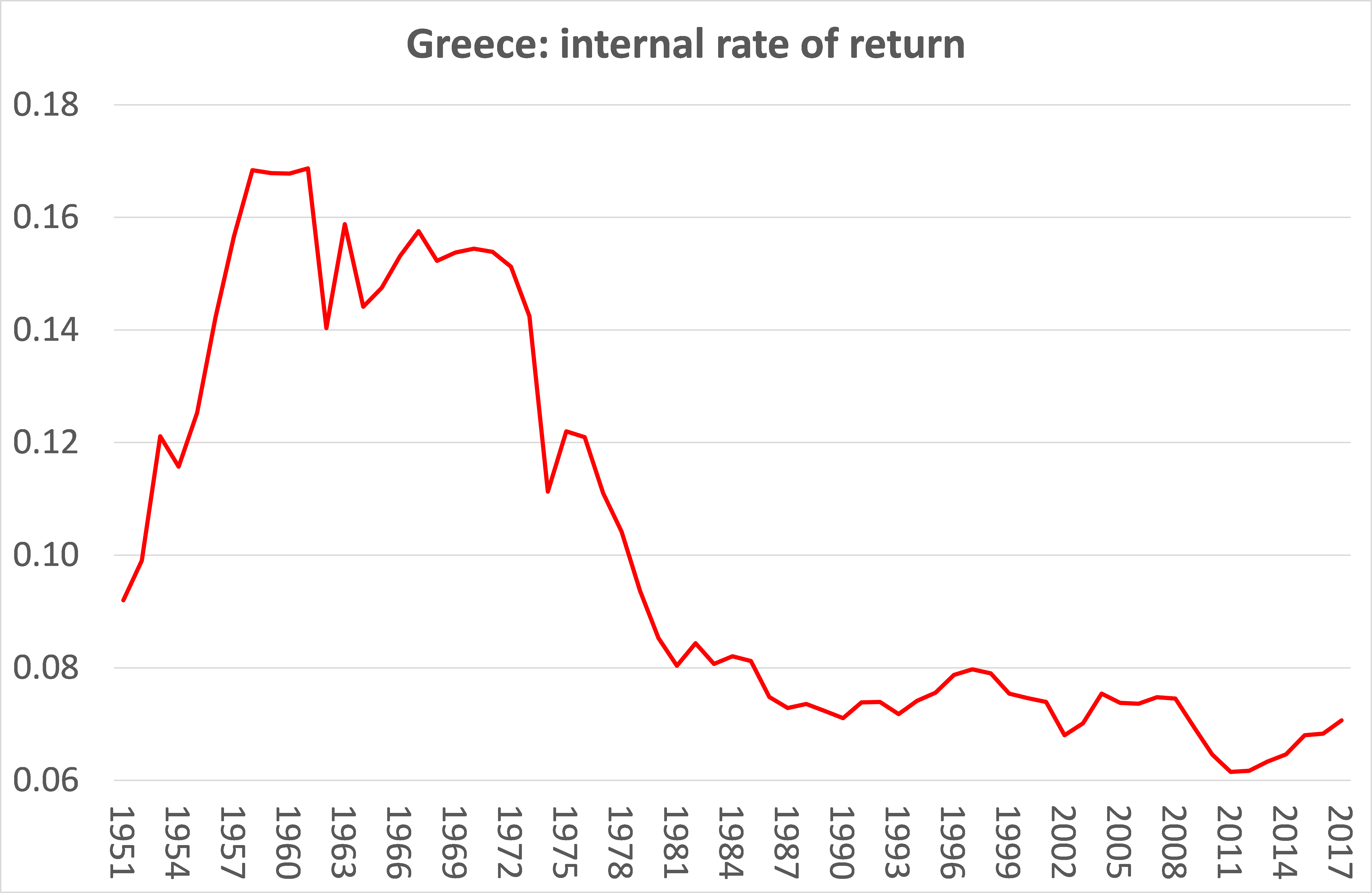
Above all, Greek capital has experienced low and falling profitability.  According to the Penn World Tables, the internal rate of return fell 23% from 1997 to 2012.  From then to 2017, it recovered by just 14%.  But in 2017, profitability was still 12% below 1997.  Since 2017, according to AMECO data, profitability improved, but was still 10% below the pre-crisis level of 2007.


But now Greece’s tragedy is in its third act with the pandemic.  The global economy has entered a slump in production, trade investment and employment that will outstrip the Great Recession of 2008-9, previously the deepest slump since the 1930s.  And Greece is right in the firing line.  Around 25% of its economy is in tourism and that is being decimated.

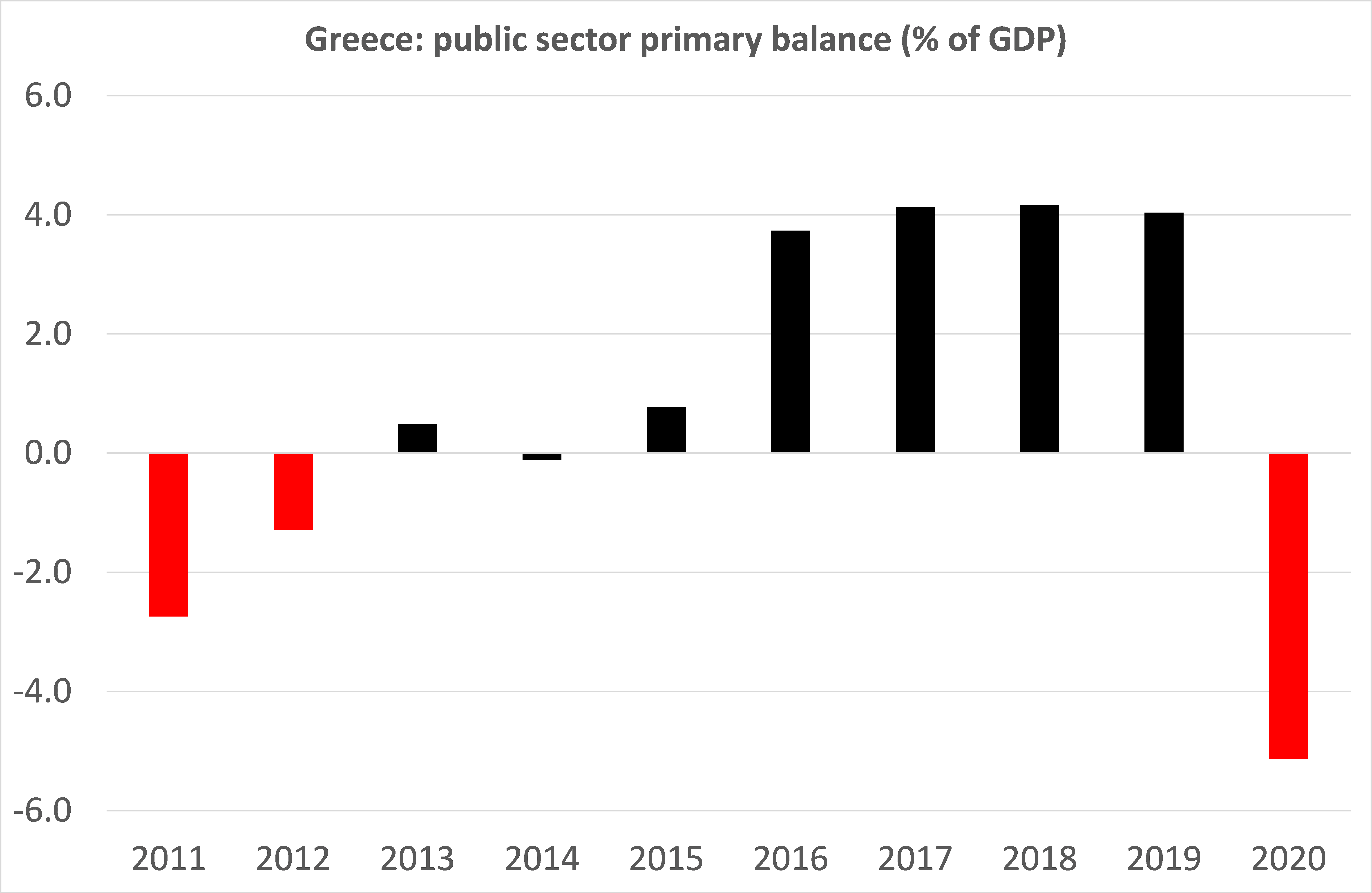
And the government is no financial position to spend to save industry, jobs and incomes.  For years, under the imposition of the Troika first, and later the EU, Greek governments have been forced to run large primary surpluses on their budgets – in other words the government must tax people much more than any spending on public services.


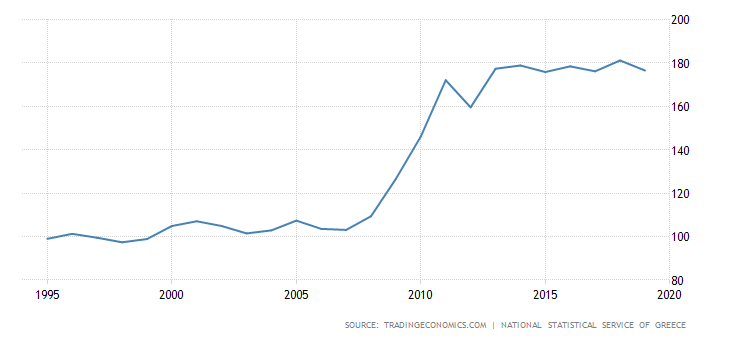
The difference has been used to pay the rising burden of interest on the astronomical level of public debt.  Every year, 3.6% of GDP is paid in interest on public debt that continued to mount to 180% of GDP.


Now the slump will drive down real GDP by 10% according to the IMF and send the debt level to 200% of GDP.  This year, the gross financing needs of the government will reach 25% of GDP (that’s the budget deficit and maturing debt repayments).  Unless fiscal support comes from the rest of the EU, the Greek people will be plunged into another long round of austerity once the lockdown is over.


And there is little sign that Greece will get any more help than it did in Act Two – except to absorb yet more debt.

The failure of the EU leaders to give fiscal support produced a frustrated reaction from former Syriza finance minister and ‘rockstar’ economist Yanis Varoufakis.  Now recently elected as an MP, Varoufakis took note of the EU leaders’ reaction to plight of Italy and Greece.  He thought that “the disintegration of the eurozone has begun. Austerity will be worse than in 2011″.  As he argued back in 2015 during Greek debt crisis, the northern states ought to see “common sense” as it was in their interest to help the likes of Italy and Greece to save the euro.  But if they will not,then Varoufakis reckoned that “the euro was a failed project” and all his work to save Greece and keep it in the euro had been wasted.

Back in 2015, Varoufakis, the self-styled ‘erratic Marxist’, as Syriza’s finance minister, had tried to persuade the Euro leaders of the need for unity.  He had argued that the long depression of the last ten years was “not an environment for radical socialist policies after all”. Instead “it is the Left’s historical duty, at this particular juncture, to stabilise capitalism; to save European capitalism from itself and from the inane handlers of the Eurozone’s inevitable crisis”. He said “we are just not ready to plug the chasm that a collapsing European capitalism will open up with a functioning socialist system”. So his solution at the time was that he should “work towards a broad coalition, even with right-wingers, the purpose of which ought to be the resolution of the Eurozone crisis and the stabilisation of the European Union… Ironically, those of us who loathe the Eurozone have a moral obligation to save it!”

In 2015, the role of Tsipras and the Syriza was even worse.  I’m singling out Varoufakis because he claims allegiance to Marxism, of a sort, and opposition to the capitulation by Syriza in Act Two.  But in his memoirs covering the period of his negotiations with the EU ‘right-wingers’ called Adults in the Room, Varoufakis shows that he went all the way and back to get a deal from the Troika that would not throw Greece into permanent penury – but failed.

In a new book, Capitulation between Adults, Eric Toussaint, scathingly exposes the wrongheaded approach of the ‘erratic marxist’.  Toussaint, who at the time acted as a consultant on debt for the Greek parliament, argues that there was an alternative policy that Syriza and Varoufakis could have adopted.

In a recent interview, Varoufakis was asked “what would I have done differently with the information I had at the time? I think I should have been far less conciliatory to the troika. I should have been far tougher. I should not have sought an interim agreement. I should have given them an ultimatum: “a restructure of debt, or we are out of the euro today”.

Too late for that change of view now.  Instead Act Three of the tragedy has begun.

Friday, April 24, 2020

France: Recession, Austerity, Class Struggle


We share this article on the French situation and perspectives for the future from the British Marxist on Line journal, Left Horizons.  It's a little long but as the LH editors point out, "Not only is it an excellent document in its own right, dealing with developments in France, but many of the points and arguments advanced, perhaps the majority of them, are applicable to the situation in Britain.There are differences, of course, but there are also important points that will resonate with active socialists here. Well worth reading."
French workers strike and protest Macron's pension reforms. January 2020. Source.


By Greg Oxley, CPF Paris

[Editor: This is a long article but it deserves to be published and read. Not only is it an excellent document in its own right, dealing with developments in France, but many of the points and arguments advanced, perhaps the majority of them, are applicable to the situation in Britain.There are differences, of course, but there are also important points that will resonate with active socialists here.
Well worth reading.]
…………………………………………………
In 1740, Prussian troops were parading before Frederick the Great and Prince Leopold, in preparation for the invasion of Silesia. An officer of the guard noted extracts from their conversation, of which the following :  
Frederick: Dear Prince, when you see our army gathered in this way, what impresses you most?
Leopold: Majesty! Could it be anything but the sight of our troops and the regularity and perfection of their movements?
Frederick: No, dear Prince, what impresses me the most is that here we are, perfectly safe as we watch 60,000 men. They are all our enemies, and every one of them is better armed and stronger that we are. And yet they tremble in our presence. We have no reason to be afraid. That, dear Prince, is the miraculous effect of order and subordination!
[From C. Hildebrandt: Anecdotes on the life of Frederick the Great. Volume 5, Leipzig, 1829-35.]
************
The coronavirus pandemic has had a devastating impact on the global economy. It has come at a time when the economic cycle was already starting to descend. In France and Europe, growth rates were already low (1.2% for the euro zone) before the advent of the health crisis. Since then, the economy of Europe and the world has fallen sharply.

According to a first analysis published by the International Monetary Fund, the world economy will contract by 3% in 2020. The American economy will drop by 5.9%, which represents the largest annual decline since 1946. In the euro zone, the IMF forecasts an average 7.5% drop in GDP for the 19 countries concerned. The downturn of the European economy will no doubt be the strongest of all the regions of the world. China's growth rate also slowed before the health crisis. And now, it is not expected to exceed 1.2% for the current year, which would be the slowest growth in the Chinese economy since 1976. No country in the world will escape the recession. The total loss in value to the world economy in 2020 is estimated to be something like 9 trillion dollars. This situation is causing to a sudden deterioration in the living conditions of workers and a massive increase in the number of unemployed. In the euro zone, the number of unemployed is expected to increase by 40%. It is difficult to say how long this recession might last, but its economic and social repercussions could be spread over several years, especially if the virus proves difficult to control in the most developed countries and spreads massively in the Indian subcontinent, Latin America and Africa.

Exceptional circumstances
The capitalists and their political representatives will launch an even more relentless offensive against the rights and living conditions of the workers in order to defend their profits despite the crisis. They will justify the imposition of new austerity measures by the exceptional circumstances arising from the pandemic. In relation to public finances, the capitalists are already demanding massive handouts and tax concessions. Macron and the ECB have responded favourably. Taxpayers will foot the bill. This increase in public spending will go hand in hand with an inevitable reduction in returns from VAT and income taxes, pushing the government to further tighten social spending. Pensions, social benefits – including family allowance or unemployment benefits – will be the target of new attacks.

In businesses and factories throughout the country, employers will strive to maintain and increase profit margins despite the fall in activity, to the detriment of employment, wages and working conditions. All the injustices and inequalities that caused the Yellow Vests movement and the strikes of the last period will worsen. The impact of the health crisis is particularly harmful for the most vulnerable sections of society. Thus, the attempt to restore an "economic equilibrium" according to capitalist criteria will end up destroying the social equilibrium, that is, the passivity of the mass of the population on which the capitalist order rests.

Cumulative effects
This process has already been underway for some time, as evidenced by the social unrest in recent years. The cumulative effects of rising inequality, mass unemployment, increasing job insecurity and the downward pressure on wages and pensions have produced a profound change in the social and ideological climate, prompting into action previously inert and "apolitical" layers of society. The Yellow Vests were a movement that incorporated various political tendencies, including elements close to the far right. However, generally perceived in public opinion as a massive challenge to the existing social order, the movement benefited from the support of several million citizens. Then, in the wake of this movement, came the longest transport strike since 1968, in opposition to the pension reform.

The social instability of the last period is of deep concern the capitalist class. Materially, their power comes from the fact that they own and control almost all the major levers of the economy and that the present state is in the hands of their servants. And yet, despite their seemingly unshakable power, the capitalists are sat on a volcano. Virtually all of the essential functions of contemporary society are performed by the workers of the country.

This position gives them an infinitely greater potential power than that of the capitalists, if only they were to become conscious of this power and decide to use it. We are not there yet. But the social unrest of the last period indicates a development in this direction, and the most discerning representatives of the state and the capitalist class feel that "the miracle of order and subordination" is beginning to dissipate.

Dead-end jobs and hospital cuts
By pushing to make jobs more "flexible" and by increasing the numbers short-term, poorly paid contracts for decades, governments and employers have greatly increased the vulnerability of working people. They wanted a higher rate of exploitation of workers and sharpening competition between them in the context of mass unemployment, making it easier to sack workers and weaken the unions. In the current crisis, unstable jobs – fixed-term and temporary work agency contracts, subcontractors, etc – have been axed on a massive scale. The workers in question have virtually no means of defending themselves. The self-employed and other "uberized" workers also find themselves suddenly without work and without income.

Hospitals and health services are at the forefront of the fight against the pandemic. However, the political representatives of capitalism over many years have slashed so-called superfluous beds and health facilities. Today we are paying the price for this destructive activity. Faced with the coronavirus challenge, hospitals are sorely lacking in staff and equipment. The whole strategy of the capitalists and successive governments – both right and "left" – has been aimed at increasing the power, profits and privileges of the capitalist minority, to the detriment of the rest of society.

One after another, the all the profitable sectors of the economy previously in the public domain have been handed over to the capitalists. Awareness of this reality is now taking hold of a growing mass of citizens. Despite the government's persistent calls for "national unity", the current crisis has brought out the class nature of society more starkly than before. For the time being, confinement measures limit the possibilities of active struggle. But when the pandemic recedes, people will be demanding changes to respond to public distress, to create jobs, increase wages, reduce the vulnerability of workers and improve the situation in hospitals and retirement homes and an end to austerity.

The danger of nationalism and populism
These aspirations go directly against the objectives of the capitalists and the government. Capitalists give themselves the right to defend their interests. The workers, for their part, take the right to defend their own. And where rights are contested, force will decide. The suddenness and severity of the economic crisis may delay the conflict, but eventually a major confrontation is inevitable.

Here, precisely, we come to the heart of the question in relation to perspectives for France. It is one thing to raise the probability of a large-scale confrontation between the classes in the coming period. But predicting the outcome of this confrontation is another matter. To paint a picture of a future made up entirely of "class against class" would obviously be childish. The historical process is contradictory. The anger caused by a crisis and the need for change does not necessarily flow into the channels of progress and revolution. It can also, in certain circumstances, broaden the social base of reactionary and nationalist forces. In the coming period, society will become more and more polarised. The extremes will win at the expense of the centre.

The social consequences of the current crisis will reinforce the nationalist tendencies which exist in France and in practically all European countries. The propagandists of the European Union promised that free trade and the opening of borders would guarantee a future of economic and social progress. In fact, the French economy has been exposed to increasingly fierce international competition, leading to the destruction of whole swathes of its industrial and agricultural infrastructure. Relocation has accelerated in the scramble for cheap labour from abroad.

Competition between workers
The European Union has helped the bosses’ confederation (MEDEF) and successive governments in their fight to wear down and destroy the social achievements of the labour movement. Direct competition between workers from all over the world is seen to be a threat to the status of French workers. Faced with the ravages of capitalist globalisation, austerity and the fear of impoverishment or of being "declassed" are expressed in a resurgence of nationalist ideas. The feeling that France’s destiny is in the grip of external forces, as powerful as they are uncontrollable, and that the country is being strangled by the invisible hand of the world market, has favoured nationalist and protectionist ideas. The wide social basis of Marine Le Pen’s Rassemblement National is an expression of the growth of nationalism.

Other movements hostile to the "elites" are sometimes tinged with nationalist reflexes to a certain extent, as was, for example, the Yellow Vests movement. There are also nationalist currents in France Insoumise and the PCF. While giving a new impetus to the class struggle, the current crisis will tend to radicalise nationalist and xenophobic tendencies in society, especially since, for many, the arrival of the coronavirus in Europe will be viewed as the consequence of too much exposure of the country to harmful foreign phenomena.

Irreconcilable interests
Nationalism is a poison for the consciousness of the workers. It blots out the conflicting and irreconcilable interests between exploiters and exploited, while sowing mistrust and hatred between victims of exploitation on the grounds of nationality, and often, by extension, of race or religion. For the workers' movement, it constitutes an extremely grave danger, because it undermines the foundations of collective action and solidarity, without which the workers are weak and vulnerable. If capitalist globalisation and free trade are a blind alley for workers, so also is that of "sovereignty" and nationalist isolationism. Nationalism is a serious and potentially deadly threat.

To say that nationalism is a blind alley is of no comfort. After all, Nazism was also a blind alley for the masses, but it was able to inflict terrible suffering on humanity before demonstrating this. Today, many wars are going on, some of which are at the gates of Europe. However, after several decades of peace in Western Europe, world wars may seem like a distant past. But contemporary nationalism is no less dangerous for that. It draws its strength, precisely, from the innumerable humiliations, exiles, persecutions and massacres, nation against nation, in European and world history.

Nationalism revives the old hatreds, rivalries and resentments buried in the collective consciousness and injects them back into the present-day politics. History shows that once nationalism manages to take root in society, it is very difficult to eradicate. The fight against this scourge is therefore of vital importance.

Contaminated by propaganda
Apart from the people who have been contaminated by propaganda of consciously chauvinistic and racist elements, the sources of nationalist reflexes in the population are many. National consciousness has deep historical roots. We know that Marx and Engels, in the Communist Manifesto of 1848, said that workers "have no country."
The working class is indeed an international class with common interests in the struggle against the exploitation and injustices of capitalism. Organisations that claim to defend the interests of workers in a given country should therefore seek to develop solid links and solidarity with struggles in other countries and oppose any attempt to pit workers against each other  on the grounds of nationality, race or religion.

However, it is obvious that even the most internationalist among us cannot be indifferent to the fate of the country in which they live and work, nor to the fate of their language and cultural roots. The workers see that "in their own country" there is a shortfall of several million good jobs, that this tends to lower wages and undermine the gains of the past, that there is a shortage of housing, that health systems, social security and pensions are under pressure and deteriorating, that local industries exposed to global competition go bankrupt or go abroad. They feel that the economy and society in their country is being battered by powerful external forces that no one seems to be able to control.

Need to gain control
In reaction to this, it is inevitable that people will feel the need to ‘gain control’ of the situation, to bring society back to a smaller and more easily manageable territorial base and regain "national sovereignty". This phenomenon is not, of course, limited to France. There is a rise in sovereignist tendencies in practically all the countries of Europe. In the UK, the vote in favour of Brexit was an expression of this, to name just one example among many.

In addition to the negative consequences of globalisation, this nationalist reflex is underpinned by the absence of an alternative to the capitalist system in the program of the workers' movement. Those who say – as we do – that it is the capitalists and not the "immigrants", who destroy jobs, are told that the capitalists are indeed in control and that therefore we have to live with that reality.

The fact that the program of the workers' movement does not offer any prospect of breaking with the capitalist system, and that even the so-called reformists are in reality "reformists without reforms", can only encourage the emergence of nationalist tendencies. After all, if no transformation of society to create enough jobs and meet the needs of all people is possible, there only remains a struggle to find out who will have a job and who will not. This is how the notion of "national priority" promoted by the nationalists is making headway. To roll back nationalism, it is essential that the workers' movement be freed from the straitjacket of reformism and that it should put forward a program for the revolutionary transformation of society.

In the name of the “people”
The lack of this perspective opens the way for "populism", which is characterised by the denunciation, in the name of "the people", of the power of the "elites". Populism exploits popular resentment against the powerful and against state institutions for political and electoral ends but does not present any alternative to the existing social order. Furthermore, the easy target of "elites" serves to hide the real cause of social inequality.

The privileges and the power of the rich and the people “at the top” in general are derived, in one way or another, from the grip of the capitalist class on the economy and on the whole of society. Fixing attention on the "elites" protects capitalism, of which they are only an emanation. The elites benefit from the system, but the system itself will only disappear when the ownership and control of the productive, commercial, and financial apparatus of the big capitalists is removed. The elites will fall with the class they defend.

Parliamentarianism and capitalist democracy in general can only acquire stability to the extent that all social classes benefit from it to some extent. But when the balance between the classes gives way to a policy of permanent austerity to protect the profits and power of a minority, the parliamentary system begins to appear, in the eyes of those who suffer this austerity, as being a cumbersome and ineffective talking shop full of well-placed parasites, divorced from the people and serving only their own interests.

Today's capitalist system, which can only exist by imposing permanent austerity, is thus undermining the economic and social foundations of parliamentarism. The emergence of powerful populist tendencies in practically all European countries is explained by this process and by the changes it brings about in the psychology of the masses. At the same time, the impotence of parliamentarism, which satisfies neither the capitalists nor the workers, favours the emergence of Bonapartist tendencies in the political regime. Here, we are not talking, of course, about the Bonapartism of the ascending phase of capitalism, but that of the reactionary decadence of the system.

The weakening of the workers' movement
The workers' movement must now face renewed attacks from the state and the capitalist class in a weaker position than in the past. There are objective causes which have contributed to the weakening of trade union organisations and left-wing parties in recent decades. Among them is the transformation of the industrial landscape. Historically, the strength of trade unionism developed with of the industrialisation of the country, particularly with the creation of large concentrations of workers in heavy industry such as the steel, coal, railways, ports and airports, energy, cars and aviation.

The breaking up of many of these concentrations and the dislocation of the communities around them have largely destroyed many former strongholds of the CGT trade union federation and the Communist Party (PCF). The growth of the international division of labour and the specialization of production have led to a massive use of subcontracting in large companies, dividing and weakening the workforce. Mass unemployment, the spread of unstable jobs and the profound changes in production as a result of the development of technology (computer science, internet, artificial intelligence, robotisation, etc.) have made the task of trade unions considerably more difficult. But despite all these challenges, the CGT is a still very important force of several hundred thousand members, whose reserves of support in society go far beyond its own membership. It constitutes the central and by far the most preponderant element of the French workers' movement.

In addition to the social and economic changes that have weakened the left, the consequences of the policies of the Socialist Party (PS) and the PCF over several decades have done considerable damage and have greatly discredited these parties in the eyes of the workers. Once they found themselves in government, the leaders of the parties that were originally created to defend the interests of the workers capitulated to capitalist pressures, to the point of adopting vicious counter-reforms. In 1981, when they came to power, the Socialist Party and the PCF had a massive and enthusiastic social base.

Inconvenience to capitalists
Both parties were theoretically "revolutionary" according to their statutes. But their program was limited to social reforms which created some temporary inconvenience to the capitalists, but which left economic power firmly in their hands. The nationalisation of the banks and of some industrial groups had no socialist content, since the internal hierarchy and the criteria of profit and competition remained the same.

Under pressure from the capitalists, it only took a few months for the government to proclaim a "pause" in the implementation of its program. Shortly after, starting in the summer of 1982, it adopted a policy of massive closures in steel and coal, together with counter-reforms. The PCF leadership supported the entire austerity policy at ministerial level and in the National Assembly and did not leave the government until July 1984, under pressure from the party ranks. Back in power from 1997 to 2002, the PS and the PCF applied a policy of privatisations. Then the last “socialist” government of François Hollande (2012-2017) was completely wedded to the interests of finance capital.

The experience of these ‘left’ governments demoralized and disoriented workers who believed in the promises of "change". The leaders who were supposed to defend their interests had turned against them, once in power. The wild enthusiasm of the early 1980s gave way to passivity, defeatism and political indifference. It is no coincidence that the extreme right, in the form of the National Front, began to make ground precisely when the socialist-communist government turned against its own social base under Mitterrand.

Party membership collapsed
The membership of the PS and the PCF collapsed. During the period of PCF participation in government, from 1997 and 2002, during which certain privatisations were carried out directly by a PCF minister, the party leadership went so far as to claim that the opening of capital to private investors and employees was a new form of "social ownership" of the means of production! Over the same period, the party's membership fell from more than 250,000 to 100,000. Today, the PCF has around 50,000 members.

Not surprisingly, very many workers have drawn the conclusion that the traditional parties of the left, far from representing an alternative to the capitalist system, are themselves part of the system, and that even if the militants of these parties are not conscious agents of the system , they have no alternative to offer. Opinions such as these were rife among the Yellow Vests.

The reformist policy of the PCF leadership has reduced its appeal to the new generation of militants. Its base in the CGT has declined. Despite repeated attacks on the rights and living conditions of workers and young people, the party has not seen any increase in membership. However, in the economic and social situation that lies ahead, the PCF could begin to regain ground. But that will largely depend on its political program.

France Insoumise
has also experienced a decline, starting from a much smaller militant base than the PCF. Its program is a watered-down version of the reformism of the old PS, before it turned right in 1982-1983. The approach of Mélenchon its leader, is a form of left-wing populism. The people on one side, the elites on the other. But we will search in vain, in the program of France Insoumise, for any decisive measures against the capitalist class. Despite relative electoral success, the internal structures of this party are fragile with weak roots in society.

Trade Unionism and Yellow Vests
The position of the labour movement today is very different from the situation that existed in the past. After the wars of 1914-18 and 1939-45, or in 1968, and then during the fall of dictatorships in Greece, Portugal and Spain, the first wave of the revolution always pushed to the fore the left parties which had not been completely discredited in the previous period and which had an important political tradition. During the general strike of 1968 – in the context of the industrial boom of the "glorious thirties" with a very low rate of unemployment – the PCF and the CGT were in a position to capture and organise the immense majority of social forces in motion. This is no longer the case. The 2018-2019 Yellow Vests movement was a massive militant movement that took place outside of traditional workers' organisations.

However, despite its decline, the PCF is still the largest party in France in terms of militant strength. The CGT is by far the most important union structure with an incomparably greater capacity for mobilisation and stronger social roots than all the other structures put together. Thus, the next time capitalism provokes a class conflict as acute and massive as that of 1968, the PCF, and especially the CGT, will still occupy an important position, but this time, this will be alongside a significant movement of “direct action” – forces outside of their structures and over which they will have no control.

Concrete results of trade unionism
It could be said that the distrust of trade unionism on the part of the Yellow Vests was partly due to their inexperience, but it must be understood that it was also due to an indirect experience of the concrete results of trade unionism in an epoch of counter-reform. Just because they were not unionised, doesn’t mean that their opinion was based on nothing. They knew that the countless sporadic demonstrations and strikes organised by the unions and long years of fighting "against austerity" had not prevented the deterioration of living conditions.

Unions – and especially the CGT – offer workers the organisational framework for defensive action, faced with the greed of employers and reactionary policies at government level. The CGT constitutes the backbone of the French workers' movement. Without organisation, workers are completely at the mercy of employers. But unionism has its limits, especially in our time, where the machinery of government and the workings of the capitalist system are wholly and relentlessly turned against the interests of workers and social progress. Even if the most combative unions were much stronger than they are today, union action alone could not solve the problems created by capitalism.

Even a general strike, which is the ultimate expression of union power, can only temporarily hamper capitalism and paralyze certain sectors of activity. The general strike could only become a serious threat to the survival of capitalism if it formed part of a political offensive for the seizure of power by the workers. The Yellow Vests believed they could do better than the unions were capable of through direct action – blocking highways, assaulting "places of power", etc. But the Yellow Vests movement won no tangible concessions. To struggle with any chance of success, it is necessary to define objectives, to elect representatives; in a word, to organise.

For a revolutionary program
In our times, capitalism cannot exist without constantly breaking down the social conquests of the past. Public services must be transformed into so many markets and sources of profit. The position of workers must be made more uncertain, more vulnerable. Social spending must be reduced if the resources of the state are to more fully meet the needs of the capitalists. Anything that stands in the way of the law of profit must be swept away. We can try to resist this process, but if the system remains intact, any serious attempt at bringing about a major transfer wealth to the detriment of the capitalists will end up turning against those who are supposed to benefit from it.

A significant reduction in profits in a capitalist economy is ultimately counterproductive, since the capitalists do not invest in activities that are not profitable. Under capitalism, whatever cannot attract capital falls. It is precisely this reality that pushed the reformists at the head of the PS and the PCF to abandon their plans for social reform when they found themselves in government.

Worsening working conditions
The conclusion which follows from this reality is that the fight against cuts in public services, mass unemployment, worsening working conditions, and against all the injustices and inequalities engendered by capitalism can be victorious only if it is part of an wider struggle for the abolition of the capitalist stranglehold on the economy and on the state. Social reform and revolution go hand in hand. It is of this objective truth – and its translation into a general programmatic platform – that we must now convince the militants of the CGT, the PCF, the Yellow Vests and all those who are engaged, in one way or another, in the fight against austerity.

The expropriation of the capitalists will pave the way for the establishment of a new social order, based on public property and the democratic management of the nation's natural, productive and financial resources, in the interest of the common good and social equality. We call this form of society socialism or communism, not to be confused with the oppressive regimes which in the USSR and in the Eastern Bloc, which usurped and distorted these denominations. The socialisation of the means of production is the only way to solve the problems posed to humanity, including the major problems of an environmental and ecological nature. But without the most complete democracy possible at all levels of the economic, social and administrative organisation of society, it is impossible to describe a society as socialist or communist.

Perspectives and tasks
The winter transportation strike of 2019-2020, which followed the mobilizations of the Yellow Vests, marked the end of a period of relative lull in union activity. But the events of the last period were only the initial phase of the radicalization which is underway. The threat from the coronavirus made the process less visible, but it certainly did not stop it. When the time comes, the next wave of struggles will likely be more explosive, especially since the electoral weakness of the left hardly allows for illusions in a possible solution by parliamentary means.

The central question of our time is that of the program of the workers' movement, in both its trade union and political components. If the workers' movement does not adopt, as the central axis of its program, the revolutionary expropriation of the capitalist class as a means of putting an end its power, then capitalism will resolve the crisis in its own way.

Failure to take power will leave society in an impasse and condemn the workers' movement to a serious defeat. Clearly, between the adoption of a revolutionary program and the realisation of the revolution itself, there will be a long way to go in convincing the workers of its validity. But, on the one hand, without program and without leadership, a transformation of society is out of the question. On the other hand, the adoption of the program will strengthen the fight against capitalism and push the nationalist far right into the background. Presenting workers with a perspective of revolutionary change is essential in the struggle against the phony "change" propounded by nationalism.

Depression of 1930s
To sum up, we already know that the current recession will probably be the most serious crisis of the capitalist system since 1945, and possibly more serious than the Great Depression of the 1930s. In France, as in all of Europe, the capitalists, whose profits and markets are threatened, will become even more relentless in their fight against everything that stands in the way of the submission to capitalism of all aspects of economic, social and political life.

In the face of this offensive, workers will have no choice but to resist with all their strength. The crisis will accelerate the process of radicalisation of workers and of the middle layers of society, whose exasperation and need for change were already evident in the previous period. In parallel with this process, the crisis will give new impetus to nationalist and xenophobic tendencies. The exacerbation of antagonisms between states, within the European Union and on a global scale, will also contribute to strengthening nationalist movements. The impotence of parliamentarism will tend to accentuate the Bonapartist aspects of the government regime.

A positive perspective in which revolutionary militancy will be more promising than in the past is now opening up before us. Among the most politically aware and militant layer of youth and workers, the impact of the crisis will raise the question of social change with greater urgency and give rise to a more demanding and critical attitude towards the ideas and behaviour of the leaders of the workers' movement. Every opportunity must be used to broaden the audience for revolutionary ideas. The workers' movement - the PCF and the CGT, in particular – must now rise to the occasion. The daily struggle for social progress must be clearly linked to the objective of the conquest of power by the working people.

Published in the French Marxist website, La Riposte April 18, 2020.
April 21, 2020