If you have opinions about the subject matter of posts on this blog please share them. Do you have a story about how the system affects you at work school or home, or just in general? This is a place to share it.
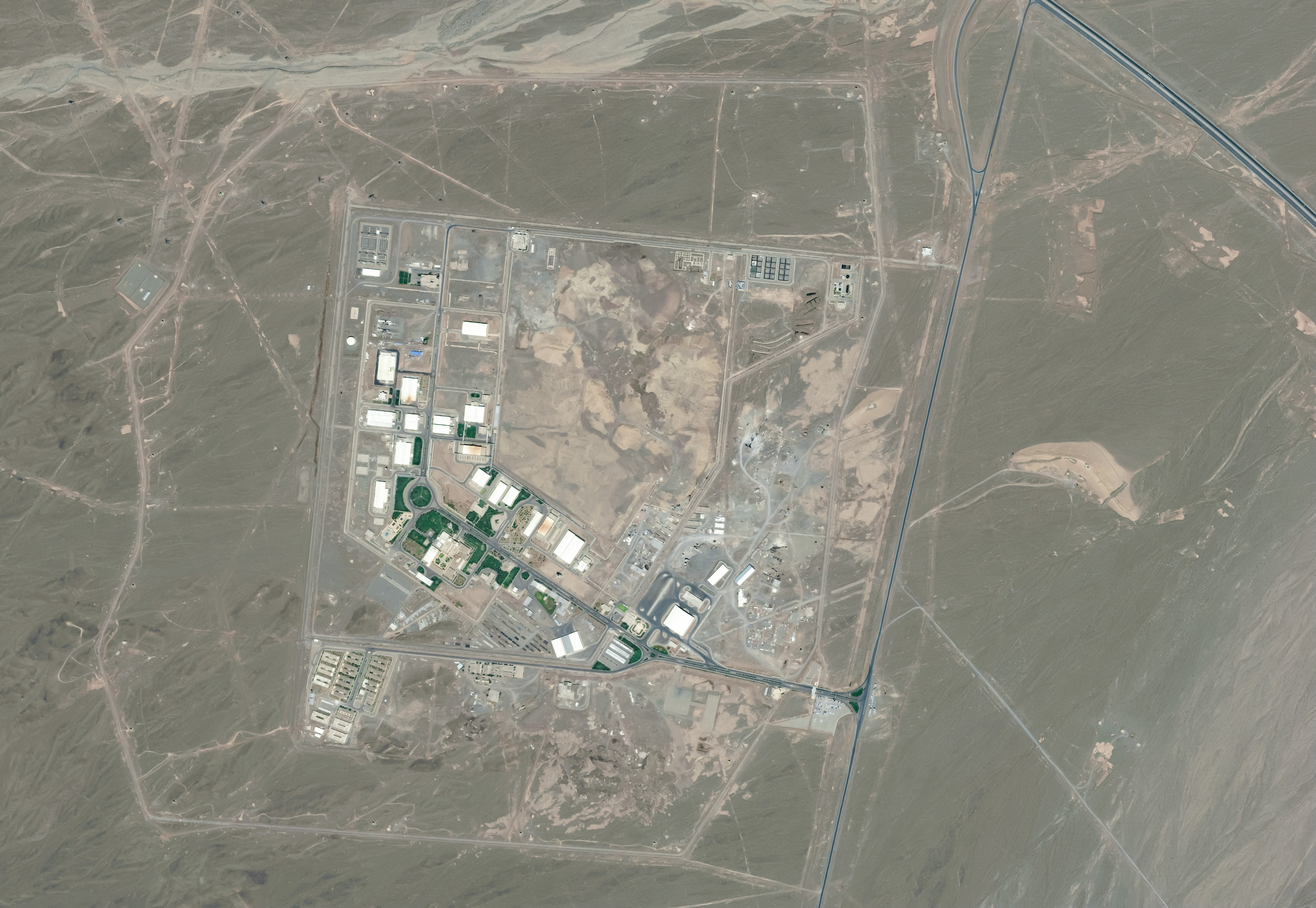
Satellite imagery from 2013 of the Natanz Fuel Enrichment Plant in Iran. / Satellite image (c) 2020 Maxar Technologies.
The
tit-for-tat attacks between Israel and Iran that consumed much of the
world’s attention over the past two weeks reached a crescendo on April
13, when an Iranian drone and missile assault on Israel failed after an
armada of allied fighter planes—secretly organized by the Pentagon, with
the support of Russia—shot down more than three hundred armed Iranian
drones and missiles headed for targets in Israel.
The Middle East
and the Western world anxiously waited for the Israeli response. It
came a few days later when two Israeli fighter planes, operating outside
Iran’s border, fired supersonic missiles at a high-tech Iranian
defensive missile site that was protecting Iran’s most important nuclear
enrichment site, near Natanz, eighty miles north of Isfahan.
The New York Times,
in a dispatch from Washington, depicted the attack as limited but a
‘potentially big signal” to the Iranian leadership, The message was that
Israel was willing and capable of attacking the heart of the Iran’s
most important weapons complex: “The taboo against direct strikes on
each other’s territory was now gone.” Similar worried assessments were
published around the world. A later Times report
told of a conversation between President Joe Biden and Israeli Prime
Minister Benjamin Netanyahu, in which the unpredictable Israeli leader
was said to have been talked out of further, and far more aggressive,
attacks. The world had perhaps moved away from the brink.
The
Israeli decision to strike the Iranian missile defense site, and not
the enrichment facility at Natanz itself, was seen in a far different
light by political and weapons experts in the American intelligence
community. Targeting the missiles was viewed as what a poker player
would call a “tell”—a hint of a far deeper meaning.
For
decades, the Israeli leadership—especially Netanyahu—has repeatedly
warned the world of Iran’s burgeoning nuclear capability and dismissed
the fact that the Iranian program has been under supervision, and
constant camera watch, of the International Atomic Energy Agency
safeguards. Two highly secret American National Intelligence Estimates,
in 2007 and 2011, made public by this reporter in the New Yorker,
also concluded that Iran had made no effort to fabricate its suspected
highly enriched nuclear materials into a warhead. America’s nuclear
weapons experts, despite years of efforts, have failed to find any
evidence of an underground Iranian facility capable of turning highly
enriched uranium into a weapon.
Now, given free rein and a
rare measure of international support, to respond to the Iranian
missile barrage, Israel chose not to attack the enrichment facility
itself.
“This was it,” an American intelligence official told me.
In a series of backchannel talks, the Israelis were advised that they
had three options for retaliation. The first was “a massive crippling
strike that would escalate the war and further degrade Israel’s world
standing.” The second was “a limited strike on the greatest threat to
you and the world by taking out Natanz—if you in fact believe that Iran
has the bomb or are about to. You can justify the strike as restrained
and justified.” And the third: “If you know that Iran does not yet have
or is not about to have the bomb, show your hidden hand—preemption
ability—standoff hypersonic targeting at will, but pass on [targeting]
the enrichment facility at Natanz.
“Here’s your chance,” the
Israelis were told, “to tell the world,currently paralyzed by fear of
the Iranian nuclear threat, not to worry. Iran does not pose a threat
and you know it. This opens a new opportunity for risk-free negotiating
strength for the West and the Middle East. You will begin to show
balanced judgment and to put Gaza behind and shed the rogue elephant
rep.”
Some states in the Middle East got the message, the American
official said. It was his impression that the officials running foreign
policy in the Biden Administration “had no clue” about what had gone
on.
In essence, he said, “Israel called the bluff,” as in a poker
game, “on itself. We say to ourselves that we are glad that the Israelis
were moderate” in their attack on Iran, “but nobody here has asked the
right question. Did Israel really want to show to the world that it
could hit an Iranian air defense site with a hypersonic super weapon?
“The
Israeli decision not to take out Natanz could lead to a whole new
Middle East and Iran will now be free to join the world,” the official
said. “Israel showed that the Iranian bomb was a false alarm. Something
potentially great has happened.”
It is heartwarming to witness students at Yale, Harvard, Columbia and other US
universities protesting the Biden regime’s arming and overall support of the
horrific genocidal war against the Palestinian people and particularly in Gaza where
some 34,000 Palestinians have been killed with US weapons paid for by the US
taxpayer. The same taxpayer that needs to borrow money for health care.
The US mass media is attempting to paint the protests as anti-Semitic. The New
York Times and USA today makes the point that protesting the Gaza genocide or
criticism of Israel is an attack on the Jewish people and their religion;
according to these sources, Jews are in fear of their lives on College
campuses. “The pro-Palestinian student movement has disrupted campus life,
especially for Jewish students. Many have said they no longer feel safe in
their classrooms or on university quads as the tone of protests at times has
become threatening.”, writes thepro-Zionist New York Times.
“Spent the first night of Passover at the student seder
in the Gaza solidarity encampment at Columbia. The Jewish flank of the
Palestine solidarity movement is growing and it is so beautiful to behold.
Judge for yourself how unsafe these Jewish students look.” Students
at Columbia responded to the mass media's efforts to portray their protests as
anti-Semitic at a live broadcast today. You can see that here.
As a retired union activist and socialist it is wonderful to witness these
developments. I was very moved watching the live press conference that the
Columbia students held today.
One young Jewish woman talked of her
Jewish ancestors and her great grandfather who was in the Russian Revolution of
1905 fighting against the oppressive Tsarist regime that forced Jews to live in
a certain area (the pale). She also
talked of the Jewish Bund. She called it the Labor Bund. I was surprised as
very few young Jews other than leftists have a clue what the Bund was.
The Zionists do not teach about the Bund which played such a hug erole in
Jewish life in Europe before the betrayal of Stalinism and the rise of Nazism.MOst Jewish workers belonged to the Bund. I've met Jewish Israeli tourists in the US and when I mention the Bund they have no
clue what I'm talking about. Joshua Freeman's book, Working Cass New York touches
on the Bund's role here in the US.
Another young woman, an Iranian Jew, was very powerful
in her remarks and how her Jewish faith drives her to do what she is doing as part of the protests. It was so uplifting for me to watch it. One of the speakers, I
can't recall which, explained how "Jewishness lives on with solidarity
with the Palestinians"
Things are happening so fast it's difficult to determine what will happen next.
Columbia University's administration called the police on protestors and
hundreds were arrested and 120 were arrested on Monday at NYU.
However faculty have come out to defend students and there is increasing anger
at what is considered an assault on academic freedom.
The efforts of the Biden Administration and the US body politic to portray
these protests as anti Jewish or anti-Semitic is not faring well, made
difficult by the fact that so many young American Jews are in the forefront of
the movement. While in these initial stages, it seems that some Ivy League
universities are ahead of the game one wonders at what point public
universities with a more working class base or community colleges might enter
the fray.
The prospect of a wider student movement arising is a major concern for the US
Congress which is overwhelmingly pro-Zionist for the reasons I have stated many
times. The Zionist regime is the only reliable ally the US has in the Middle
East and any defeat for the Zionist regime is a blow to US imperial power and
influence already under threat from China. The US support for Israel has
nothing to do with a love for Jews or preserving the Jewish identity; the US
ruling class is rife with anti-Semites.
Having said all this, it is without question that there are anti-Semites, Jew
haters, that will use the movement in support of the Palestinian cause and non
Jews in the movement in particular must give them no quarter. We must take them
up in the strongest manner possible. But the students and young people protesting at Columbia and
other universities, many of them Jewish, are on the right side of history and
their demands include divestment from Israel, and amnesty for the students and
faculty disciplined or arrested from the demonstrations.
These developments have undoubtedly caused concern in the halls of Congress and
among the US ruling class in general. The owner of the New England Patriots,
Robert Kraft, himself a Zionist, has pulled his support for Columbia
University. “I am deeply saddened at the virulent hate that continues to
grow on campus and throughout our country,” Here again, we witness how
equating Zionism with Judaism serves the interests of people like Kraft who is
worth about $12 billion.
Great social upheavals tend to open up the class divisions in society and
that's what we are witnessing here. Kraft no doubt has lucrative investments in
the Middle East, probably in Israel and Arab states. Fortunately, through the
sacrifice of the Palestinian people, and the response to their resistance in
Gaza by the Zionists, claiming that the protests are ant-Jewish or that
criticism of Israel and the Zionists is anti-Semitic doesn't work any more.
As the students on the university campuses take the lead here we should recall
that the same situation existed in 1968 when the French students opened up the
floodgates of protests. Before long, some ten million French workers
ended up occupying their workplaces in what we know as the French General Strike.
There was at that time a possibility of a genuine socialist transformation of
French society leading to a wider movement to end capitalism.
I am not saying that is happening here, but the student protests will
undoubtedly have an effect on the working class and our organizations. As they
occupy campuses, the UAW, is attempting to organize more workers at the non
union plants in the US South. I think the ILWU is still in negotiations though
we wouldn't know it with the media black out and the ILWU leadership's silence
on the matter.But organized labor will not be left out in the inevitable battles with capital that are on the horizon.
Yes, we are a divided country is many ways as the right wing has made serious
headway over the past period, in my view due to the failure of the left to
respond to the offensive of capital with an offensive of our own. The trade
union leadership, the Dogs That Never Bark, as I call them, have disgracefully
done little to change the situation and will no doubt campaign for Biden in the
next few months.
It is inevitable that there will be turmoil within the ranks of organized labor
at some point in time as the anger that simmers beneath the surface of US
society rises to the top.
Let's give our support to the students on the front lines.
This is six days after the event and from what we get from the mass media is that Israel responded though with little effect on Iranian society from what we can gather. It is an excellent analysis of these events.
By John Pickard
The Iranian missile and drone attack on Israel over the
weekend has changed nothing fundamental in the political and military
balance in the Middle East, but it has increased by a notch the
possiblity of a generalised war in the region. The growing splits within
Israeli politics and the divide between Biden and Netanyahu will both
be intensified by the Iranian attack and Israeli efforts to drag the US
into a war with Iran will almost certainly fail.
The Iranian assault, involving hundreds of missiles and drones, was really a statement,
a gesture carefully calibrated to satisfy militants at home and in the
region, but not so damaging to Israel that it would provoke a reaction
from the USA. Indeed, the USA was warned of the attack in advance, and
Iran would have known that there would be little damage done to Israel,
given the latter’s formidable air defence system. The drones took hours
to travel the hundreds of miles across Iraq and Jordan to reach their
targets and would have been tracked for hours before they were shot
down. The Iranian attack is an escalation of the conflict with Israel,
but it is a measured one.
Despite its failure to make much impact in Israel – apparently the
only casuality was a young Bedouin woman injured by shrapnel – Iran will
count the exercise as a political and military victory. Militarily, it
has allowed its forces to scope out the capabilities of Israel’s air
defence system, gaining knowledge that might have some future value.
Future missile attacks from Iran or from its proxy, Hezbollah in
Lebanon, would use swarms of missiles with the aim of overwhelming
Israel’s defences and the weekend for them would constitute a test run.
Jordan exposed as a military ally of Israel
But it has also been a useful political exercise for Tehran,
in so far as it has exposed the Kingdom of Jordan, as not only a
political ally of Israel, but in helping to shoot down Iranian missiles,
a military ally. The Jordanian government has been pushed by Iran’s
action into treading a fine line, supporting Israel and the West, but
dreading the half of its population who are Palestinian. Also, according
to the Israeli news website ynetnews,
the cost of Israeli’s deployment of its multi-layered air defence
system was staggering – more than $1bn – over one night, a figure far
higher than the cost to Iran of its missiles and drones.
The Western press are apoplectic with rage over the Iranian missile
attack and politicians are falling over themselves to condemn the
assault on Israel’s “sovereign territory”. There was no such rage, of
course, when Israel attacked a wing of the Iranian embassy in Damascus
on April 1, killing seven people, including an Iranian general.
The international diplomatic protocol, accepted by all governments
including the USA and UK, is that embassies are deemed to be the
“sovereign territory” of the state whose embassy it is. Iran used the
attack by Israel in Damascus to justify its own assault, but the Israeli
assault on “Iranian territory” has been quietly forgotten by Western
politicians, who, we know, apply double standards whenever and wherever
it suits them.
But despite loud and vociferous political and diplomatic backing by
Western politicians, there is also a generalised clamour among the same
leaders for restraint by Israel. The Financial Timesreports that the French President Emmanuel Macron advised the international community to do “everything we can to avoid flare-ups” and to “try to convince Israel that we shouldn’t respond by escalating, but rather by isolating Iran”.
Biden does not want the USA to be dragged into a war with Israel, six months before a presidential election
David Cameron, British Foreign Secretary, made a similar comment: “We’re saying very strongly that we don’t support a retaliatory strike. We don’t think they should make one.” Biden called on Israel to “take the win”, assuming Netanyahu will dress up the downing of so many drones and missiles as a victory.
Armed Jewish settlers running amok in the West Bank
The last thing these leaders want is a generalised war in the Middle
East, tipping an unstable region over the edge. After the murder of a
teenage youth from one of the Jewish settlements, armed settlers have
gone on the rampage in the West Bank. At least ten Arab villages have
been attacked.
There is a low-level civil war developing in the West Bank, as the
October 7 Hamas attack and the war in Gaza have unleashed a wave of
pogroms and assults against Arabs in the occupied areas. There is a
possibility, notwithstanding the huge imbalance in terms of arms – the
Israeli settlers and the IDF are far more heavily armed than
Palestinians – of a major conflict developing. Then there is the war in
the North between the IDF and Hezbollah, at present a slowly
accelerating war of attrition, but it is another major conflict waiting
to happen.
Even without the pogroms and ongoing ethnic cleansing in the West
Bank, Israel’s relentless and bloody collective punishment of Gaza for
the attack by Hamas has shifted global politics. Latest figures show
over 34,000 deaths in Gaza, overwhelmingly non-combatants. Gaza has been
bombed back to the Stone-Age. A humanitarian crisis has been
deliberately created by Israel’s refusal of access to food, water and
medical supplies.
Gaza is a war of genocidal proportions and it is unprecedented in its
one-sided ferocity in modern times. But more than any other similar
conflict in history, it is one beamed live into televisions sets around
the world and particularly in the Arab Middle East. It is as a result of
this that the political world has turned upside down.
There is overwhelming sympathy among workers and youth around the
world for the Palestinian people. No issue in recent times has provoked
such large numbers of participants in rallies, protests and
demonstrations, as over the merciless bombing of Gaza. Politicians in
the West – who in reaility care nothing for Palestinian rights, and
never have done – have been forced by popular pressure to call for an
end to the Israeli onslaught. Even as they continue to arm Israel,
European and American leaders are squirming over the actions of the
Israeli government and are calling for a ceasefire.
Huge shift in globabl opinion
Israel is now a pariah state, if not among political leaders, then
certainly in the Global South and among workers and youth in Europe and
the USA. There has been such a shift in global opinion that is has had
an inevitable effect even in Israel, where there is growing opposition
to Prime Minister Netanyahu.
The
article by regular Haaretz columnist, Gideon Levy, penned in the early
hours of Sunday, even as Iranian missiles were heading for Israel
There is still widespread popular support for the war in Israel, but
that should not be misinterpreted. It is a sentiment that reflects a
public perception, fed by the likes of Netanyahu, that Israel – and by
definition its population – faces an ‘existential’ threat. That is
particularly true over the missile attack, given that Iran is a
reactionary theocratic regime with not a shred of political appeal for
Jewish workers. But even if the majority in Israel support the actions
of the army, there is growing opposition to the conduct of the war and
the actions of this government.
Israelis can see that even after more than six months, Hamas has not
been defeated and the hostages have not been freed. Netanyahu’s strategy
of fighting to the end, to “completely” destroy Hamas, is running out
of road. Increasingly, it is looking to Israelis like Netanyahu is
prolonging the war – with the support of the extreme right of his
Cabinet – only to stay in power. Gideon Levy, columnist in the liberal Haarezt
newspaper, blunted wrote on Sunday that if Iran attacks Israel, the
blame lies with the Israeli government. That is a profound level of
domestic opposition.
It looks like it is Netanyahu’s aim to drag the USA into a war with
Iran. Having pulverised the population of Gaza, without succeeding in
his war aims, he has in the process pulverised Israeli support across
the globe. So he has turned instead to Iran. The bombing of the Iranian
embassy in Damascus was an escalation by Netanyahu that was not
sanctioned by the White House, and nor would it have been.
Why the USA does not want to be dragged into a war with Iran
While the USA, supported by the UK and Jordan, helped Israel destroy
the swarm of Iranian missiles and drones over the weekend, none of these
states want to be dragged into a war with Iran. The right wing of
Netanyahu’s cabinet will be demanding some kind of tit-for-tat response,
possibly through a direct attack by Israel on Iran. But if that were to
occur, it would more than likely happen without US logistical support,
like comms and satellite guidance.
Why does the US not want to be dragged into a war with Iran? It is
not that the USA could not do significant damage to Iran and its
military infrastructure with its huge arsenal of weapons and large
number of bases in the region. It is because even in defeat, Iran would
exact a huge and punishing cost to the USA and its allies.
There are something like 57,000 US military personnel in the region.
There is a US base of 900 in Syria, nearly 3,000 in Iraq, a huge naval
base in Bahrain (300 km from the Iranian coast), other US bases in
Egypt, Jordan and in the Gulf. All of these would be targeted by Iran or
its proxies in a regional war and the most sophisticated air defence
systems would not prevent large numbers of casualties.
As much as Israel has pulverised Gaza, it has ground the international standing of Israel into the dirt
Even with the huge preponderance of US arms in the region, a war with
Iran would create a huge loss of life of US military personnel and the
last thing Biden wants in an election year is a succession of aircraft
bringing home body bags – what’s more, in an unnecessary war provoked by
a ‘rogue’ leader in Jerusalem.
That is leaving aside the economic cost of a war involving Iran. The
Houthis at the Southern end of the Red Sea have been able to make enough
impact that many ships are now being forced to avoid the Suez Canal and
are taking a longer (and more expensive) journey from East to West via
Southern Africa. A war with Iran would mean the blocking of the Hormuz
Straits through which a quarter of the world’s tankers carry their oil. A
deep economic recession would follow.
A war between the USA and Iran is not likely
On the balance of probabilities, therefore, a wider war in the Middle
East, certainly one involving the USA and Western states, looks
unlikely. The USA doesn’t want war with Iran and Iran doesn’t want war
with the USA. The Iranian embassador to the UN tweeted after the missile
attack, that the matter was now “concluded”.
But on the other hand, the possibility of war has gone up a notch.
What will also have increased a notch, will be the determination of
Biden to engineer a change of government in Jerusalem. Assuming
Netanyahu can even last that long – there are still widespread demands
for immediate elections in Israel – and assuming Biden is elected,
regime change will be at the top of the ‘to do’ list in the White House
at the end of the year.
What has been absent from all of the conflicts and near-conflicts in
the Middle East has been any intervention by the organised working
class. Around the world workers are expressing their outrage at the
Israeli savagery in Gaza, and sometimes this has been expressed in
trade union boycotts of arms exports bound for Israel. But where the
labour movement is bound by state repression, such as in Egypt and the
other Arab states, or where it is blinded by the ‘security’ Klaxon of
the right-wing, such as in Israel, the organised working class is
largely absent from the picture.
In the longer run, however, the lessons of this conflict will begin
to sink in among millions of workers. In Arab countries, particularly
Egypt, where there is a potentially powerful working class, many workers
and youth will digest the events they have witnessed on Al Jazeera and will have taken note of the inactivity of their governments in the face of the destruction of lives and all Palestinian identity in Gaza and the occupied West Bank.
And in Israel itself, the war and all the events around it will
exacerbate the divisions that already exist, between those whose entire
political modus operandi is based on racism and apartheid – and
‘security’ to guarantee it – and the rest, who pay for this fake
‘security’ in money and blood. The Middle East world has shifted on its
axis and although we can as yet only see outlines of change today, they
will be as nothing to the profound and permanent changes we will see in
coming years.
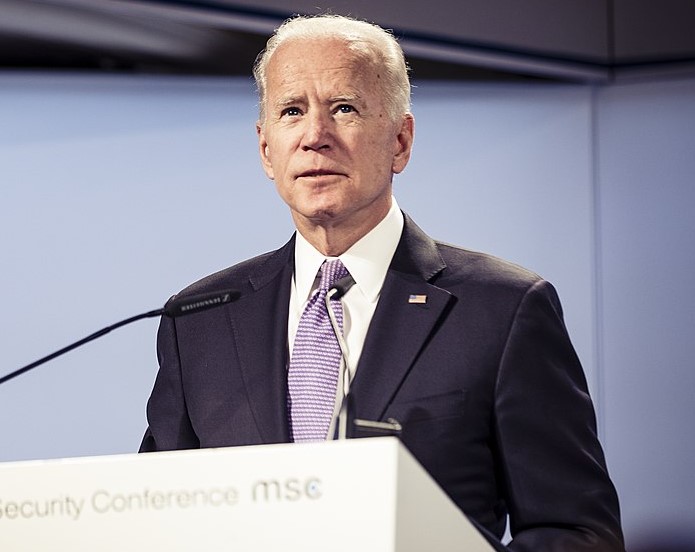
Here is Genocide Joe Biden speaking to a meeting of the International Brotherhood of
Electrical Workers (IBEW) last Friday, 4-12-24. I have to say it was not bad in the sense that
he didn’t appear to be out of it, slurring his speech, walking in the wrong
direction when he entered or left the podium or forgetting which country he was
in.
The mass media and his opponents, including the serial sexual predator and
rival for the White House Donald Trump, like to focus on the issue of Genocide
Jo’s memory but that is a side issue; it’s not the reason workers should see
him for what he is, an enemy of the working class, both here and abroad.He will go down in history as the man who
could have stopped the genocide in Gaza but instead, armed it and wore the
Zionist badge with pride.
It's nauseating listening to it. Kenneth Cooper, the IBEW Secretary Treasurer, on around $400,000 a year for his efforts keeping the books, gives him a heroes welcome. He's the "strongest champion" of the working class, the "Man the IBEW can rely on every day". Cooper goes on, "He's the most union friendly pro-labor president in the history of this great nation"
What Cooper means is he is the man the union hierarchy can rely on, people like himself. The Democratic Party and its leader, in this case Joe here, the former Senator from Du Pont, is the party of the clique that sits atop organized labor, not the members who pay the dues and the obscene salaries most of them earn. For decades the union leadership at the highest levels have been been, as De Leon once said, the labor lieutenants of capital within organized labor.
In response to this heroes welcome Biden spews out protectionist and nationalist language about how great the IBEW is, America is and so on. The IBEW has about 800,000 members, it is one of the most sort after unions to join given the pay and benefits its members enjoy. That is a good thing, the living standards the IBEW members (those who do the work) have should be had by all. All workers have lost ground including union members.
Biden is speaking to them because the IBEW and the other building trades will benefit from any infrastructure or social spending that comes out of Washington as these huge projects require union labor. In addition, if non union labor is used it has to comply with the Davis Bacon Act that requires all contractors pay the "prevailing wage" for the area. This sounds good but as wages decline, so does the prevailing wage. Not only that, as I see it, it is very popular with the labor hierarchy as it gets them off the hook from having to organizing new members. It's some free time for them.
The labor officials that do the rounds for the Democrats (and organized labor has spent billions over the years in campaign contributions) often find a way in to lucrative government office through the Democratic Party, a reward for using their members' money and resources; there are numerous political figures that rise this way in Democratic Party Administrations.
This has gotten harder and harder over the decades though as union members' response to their leaders pushing a party they have abandoned, either opt out of the electoral process altogether or turn to more conservative alternatives or a degenerate like Trump. With the absence of any labor or left alternative, and the failure of groups like Labor Notes or TDU to offer one, the growth of the right wing or the search for a "strongman" to take a hold of the reins can become a serious option.
Openly supporting Democrats is not such a useful tool for political purposes as workers have suffered
under Republican and Democratic regimes alike. I remember first noting
this change in the mid nineties when I attended National Conventions of
my union AFSCME
when the focus changed and the issue became not supporting a Party but the candidate as an individual. We support those that are best for "working families".
The IBEW leadership like all of them, will ignore the fact that Biden denied the rail workers the right to strike last year despite having the "legal" right to do so. Biden and Pelosi and the rest of the gang in Congress introduced legislation overnight that took that right away. Profits come first folks and the rail workers were forced to accept a contract they'd already rejected.
Biden's language about American jobs and American greatness sounded more like a return to the Smoot-Hawley era prior to the Great Depression and the advent of WW2. And he used the term Malarkey that proves he's just a regular Joe and and Irishman at that. It was just a show where everyone would agree.
And the fate of workers in other countries, those in Vietnam, China, Bangladesh, Cambodia or anywhere else where unions are illegal and violence against union organizers rife ,never came up. Nor did the Genocide in Gaza and it should, after all, it's one of Joe's successes. But international issues have nothing to do with our wages and conditions here so why mention them? There will have to be some turmoil within organized labor to root out the present pro-market clique.
So suffer a little nausea on a Sunday and watch Biden in action here.
Zionism threatens
political freedom in the United States and international order. There is
only one way to fight this ideology. Those who oppose it must explain
the truth to Americans: Zionism is racist.
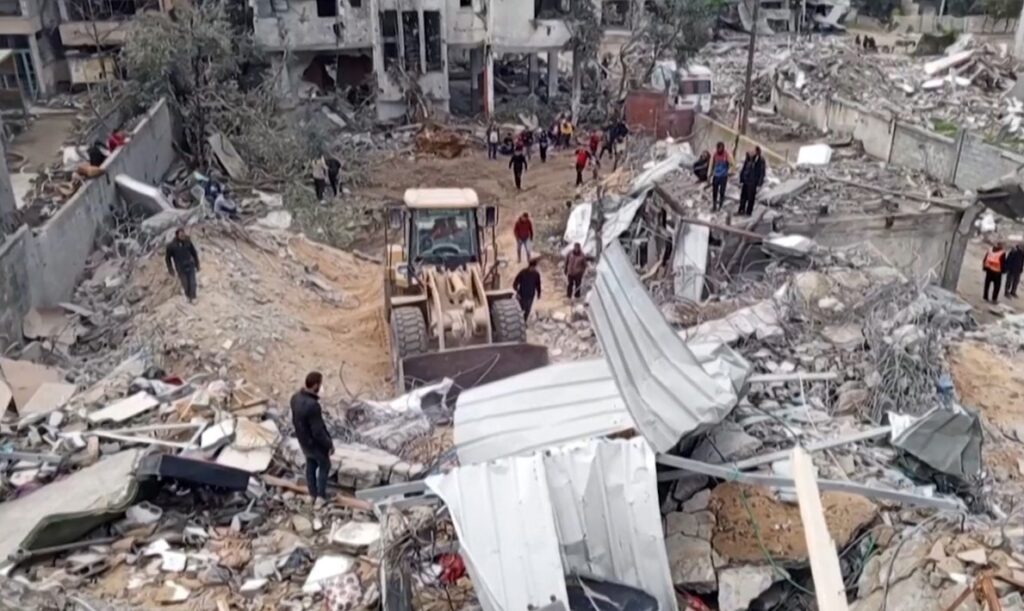
Palestinians return to Nuseirat after the Israeli military pulled
out troops from the Central Gaza Strip, April 18, 2024. (Photo: Omar
Ashtawy/ APA Images)
You could not get a better picture of Zionism than from two recent
events. Israel bombed a consulate in a foreign country – Syria – killing
top Iranian military officers, among others, and Israel supporters in
the U.S. forced the cancelation of the valedictorian address at the
University of Southern California because the speaker opposes Israeli
genocide in Gaza.
Today Zionism threatens political freedom in the United States and international order.
These actions are consistent. They are expressions of a maximalist
ideology that operates on a global level to support the Israeli regime.
That ideology, of course, is Zionism, the belief that Jews need a state
in order to be safe. Today Zionism threatens political freedom in the
United States and international order. It threatens the political
tradition of liberalism in the United States by compelling Democratic
politicians to pay for more bombs to advance a genocide.
After 150 years of struggle and practice, it is plain that Zionism is
dedicated to the neverending subjugation of Palestinians, who resist
their persecution.
There is only one way to fight this ideology. Those who oppose it
must explain the truth to Americans: Zionism is racist. Its supporters
must be called out and cornered and discredited—as adherents of a Jim
Crow ideology.
There is only one way to fight this ideology. Those who oppose it must explain the truth to Americans: Zionism is racist.
I have always said that I might have been a Zionist in an earlier
age. Zionism was a perfectly understandable ideology in light of
European oppression of Jews. Jews left Europe as refugees, not
supremacists. If Zionism had focused only on Jewish safety it might be a
tolerable ideology today.
But from the beginning maximalist Zionists won out. They wanted more
land with fewer Palestinians. For at least 75 years now this is the
Zionist credo, and they repeatedly used terrorism to achieve that goal.
–In the 1920s the socialist leader Chaim Arlosoroff sought to advance
ideas of national coexistence with Palestinians. He was murdered on the
beach in Tel Aviv in 1933 by Zionist militias that later produced the
highest officials in Israel.
–In 1949 a U.N. diplomat, Folke Bernadotte, who had saved thousands
of Jews from Nazis during the war, sought to advance plans to keep
Jerusalem an international city, as designated by the UN Partition plan.
He was assassinated in Jerusalem by a Zionist gang that – again – later
produced the highest officials in Israel.
–In the 1990s a Labor Prime Minister, Yitzhak Rabin, declared that
Israel would only have peace if it returned land to Palestinians so as
to allow them to have sovereignty. Rabin was murdered by a rightwinger
who enjoys deep political support to this day.
These murders arose from a consistent program: Israeli leaders have
again and again told us that they will not accept a Palestinian state
alongside the Jewish state.
Because of Israel’s defiance on that score and because of Israel’s consecration of higher Jewish rights in the nation-state law in 2018, human rights groups worldwide have stated that Israel is an apartheid state.
Zionists have one answer to those charges — it’s antisemitism, you just hate Jews. (No, we hate segregationists.)
Israel has used overwhelming violence to quash resistance. It has
repeatedly massacred Palestinians, and in Gaza, in the last six months
has indiscriminately killed tens of thousands of women and children, and
aid workers. Any sensible person understands that this onslaught will
only foster radical resistance.
I don’t support violence against civilians. It is why I have been
outspoken against Hamas’s October 7 attacks, and the dehumanization that
occurs on both sides in a war.
But clearly Zionism is the root problem. Zionism destroys every good
thing in its path. It is an ideology that treats Palestinians as lesser,
in their own land. It brought religious nationalism to the Middle East
and destabilized a region long before ISIS. It attacks villages so as to
solidify “the Jewish majority,” and even the liberal wing rationalizes
its actions. (“My father…. was a terrorist,” says Jeremy Ben Ami of J Street – an organization started to oppose Zionist settlements that has achieved nothing for that agenda in 15 years.)
Today Zionism is undermining American freedom. Zionists and
sympathizers in the U.S. government pushed the Iraq war that destroyed
Arab cities and the American image too. Zionist sympathizers are today
justifying a genocide and denying the famine in Gaza– and getting Biden
to sign off. The Zionist lobby has corrupted our elections, canceled
free speech on a routine basis, wrecked the American Jewish community,
and compromised some of the best minds of my generation (including
Jewish writers in whom I have observed the tragic loss).
There is only one way to defeat Zionism. It must be indicted and
described, as the racist antithesis of everything the American
experiment has achieved. Its support must be harried, hectored, and
starved. It must be defeated in the United States, in Congress, and at
the University of Southern California. We will win, because we must.
CHATTANOOGA,
TENNESSEE – Ten years ago, Angelo Hernandez’s father was involved in
the union drive at the Volkswagen plant in Chattanooga. That effort
narrowly failed, but a decade later, the son may be able to achieve his
father’s dream.
“He was the one who, like, told me about the union before I was even in this job,” says the 20-year-old Hernandez.
When the current union drive got started late last year, his dad
started pushing him to get involved. “I’m here and I’m gonna go for it
right now,” Angelo says he told his dad.
For more than a decade, workers have fought, argued, and tried to
persuade their colleagues to join a union. After the first loss at this
Volkswagen plant in 2014, the United Auto Workers even established a
minority union, Local 42.
THINGS BEGAN TO CHANGE IN 2022, when Volkswagen expanded the plant to produce the all-electric ID.4. In the process, the company hired over 2,000 new workers.
With labor shortages throughout the manufacturing sector, many of the
workers hired by Volkswagen were much younger and more diverse. Some
had even moved from more pro-union parts of the country to work there.
While in the past, Volkswagen workers, who had less experience with
unions, were skeptical of the bureaucracies of the scandal-tainted UAW,
younger Southern workers seemed more receptive to trying something new.
“I just hope it goes through,” says 25-year-old Manny Perez. “And I’m
not well informed about it. I just know. Being able to have a voice of
your own is more important than just letting other people decide for
you.”
Over the last decade, there has been a sea change among workers at
Volkswagen’s Chattanooga plant, in large part due to this newer, younger
workforce. It could lead to a historic victory in the union election,
which concludes today, and the signature victory for organized labor in
the South that has eluded them for years. Votes will be tallied this
evening.
“A lot of the people who’ve been staunchly anti-union are from an
older generation,” says 32-year-old Caleb Michalski, a safety lead, who
has worked on various assembly teams at the Volkswagen plant. “A lot of
the younger generation, through a combination of social media and
education and stuff like that, they realize, like, hey, it doesn’t make
sense.”
VOLKSWAGEN HAS CLAIMED TO BE NEUTRAL in each campaign at the Tennessee plant. But under the radar, they have fought the union, while linking arms with leading politicians,
who repeatedly warned that the plant would close or lose shifts.
Southern governors are trying the same tactics this time around, signing a joint statement expressing alarm at the UAW campaign here and elsewhere.
In 2019, Volkswagen fired or transferred several unpopular shop floor
managers, and brought back a popular plant manager, Frank Fisher, who
promised to make things better.
“When I first started it was January 2020, immediately after the last
election, and it was when, you know, the plant manager said, ‘Hey,
let’s fix this in-house,’” says Michalski. “And they made a lot of
changes. And so when I first started, right at the beginning of that
first wave of changes, I was impressed by it.”
He said that the receptiveness of management made him believe that it
was possible to get problems at work addressed without a union.
“Before, I was always like, ‘Well maybe the right people just don’t know,’” he says.
Workers say that Volkswagen’s anti-union tactics are having little effect on dissuading workers.
However, as a safety lead, Michalski found himself frustrated in his
efforts to get issues addressed within the plant. Volkswagen regularly
requires him and his co-workers to lift vehicles, which can weigh over
700 or 800 pounds, and sometimes as much as 1,400 pounds.
For nearly a year, he begged Volkswagen to get a hoist. They took little action, while many members of his team got hurt.
“I hurt my back in November, I’ve been having chronic pain for the
last month, I can barely turn my head and neck,” says Michalski. “Every
single one of us have gotten injured. We’ve had two guys that had to
have shoulder surgeries, a third one that’s going to have to have
shoulder surgery, and one guy shattered his kneecap.”
Michalski finally had to talk to the CEO of Volkswagen America to get
a hoist approved. But weeks later, the hoist still hasn’t been
installed.
“I shouldn’t have to talk to the CEO of a multibillion-dollar
corporation just to get a hoist,” says Michalski. “I think that we need
the ability to say, ‘Hey, this process is unsafe.’ And that’s it, not
having to argue for weeks and weeks, and weeks of meetings to say like,
‘Hey, we need a hoist.’”
In addition to the decade-long battle to win hearts and minds at the
plant, Volkswagen workers also say that the success of the “Stand Up
Strike” at the Big Three U.S. automakers helped spur interest in the
union.
“You have strike after strike happening around the country. You had
the writers, the actors, and then UAW followed up,” says Volkswagen
worker Zach Costello, speaking of the “Summer of Strikes” last year.
“And then you had the big contract [UAW] got. That, like, sparked an
insane amount of discussion around unions all around the plant.”
In the closing days of the campaign, workers say that Volkswagen’s
anti-union tactics are having little effect on dissuading workers. Due
to the influence of German labor law, the company has not yet engaged in
anti-union “captive audience” meetings or one-on-one discussions, which
can be lethal in killing union support.
Instead, anti-union forces at Volkswagen have largely focused on TV
and online ads attempting to tie the UAW election to President Biden,
who is unpopular in this red state, though perhaps not entirely at the
plant. Near the entrance to the plant sits a banner that reads: “Back
Biden, Vote UAW.”
In recent days, local TV ads and billboards have been blasting the
UAW with messages like “UAW = Biden.” The union has endorsed Biden, who
walked the picket line during the Big Three Stand Up Strike. In an official statement
that the union has sent to its members, Biden congratulated workers in
Chattanooga for the union drive. “As one of the world’s largest
automakers, many Volkswagen plants internationally are unionized,” Biden
said in the statement. “As the most pro-union president in American
history, I believe American workers, too, should have a voice at work.
The decision whether to join a union belongs to the workers.”
The ads are warning members repeatedly that their dues money will be spent on helping Biden’s re-election campaign.
With the Volkswagen plant located in “Trump country” in eastern
Tennessee, UAW activists have responded by distancing themselves from
the political function of their union.
“This vote is not about politics,” Volkswagen worker Isaac Meadows told the Prospect in an interview. “This vote is about the workers … standing up for themselves.”
Electing the UAW could inspire workers at other plants in the South
to unionize. Already, the UAW has filed for a union election at a
Mercedes plant in Vance, Alabama, and it has several other campaigns
under way.
Vanderbilt University sociology professor Josh Murray, who has spent
years studying unionizing efforts in the South, thinks that a win at
Volkswagen could create a domino effect.
“In social movement theory there is the idea of the ‘politics of the
possible,’ which says movement success breeds future movement success
because it mobilizes people by giving them evidence that winning is
possible,” says Murray. “Applied to the UAW, the huge victory in the
strikes against GM, Ford, and Stellantis makes victory at Volkswagen
more likely, and a victory at Volkswagen would make further victories at
currently non-unionized plants more likely.”
In the closing days of the third UAW election at Volkswagen in a decade, that hope is evident among workers and organizers.
“As far as workers reclaiming our power, it starts with us,” says
Michalski. “And if we can be the first to start bringing organized labor
to good-paying jobs with workers who have rights here in the South, I’m
all for it.”
Interesting points about the Jewish populations of the world and their lives for thousands of years before Zionists or Jewish nationalism was founded in the latter half of the 19th century.
It's a bit misleading when he says Jews lived in the country( Iraq) a Muslim country for 2500 years as Iraq was not a country until the British created it just over 100 years ago and Islam as a religion is less than 2000 yeas old. Like all the so-called prophets that god apparently speaks to, he always speaks to them alone, never any witnesses.
But this is only a selected clip and I haven't seen it all so he may have defined it a bit more.
A general election in India starts today. 970m Indians, more than 10% of the world’s population, will head to the polls in what will be the largest election in history for the Lok Sabha (House of the People) parliamentary elections. The poll will spread across India and take up to 4 June to complete. Opinion polls suggest that Prime Minister Narendra Modi, leader of the Hindu nationalist Bharatiya Janata Party (BJP), and his coalition will win a third successive 5-year term, and win by some distance.
The main challenge to the BJP comes from a coalition of political parties headed by the Indian National Congress, the biggest opposition party. More than two dozen parties have joined to form the Indian National Developmental Inclusive Alliance("India" for short). Key politicians in this group include Congress president Mallikarjun Kharge, as well as siblings Rahul and Priyanka Gandhi, whose father was the former prime minister Rajiv Gandhi.
The BJP was formed by members of what was basically a Hindu religious fascist party, the Rashtriya Swayamsevak Sangh (RSS), an organisation modelled on Mussolini’s Black Brigades. Modi was a long-time member of the RSS who then moved seamlessly into the BJP. After winning power in 2014, Modi has cemented his control of government. It is now seen as ‘business-friendly’, but the BJP is still dedicated to turning a multi-ethnic and multi-religious India into a Hindu state, where minorities, particularly Muslims, will be reduced to second-class citizens. With increasing confidence, the Modi government has suppressed any public dissent by liberal democrats and socialists against this trend. Many opposition politicians have been imprisoned on trumped-up charges and prevented from participating in the election and in public debate.
Opinion polls show that the BJP alliance will probably win this election with an increased majority, possibly enough to get a two-thirds majority in parliament, enabling the next government to push through further restrictions and laws against dissent. India’s reputation as the most long standing and largest ‘democracy’ in the Global South is being broken up.
How is it possible for the BJP and Modi to be so popular? First, because of the bulk of the BJP’s political support comes from the rural and more backward areas of this huge country who have not benefited from the strident rise of Indian capitalism in the cities. These areas are bulwarks of Hindu nationalism, incentivised by fear of muslims.
The second reason is the total failure over the decades of the main capitalist party and standard bearer of Indian independence, the Congress party, to deliver better living standards and conditions for the hundreds of millions, not only in the country but in the city slums. Congress appears to millions as the party of the establishment controlled by a family dynasty (the Gandhis), while the BJP appears to many as the populist party of the forgotten people.
The Modi government makes much of its handouts to the poorest. Welfare schemes have been expanded such as providing free grain to 800 million of India's poorest, and a monthly stipend of 1,250 rupees ($16; £12) to women from low-income families paid into half a billion new bank accounts, along with free gas connection in millions of houses for the poor and over 40 million toilets constructed.
But in reality, the BJP and the Modi government is fully integrated and supportive of Indian capital, especially big capital. PM Modi has made the economy a major part of his election pitch, pledging at a rally last year to lift the country’s economy “to the top position in the world" should he win a third term. The Modi’s government's key policy is Viksit Bharat 2047—a plan to make India a developed nation by 2047, 100 years after independence, something China is targeting for 2030.
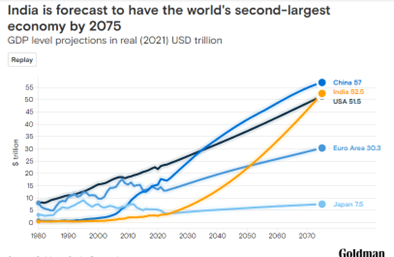
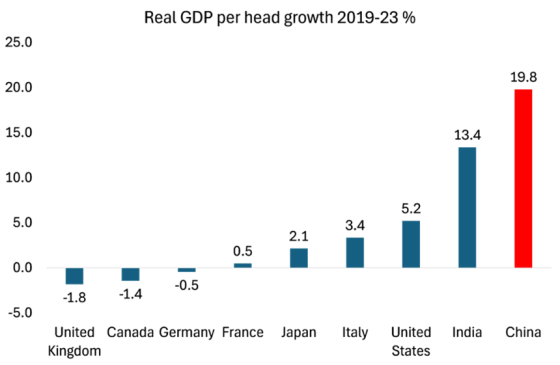
The Indian media and Western economists laud the strong economic growth that India is apparently enjoying under the Modi government. According to the official figures, Indian real GDP grew 8.4% yoy in the last quarter of 2023 and 7.6% over the whole year, up from 7.0% in 2022. So ecstatic are mainstream economists about the success of Indian capitalism under Modi that talk of his neo-fascist past and current repressive measures are ignored. Instead, all the talk is of India ‘catching up’ with China and even surpassing its real GDP soon. For example, Goldman Sachs projects India will have the world’s second-largest economy by 2075.
The forecast is that India will grow even faster while China’s growth slows and soon India will contribute more to global growth than China. India will take over China’s lead in manufacturing and technology and thus prove that a privatized, free market economy can triumph over a state-led planned one that is China. According to Bloomberg Economics, India could become the world's No. 1 contributor to GDP growth as early as 2028 as India’s economic growth will accelerate to 9% by the end of this decade, while China will slow to 3.5%!
But all this is just hype. Take the growth figures. The perennial cry from Western economists when they get the growth figures for China is that they are faked. But actually, it is India’s national statistics office that is being ‘economical with the truth’. GDP figures contain dubious categories like ‘discrepancies’. These refer to the difference between real GDP growth of about 7.5% a year and real domestic expenditure growth of just 1.5% a year. They should be the same theoretically, but they are not – and the national statistical office ignores the latter. Part of the reason for the ‘discrepancy’ is that India’s government statisticians are ‘deflating’ money GDP into real GDP by a price deflator based on wholesale production prices and not on consumer prices, so that the real GDP growth figure is much higher than the real increase in spending. Also, the GDP figures are not ‘seasonally adjusted’ to take into account any changes in the number of days in a month or quarter or weather etc. Seasonal adjustment would have shown India’s real GDP growth well below the official figures.
What exposes the unrealistic figures the most isa recent paper on India’s staggeringly extreme inequality of wealth and income. The World Inequality Lab finds that“the present-day golden era of Indian billionaires has produced soaring income inequality in India—now among the highest in the world and starker than in the U.S., Brazil, and South Africa. The gap between India’s rich and poor is now so wide that by some measures, the distribution of income in India was more equitable under British colonial rule than it is now.”
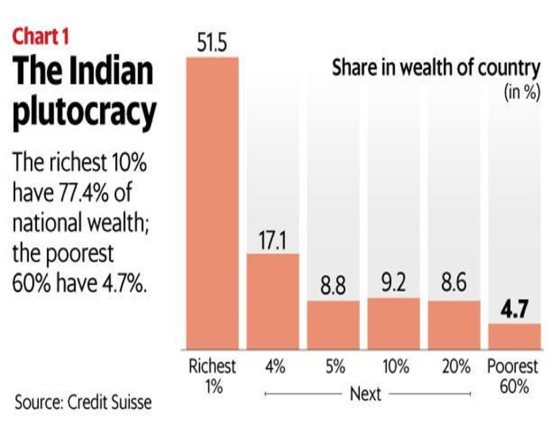
The top 10% of the Indian population now holds 77% of the total national wealth. Between 2018 and 2022, India is estimated to have produced 70 new millionaires every day. Billionaires' fortunes increased by almost 10 times over the last decade and their total wealth is higher than the entire national budget of India for the fiscal year 2018-19. The current total number of billionaires in India is 271, with 94 new billionaires added in 2023 alone, according to Hurun Research Institute’s 2024 global rich list.. That’s more new billionaires than in any country other than the US, with a collective wealth that amounts to nearly $1 trillion—or 7% of the world’s total wealth. A handful of Indian tycoons, such as Mukesh Ambani, Gautam Adani, and Sajjan Jindal, are now mingling in the same circles as Jeff Bezos and Elon Musk, some of the world’s richest people.
The report also found that the rise in inequality had been particularly pronounced since the BJP first came to power in 2014. Over the last decade, major political and economic reforms have led to“an authoritarian government with centralization of decision-making power, coupled with a growing nexus between big business and government,”the report states. This, they say, was likely to“facilitate disproportionate influence”on society and government.
In contrast, many ordinary Indians are not able to access the health care they need. 63 million of them are pushed into poverty because of healthcare costs every year - almost two people every second. Indeed, it would take 941 years for a minimum wage worker in rural India to earn what the top paid executive at a leading Indian garment company earns in a year. While the country is a top destination for 'medical tourism', the poorest Indian states have infant mortality rates higher than those in sub-Saharan Africa. India accounts for 17% of global maternal deaths, and 21% of deaths among children below five years.
Rural distress, stagnation and falling farming incomes have led to a number of protests by farmers. According to Samyukta Kisan Morcha, an umbrella of farm unions, over 100,000 farmers have committed suicide in the last ten years of Modi's rule. India ranks 111th of the 125 nations in the Global Hunger Index (2023) report. India is home to over a third of the world's malnourished children, which is not only a health crisis but has a wider impact on the economy. A 2023 joint report by FAO, UNICEF, WHO and WFP, found that 74% of the population cannot afford healthy food.
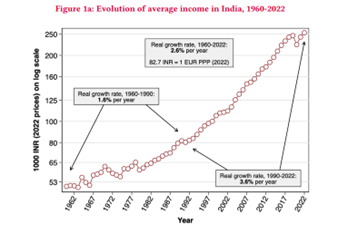
The WID averaged out national income growth between rich and poor. On that measure, growth in incomes in India is nowhere near the hype levels surrounding real GDP growth. Average real income growth in India is around 3.6% a year compared to the 6-8% claimed for real GDP growth.
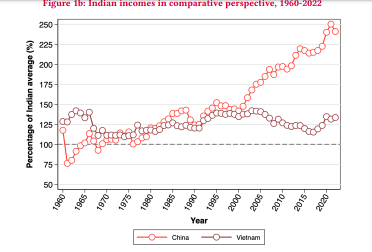
The idea that India is or will close the gap with China is a pipedream. Here the WID paper shows the gap between China’s average income, and that of India and Vietnam. Even Vietnam is holding its advantage over India.
India’s $3.5 trillion economy remains dwarfed by the $17.8 trillion Chinese economy. It would take a lifetime for India to catch up with its shoddy roads, patchy education, red tape and a lack of skilled workers.
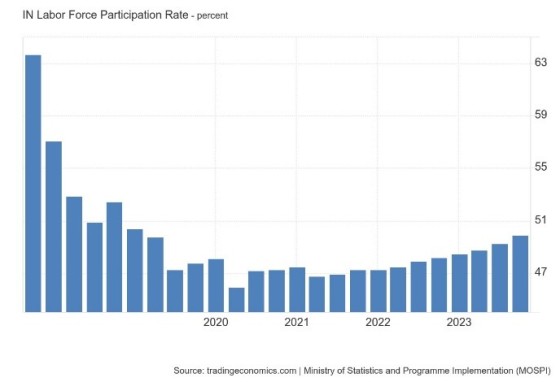
The Indian economy is failing to create jobs, especially those that would support a dignified standard of living. Apart from public administration, the most rapid income growth by far this past quarter (at 12.1%) was in finance and real estate. But this neo-liberal feature of Indian development, now augmented by “fintechs,” generates only a handful of jobs for highly qualified Indians. Among other growth sectors, construction (helped by the government’s infrastructure drive) and low-end services (in trade, transport, and hotels) mostly create financially precarious jobs that leave workers one life event away from severe distress. The labour force participation rate in India has declined over the last 15 years. Under Modi, less than half the adult working population is employed.
Two-thirds of Indian workers are employed in small businesses with less than ten workers, where labour rights are ignored – indeed most are paid on a casual basis and in cash rupees, the so-called ‘informal’ sector that avoids taxes and regulations. India has the largest ‘informal’ sector among the main so-called emerging economies. India’s post-COVID manufacturing performance has been particularly weak. This reflects the country’s chronic inability to compete in international markets for labour-intensive products – a problem made worse by the slowdown in world trade and weak domestic demand for manufactured products.
Overall, government spending on health has fallen and now hovers around an abysmal 1·2% of gross domestic product, out-of-pocket expenditure on health care remains extremely high, and flagship initiatives on primary health care and universal health coverage have so far failed to deliver services to people most in need. Another contentious issue is the lack of credibility of India's continuing claim that only 0·48 million people died as a result of theCOVID-19 pandemic, whereas WHO and other estimates are six to eight times larger (including excess deaths, most of which will be due to COVID-19). India is right down at the bottom in terms of government spending. Only South Africa which is in a serious economic situation is lower than India.
And there is the issue of basic resources for India’s 1.4 billion people. Mechanically pumped groundwater now provides 85% of India’s drinking water and is the main water source for all uses. North India’s groundwater is declining at one of the fastest rates in the world and many areas may have already passed “peak water”. The World Bank predicts that a majority of India’s underground water resources will reach a critical state within 20 years. In pre-COVID 2019, China invested about 6.5% of its GDP in infrastructure development, while India invested just 4.5%. About 78% of Indians are literate — but the percentage drops to 62% for women. On the other hand about 97% of Chinese nationals are literate. About 1.6 million Indians are enrolled in vocational education; in China it’s about 5.6 million people.
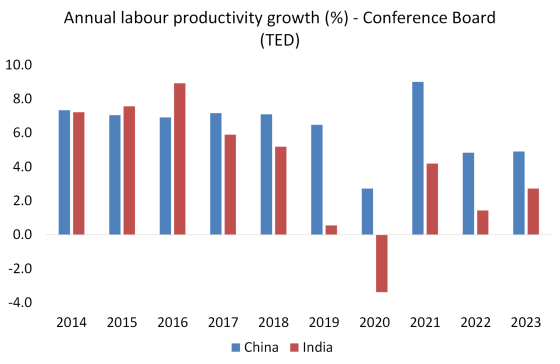
Productivity growth has been falling for most of the years under the Modi government. Since Modi came to office, India's average labour productivity growth has been 4% a year; China's 6.3%.
Productivity would rise if generally underemployed peasants could move to the cities and get manufacturing jobs in the cities. This is how China transformed its workforce, to raise productivity and wages. China has done this through state planning of labour migration and huge infrastructure building. India cannot; its rate of urbanisation is way behind that of China. As a result, employment growth is pathetically slow. An estimated 10-12m young Indian people are entering the workforce each year but many cannot find jobs due to their paucity or because they lack the right skills.
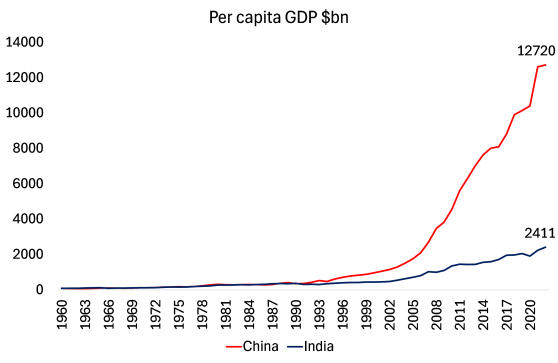
And just compare India’s per capita GDP with that of China. It’s all you need to know about ‘catching up’! Note that China and India had more or less the same per capita GDP back in 1990.
And if the post-pandemic period is anything to go by, the ‘China gap’ is widening, not narrowing.
One good measure of a better life is the World Bank’s Human Development Index (HDI). The HDI covers economic growth, life expectancy and educational attainment. If we look at the largest so-called emerging economies by population, including the BRICS (Brazil, Russia, India, China and South Africa), China has achieved the greatest improvement in its HDI of all countries. From a lowly 0.48 in 1990, China’s HDI reached 0.77 in 2021, a rise of 59%. Compare that to India, which started pretty much at the same HDI as China but reached only 0.63 in 2021, a rise of 46% but still way less than China.
Rather than ‘catch up’ and surpass China, it is more realistic to expect that India will stay in what the World Bank has called a ‘middle-income’ trap, where the vast majority of population remain in poverty while the top 10% live well and spend, but there is no investment or drive to deliver employment, training, education and housing for the rest.
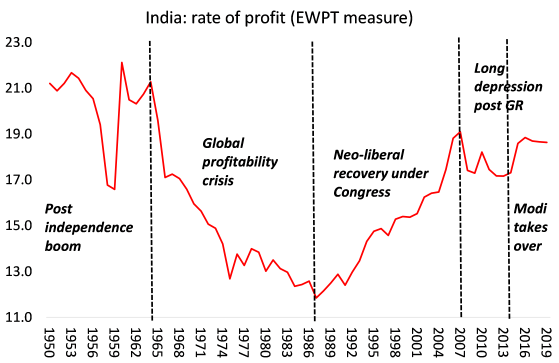
The key for Indian capitalism is the profitability of its business sector. The profitability of Indian capital took a huge plunge in the 1970s, as profitability did globally. Under successive Congress-led governments, neo-liberal policies were adopted to drive up profitability. Then came the Great Recession and the ensuing Long Depression and profitability and growth began to fall back.
Electoral support for Congress drained away as a result and Hindu nationalism emerged. The BJP claimed that the reason for poor growth, rising inequality and stagnant living standards was 'the enemy within' (muslims) and 'the big state' as represented by a corrupt Congress family dynasty. Modi was the new saviour. But since then Modi has just endorsed policies agreeable to Indian big business: privatisation, cuts in food and fuel subsidies and a new sales tax, a tax that is the most regressive way to get revenue as it hits the poor the most.
With Modi set to win another five-year term, the ‘success’ hype will be intensified, but so will reductions in the right to dissent and oppose the nationalist government. And it will be business as usual for India’s billionaires. The Indian Raj will rule.