A memoir by the son of an Israeli general who took up the Palestinian cause shows what might have been
 |
Palestinians in Gaza continue to suffer and die today, and I’ve always considered the horrors there since Hamas’s surprise attack inside Israel on October 7, 2023, to be the work of Benjamin Netanyahu, the Israeli prime minister. But he and the religious fanatics who keep him in office, were not there at the beginning.
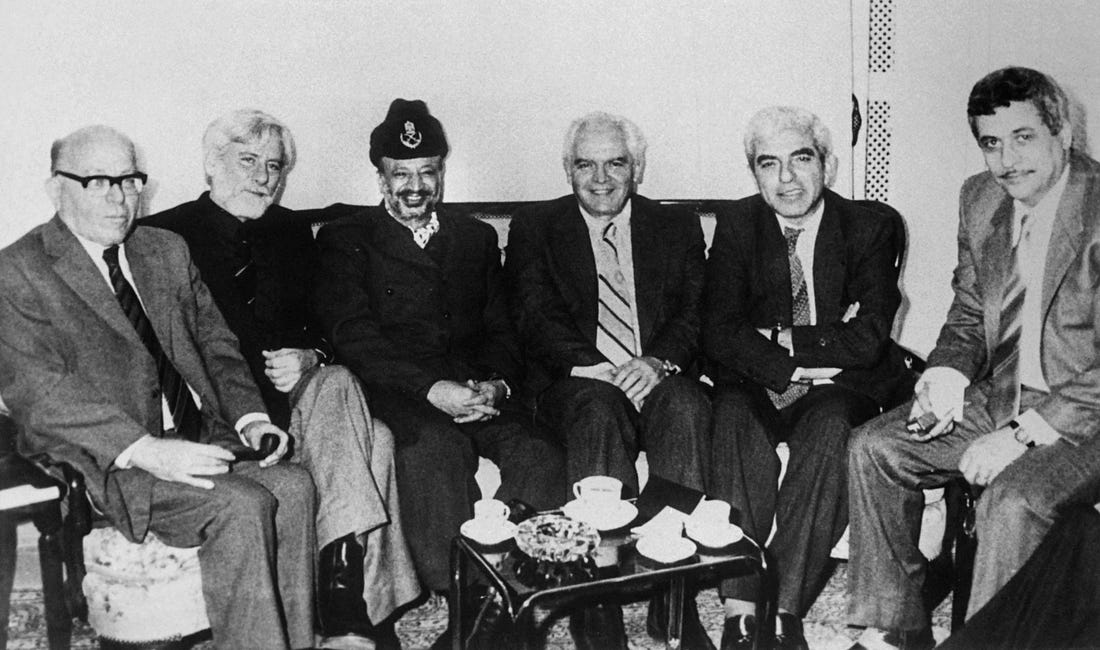
A memoir, The General’s Son by Miko Peled, first published in 2012 and reissued in 2022, focuses on the life and times of the author’s father, Matti Peled, an Israeli general who played a key role in the country’s early conquests in the Middle East, including the famed Six-Day War of 1967, in which Israel captured the whole of the Sinai Peninsula and Gaza in a little over one hundred hours of warfare, while also occupying the West Bank and the Golan Heights. Arab casualties were fifteen thousand; Israel suffered less than eight hundred combat losses. In the fanatical Zionist view that existed then and as it does today, these were 4,000-year-old biblical lands—Eretz Yisrael—that were finally being returned to Jewish hands.
General Peled followed his warfare success by arguing that the time had come for Israel to take its foot off the throat of the Palestinian community. His son writes that his father always believed the war he was leading was to be a limited one, with the intent of punishing the Egyptians for their breach of a recent ceasefire and to assert Israeli legitimacy and military might. “Taking the West Bank, Gaza Strip, and Golan Heights,” Miko writes, “was never part of any official plan.”
His iconoclastic father was an original who would go on after retiring from the army as a major general to master Arabic, earn a PhD in Arabic literature at UCLA, teach at Tel Aviv University, and spend time at Harvard. At the war’s end, however, Miko writes, his father had seen the swift victory as offering Israel a chance to solve the Palestinian problem once and for all. At the first meeting of the army’s general staff—Yitzhak Rabin, who as prime minister would be assassinated by a religious extremist in 1995, was then the army’s chief of staff—his father spoke up: “For the first time in Israel’s history,” General Peled said, according to a newspaper report at the time, “we are face to face with the Palestinians, without other Arab countries dividing us. Now we have a chance to offer the Palestinians a state of their own.” He predicted that if Israel kept the lands, as he knew many generals wanted, “popular resistance to the occupation is sure to arise, and Israel’s army would be used to quell that resistance, with disastrous and demoralizing results. . . . this would turn the Jewish state into an increasingly brutal occupying power.”
“My father said all this,” Miko writes, “as the gun barrels were still smoking and before Israel began its settlement project in the West Bank and Gaza.” The general pressed the issue, his son writes, until Rabin took him aside and “told him it wasn’t the right political climate to discuss this.” It was Rabin’s change of mind decades later as prime minister that cost him his life.
Since the war that started after October 7, the surviving residents of Gaza have remained under repeated Israeli air force and army attack, and Hamas is still far from finished as a potential threat inside Gaza.
Israel’s response to its failures on the ground has been to turn to its courts. In late March, the Knesset passed a law that would permit the hanging of Palestinians convicted of fatal attacks, while also excluding similar proceedings against Jewish extremists of similar crimes, which are happening more and more frequently in the embattled West Bank. A few days ago, the New York Times reported that Israel was preparing to prosecute hundreds of Palestinians suspected of crimes committed on October 7. Most of those to be tried have been held without charge—a common Israeli legal tactic—since their capture.
Miko Peled is now a full-time advocate for Palestinian rights, via seminars and panel discussions, and operates out of a large office complex a few blocks from the Capitol Building in Washington. He spends much of his time, he told me earlier this week—we had not spoken in years—telling Congress about the continuing horrors facing the surviving Gazans amid less and less American media interest in their plight.
Netanyahu is no longer being primarily cast as the man behind the horrors of Gaza. He is now seen as the man behind Donald Trump, who convinced the president to go all-out in the recent Israeli and American Air Force attacks on Iran, largely in the name of the alleged nuclear threat Iran has in its underground supply of partially enriched uranium.
One of the big questions today, Miko told me, revolves around the growing importance of West Bank settlements to the well-being of the average citizen of Israel. “These are not just ‘settlements,’” he said, emphasizing the word, “but massive cities. Universities. Now you can buy a house in the West Bank. All in Israel go to the big shopping malls there. All has been taken from the Palestinians and integrated into Israel except for—listen to this—‘pockets of hostile population.’
“The highways are great [between Israel and the settlement complexes]. The remaining Palestinians in the West Bank are left with dirt roads. Everyone in Israel has a cousin who lives in one of those cities. Three or four generations have already been born there, starting as refugees.”
His point was that the question of stopping the settlements is no longer a viable issue, given the importance of the settlements to the Israeli sense of well-being. As the settlements expanded, the Palestinians were pushed out. “It’s in the Bible,” Miko told me, with a caustic laugh.
As he has continued his work on Palestinian issues, he said, he began to realize “just how deeply rooted the Zionist propaganda machine is in America. The Zionists knew all politics is local. They understood how important it was to get on local school boards and library boards . . . to get their people into philanthropy and into the media. On one hand you gotta say good for them. The system is there and it’s legal. You didn’t have to convince the politicians to support Israeli causes. . . . They knew they had to do it.”
Things are changing now, Miko declared, in the wake of the horrors of Gaza and the obvious Israeli input into Trump’s decision to join Israel in what turned out to be a dubious war against Iran. “Americans—and politicians in the Congress—are beginning to wake up to Israel as their enemy. It’s easier for us”—a pro-Palestinian advocacy group—“to go to the Congress. More and more members are swearing off Israeli money.”
That success, he said, comes with a complication: “The right are saying we shouldn’t be spending money on Israel. The problem with that is that they are hiding their anti-Semitism by riding on the pro-Palestinian train. The reception we are getting from staffers and members is unbelievable, and their support is real . . . but they’ve got to come clean on their decades of anti-Semitism.”
It is, he said to me, “a very subtle distinction.”
No comments:
Post a Comment