 |
 |
Before we start, please click right below to run the 30‑second Super Bowl ad called “Sticky Note” – even if you’ve seen it – and come back here when you’re finished.

Now, let’s begin with the stunning data that appeared onscreen near the end:
“2 in 3 Jewish teens have experienced antisemitism.”
That data came from a survey run in early 2024 by BBYO of 1,989 Jewish high school students in the U.S. and Canada – all current BBYO members. In the summary, BBYO reports that 71% of its members have experienced antisemitic harassment or discrimination. Nearly three‑quarters say they’ve seen more discrimination at school or in extracurricular activities since October 7.
 Subscribed
If you read past the headline, another pattern jumps out. The survey shows that a lot of what these teens are facing is explicitly tied to Israel and its genocide in Gaza: being harassed by “anti‑Israel or pro‑Palestinian” classmates, being blamed for the actions of the Israeli state, and disengaging from activities out of fear of being harassed “over Israel.” In other words, even the movement’s own youth survey quietly admits that Israel’s actions are central to what these kids are going through.
On a related note, the ADL’s own data for 2024 shows that 58% of all recorded antisemitic incidents in the U.S. were “related to Israel or Zionism.” When a majority of incidents are now categorized that way, it’s hard to escape the conclusion that Israel’s oppression of Palestinians is a leading driver of antisemitic incidents in the U.S.
If Israeli oppression is contributing to such a large share of anti‑Jewish incidents, there’s an obvious way to reduce those incidents: confront and change the policies fueling anger and resentment in the first place. Instead, Blue Square pours millions into teaching kids to cover up the symptoms with a graphic design element, while leaving untouched the political reality that keeps producing the problem.
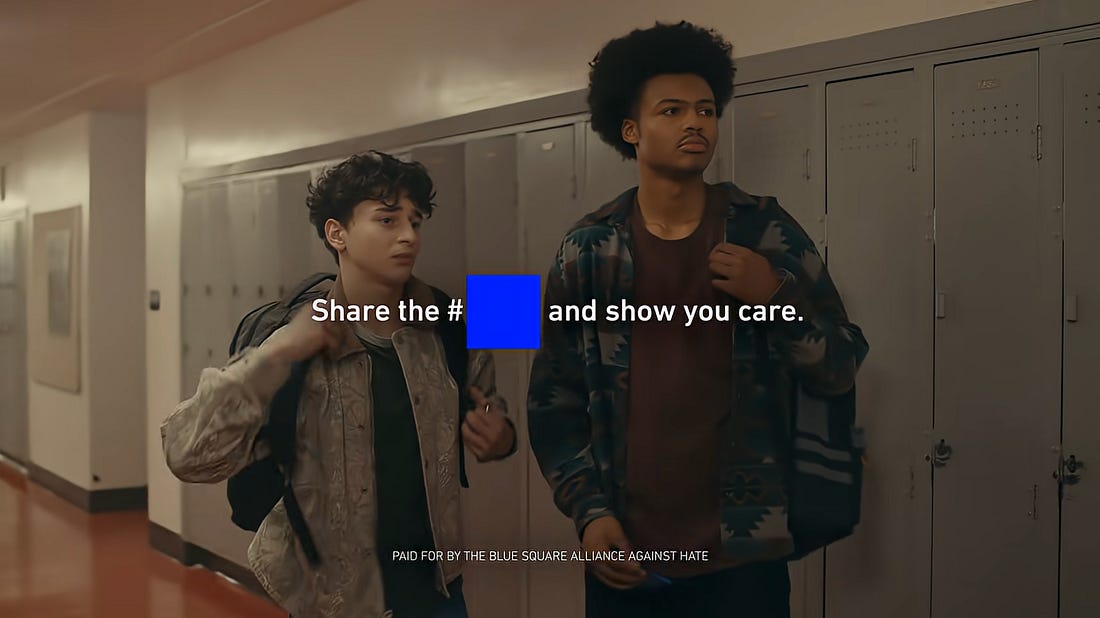
According to the Super Bowl commercial, if you’re a young Jewish victim of antisemitism, your best option is to find a big Black kid no one will mess with, who’ll be your protector and literally cover up statements of hate with a blue square. The message is: don’t confront the system, don’t ask why this is happening, don’t talk about Israel – just find a Black shield and slap a graphic over the problem.
It’s offensive, and not just because of the casting. In the spot, the Black child says to the Jewish child, “I know how it feels.” The line seems clearly written to suggest that the Jewish and Black experience are similar for young people in America today – that these kids are moving through the same landscape of danger.
They aren’t.
Black and Jewish kids both deserve safety and dignity. Both face real bigotry, and there’s a long history of Black and Jewish Americans marching side by side in the struggle for civil rights. But it remains much harder to be Black than to be Jewish in this country, and turning a Black child into a comforting backdrop for a PR campaign isn’t solidarity – it’s distortion.
In 2024, just over a quarter of Black children under 18 in the U.S. lived in poverty – roughly three times the rate for non‑Hispanic white children. Jewish poverty exists, and matters, but Jewish households overall look very different. By 2020, surveys found that roughly half of U.S. Jewish households reported incomes of at least $100,000 – far above what most Americans earn. One widely cited demographic analysis puts median Jewish household net worth at about $443,000, compared with roughly $99,500 for the typical American family.
On top of that, Black communities live with forms of structural racism that show up everywhere, from housing and schools to employment and the courts. FBI hate‑crime data show that Black Americans are the single most targeted group in race‑based hate crimes.
None of this is a competition over who suffers more. It’s a simple reality check. When a Black child in America says, “I know how it feels,” they’re speaking from inside a system that makes it harder to build wealth, harder to move through institutions without discrimination, and harder to trust that they’ll be treated fairly. Putting that child in a Super Bowl ad doesn’t honor that reality – it flattens it.
And while we’re here, it’s worth naming another inversion that runs through this whole campaign. Even as Israel destroys homes and neighborhoods in Gaza and forces millions of Palestinians into hunger and displacement, Zionist institutions keep insisting that they’re the “real victims” whenever anyone demands equal rights or accountability. The suffering of Jewish kids is real and deserves to be taken seriously. But that reality doesn’t give billionaires and branding firms the right to turn a genocide into a feel‑good story about how misunderstood Israel and its defenders are.
The ad’s fake throwback slur raises its own questions. The sticky note says, “Dirty Jew.” As a Baby Boomer, I associate that phrase with what my parents or grandparents – or Robert Kraft – might have heard as kids. Today, if a teenager stuck a hateful note on a Jewish classmate’s backpack, it would be far more likely to say something about Israel, Zionists, or some ugly attempt to blame all Jews for Israel’s genocide in Gaza. Blue Square doesn’t want to mention that, because once you name it, you have to talk about what Israel has done.
Robert Kraft – whose net worth is estimated at roughly $13 billion – can spend his fortune however he likes. But I wish he’d listened to a neighbor from another era in the Boston area, Henry David Thoreau. The author of “Walden” wrote, “There are a thousand hacking at the branches of evil to one who is striking at the root.”
Right now, Blue Square is hacking at branches. It’s metaphorically covering up the consequences of Israel’s crimes against humanity with a shiny blue graphic and a sentimental friendship, while the policies that are destroying Palestinian lives are helping make Jewish kids less safe. Instead of asking Black children to stand in front of Jewish children as human shields in a PR campaign, Kraft could use his power to strike at the root – by demanding an immediate end to Israeli oppression.
If you’ve been moved by this post, please share it. And if you haven’t subscribed to The Progressive Jew, please take a free subscription. The Progressive Jew is for people of all faiths and of none. Thank you for your support.
No comments:
Post a Comment