State of the Union affirms national security state's greatest show on Earth
 |
 Subscribed
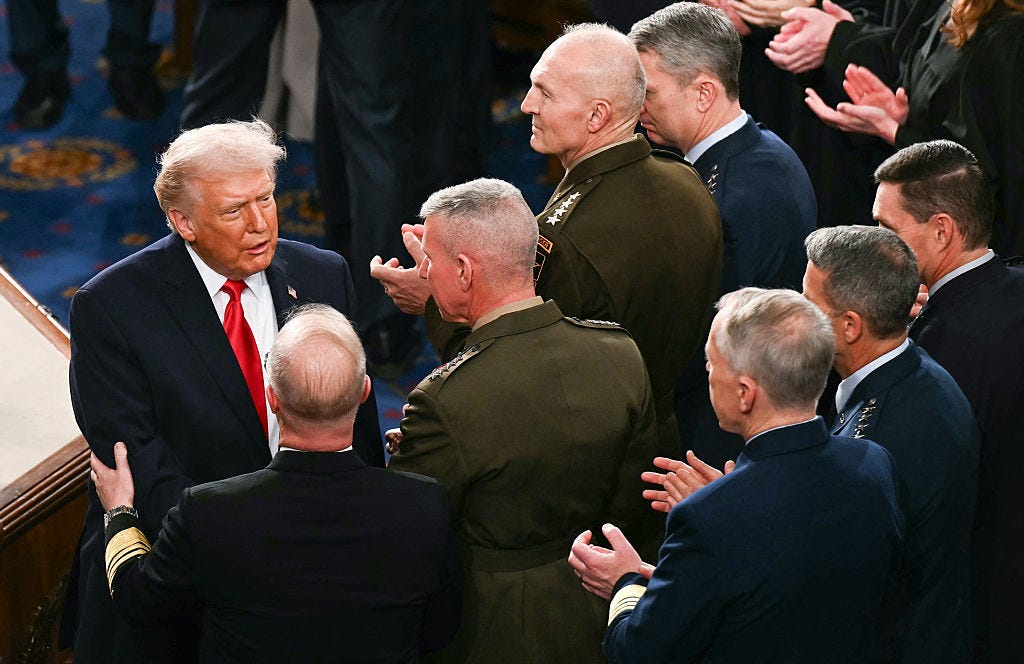
“We’ve…taken down one of the most sinister cartel kingpins of all,” Donald Trump said in his celebration of the national security state last night.
“In January,” he went on to say, “elite American warriors carried out one of the most complex, spectacular feats of military competence and power in world history.”
There’s little question that the national security state can produce “spectacular feats.” And Trump loves it. No other part of the government can do anything close. Trump has been seduced, pure and simple, by the one thing that works (as he sees it).
“Foreign leaders,” Trump crowed last night, “called me and they said, ‘Very impressive, very impressive,’” in responding to the kidnapping of Nicolas Maduro in Venezuela.
From the killing of Bin Laden in 2011 to the present, the US (and Israel) have conducted more and more regular decapitation strikes, a method of warfare that is nothing like the many failed attempts to take down Saddam Hussein. Aided by ubiquitous surveillance, tippy-Top Secret techniques, and artificial intelligence, individuals can now be found and tracked in real time.
Contrary to Hollywood depictions, it’s not just one guy at an all-seeing computer telling the door kickers where to go. In actuality, there are thousands of supporting actors and unsung participants—spies, cyber warriors, planners, targeters, analysts, pilots, drone operators, watch officers, and on and on—who back up the Delta Force or SEAL Team 6 commandos on the ground.
Just like Amazon same-day shipping, decapitation strikes can now produce instant results thanks to a sprawling infrastructure and logistical system that has been painstakingly constructed over the past two decades. From the perspective of the customer (whether that’s Trump or Obama), the promise of success and perfection has become so alluring, the option is just too convenient to pass up. It seems almost frictionless, with little thought going into anything beyond the takedown. Just push a button and you get results.
The capability to do this is not static. Strikes like those on Maduro and El Mencho are more and more feasible today because of the wealth of data that was never available before, as quickly, or as precisely targeted: data produced by phones and computers, the digital exhaust of social media, the emanations of cars and the vast Internet of Things gadgets, such as Ring cameras. That data is processed in ways that are faster and faster and with greater and greater precision. The objective is real-time geolocation.
What Trump celebrated in the State of the Union—and what no one has really named—is this practice that I call lethal doxxing: the acquisition of someone’s most sensitive personal information revealing their up-to-the-moment location, followed by the lethal part. It’s doxxing at nation-state scale, with a kill chain attached.
Lethal doxxing (n.): The practice of using cutting-edge state surveillance techniques to discern a target’s real-time location to capture or kill them. See: El Mencho, Nicolas Maduro, Qasem Soleimani
And as with Internet doxxing, the information age has made this easier than at any point in human history. Maybe that’s why ICE is so paranoid about it, treating doxxing as a life-or-death threat to their officers.
The killing of Mexican cartel leader “El Mencho” is just the latest indication of a quiet shift toward lethal doxxing as a routine instrument of diplomacy, statecraft, warfare, or even just revenge. That shift, scarcely discussed at all in the mainstream, has taken place for reasons that make it likely to outlive the Trump administration.
Put simply, “hard targets” have become relatively easy ones. The body count is growing rapidly, adding to experience and confidence on the part of the secret special operators of the US and Israeli militaries. Here are just some of the big ones:
Osama bin Laden, May 2011.
Anwar al-Awlaki, September 2011.
Joaquín “El Chapo” Guzmán, January 2016.
Abu Bakr al-Baghdadi, October 2019.
Qasem Soleimani, January 2020.
Ayman al-Zawahiri, July 2022.
Ismail Haniyeh, July 2024
Hassan Nasrallah, September 2024.
Yahya Sinwar, October 2024.
Ahmed al-Rahawi (Houthi Prime Minister), August 2025.
Nicolas Maduro, January 2026.
Welcome to the golden age of lethal doxxing.
US adversaries, presumably benefiting from the same advancements, seem interested in the same practice. Following the Maduro operation, there have been reports that the Chinese military has been probing leadership elements in Taiwan for its own targeting purposes.
Lethal doxxing is attractive in part because it generates a lot of headlines and heroic reporting with the appearance that something important has happened.
And yet Joseph Humire, now Trump’s own Acting Assistant Secretary of Defense, discussed the limitations of decapitation strikes in testimony before Congress last year:
“Prominent academics, such as Dr. Guadalupe Correa-Cabrera from George Mason University, have argued that major Mexican cartels have abandoned the kingpin model a long time ago in favor of a CAS structure that functions as a transnational enterprise. She argues this is a result of Mexican President Felipe Calderon’s ‘decapitation’ strategy against the cartels, which resulted in the fragmentation of their structures and the expansion into several countries throughout the Western Hemisphere, including the United States.”
In the case of al Qaeda, this was always the fear, that the War on Terror was a game of ‘whack-a-mole’ (though to be fair, its most famous leader was never replaced by anyone near as effective). And yet, though corporate al Qaeda in Afghanistan was defeated, it still survives and it spawned the half dozen organizations, including ISIS, that are still very much alive.
I could link to any number of scholarly studies arguing for and against decapitation strikes, but what’s the point? In any of the string of examples we have, ask yourself: what, beyond the theater, has been achieved for the long-term?
From the Western Hemisphere to Iran, we are to believe that all of those Purple Hearts and Medals of Honor represent more than the honor and bravery of the individuals in uniform. And yet, after all is done, nothing changes. The drug war, and the military efforts to bring stability to Mexico and Central America, are literally endless. We’ve been warring with Iran my entire life. The terrorist “threat” never goes away. Russia is on the move. And on and on.
Now we face the “possibility” of a decapitation strike in Iran, some version of modern-day regime change played out in a bin Laden-like killing or a Maduro-like capture. The media coverage (especially from Israel) certainly implies some kind of major showdown is coming, as I wrote about yesterday.
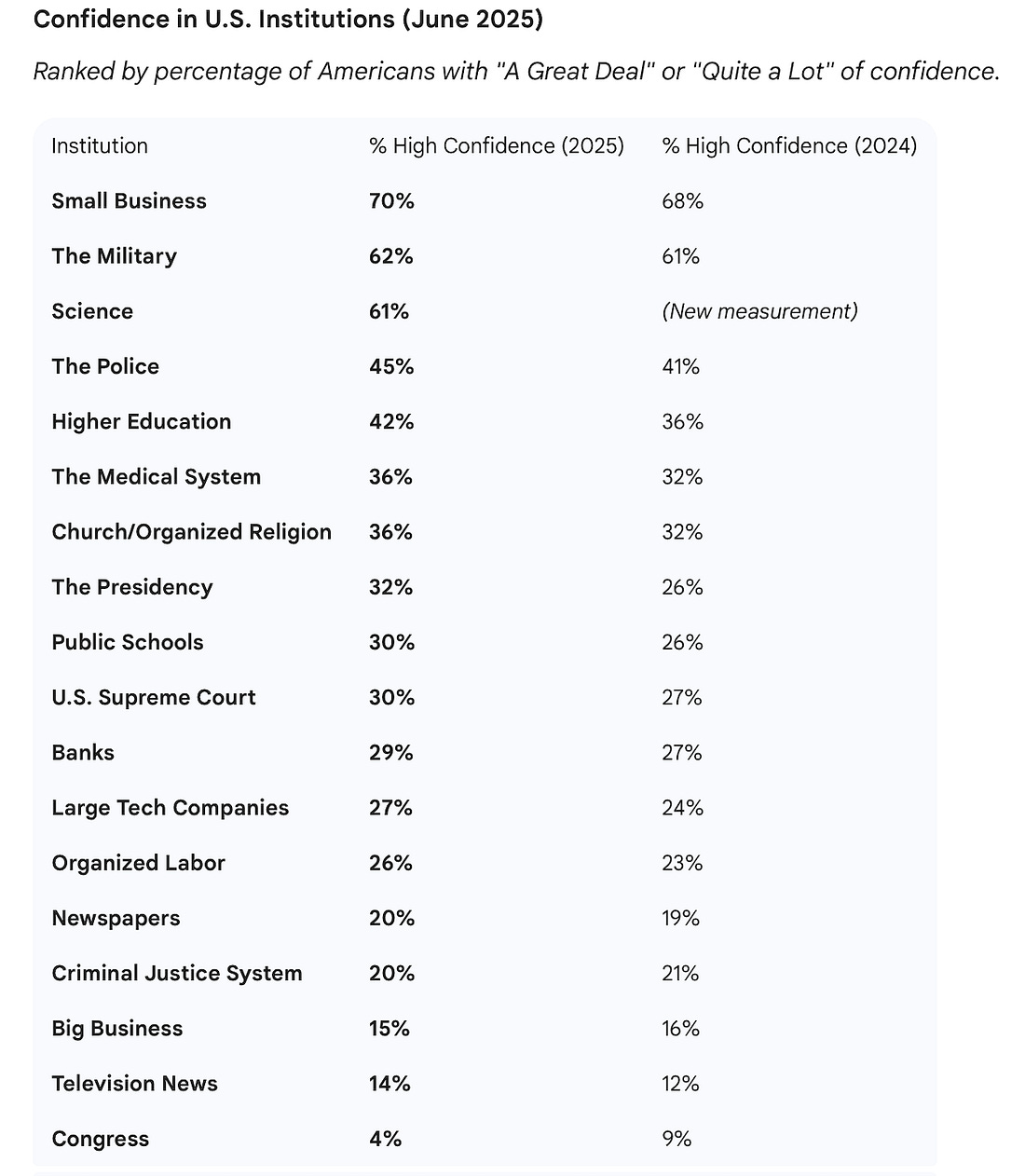
This and other operations like it happen not because they influence American public opinion, especially in the confidence they place in the military over virtually all other institutions.
 |
And then there’s the Purple Hearts and Medals of Honor that Presidents love. Remember how Obama was treated like he practically flew the helicopters and landed on the ground in the death of Osama bin Laden, for his “bravery” in making the decision to approve the operation? Remember the photo of him and Hillary sitting with all of the generals watching television?
Now look at Trump. His approval rating saw an unusual jump in response to the Maduro operation. “Americans like what they deem to be successful foreign policy operations,” CNN’s data guru Harry Enten said of the bump.
It doesn’t have to be this way. Like Amazon, the same-day shipping that is lethal doxxing is built on the billions (now a trillion) taken from our pockets, billions that are not being used to build an equally impressive infrastructure in hospitals or schools or public transportation.
I know that that sounds like some bleeding heart making the old guns versus butter argument, but really, how do we ever hope to have something else be great unless we begin to question the crisp efficiency of our lethal doxxing machine?
No comments:
Post a Comment